Author: admin

  • Major Medical Insurance PPOs

    By MajorMedicalInsurance.com Editorial Team
    Published on · Updated on

    A major medical PPO can be a strong option for people who want broad provider choice without giving up the financial protection of comprehensive health coverage. PPO stands for Preferred Provider Organization. In plain language, it usually means you pay less when you stay in-network, but you can still get some out-of-network care at a higher cost without needing a referral in many cases.

    Quick Answer

    A major medical PPO is a type of comprehensive health plan that generally offers more provider flexibility than an HMO. You typically pay less when you use in-network doctors and hospitals, but you may still have out-of-network coverage at a higher cost. The smartest way to compare PPO plans is to look beyond the premium and review the deductible, coinsurance, out-of-pocket maximum, provider network, drug list, and Summary of Benefits and Coverage.[1][3]

    What a Major Medical PPO Actually Means

    A PPO is a network type, not a promise that every service will be cheap or that every doctor will be covered the same way. HealthCare.gov defines a PPO as a type of health plan where you pay less if you use providers in the plan’s network, but you can also use doctors, hospitals, and other providers outside the network for an additional cost.[1]

    That distinction matters because people often confuse a PPO with a whole category of insurance. In reality, a PPO can exist inside different kinds of major medical insurance plans. What makes the plan “major medical” is the broad financial protection and comprehensive benefit structure, while “PPO” describes how the provider network works. If you want the broader context first, compare this with major medical health insurance.

    The core PPO tradeoff

    • More freedom to choose doctors and specialists
    • No referral required in many PPO designs
    • Higher costs if you go outside the network
    • More flexibility, but also more need to read the cost-sharing rules closely
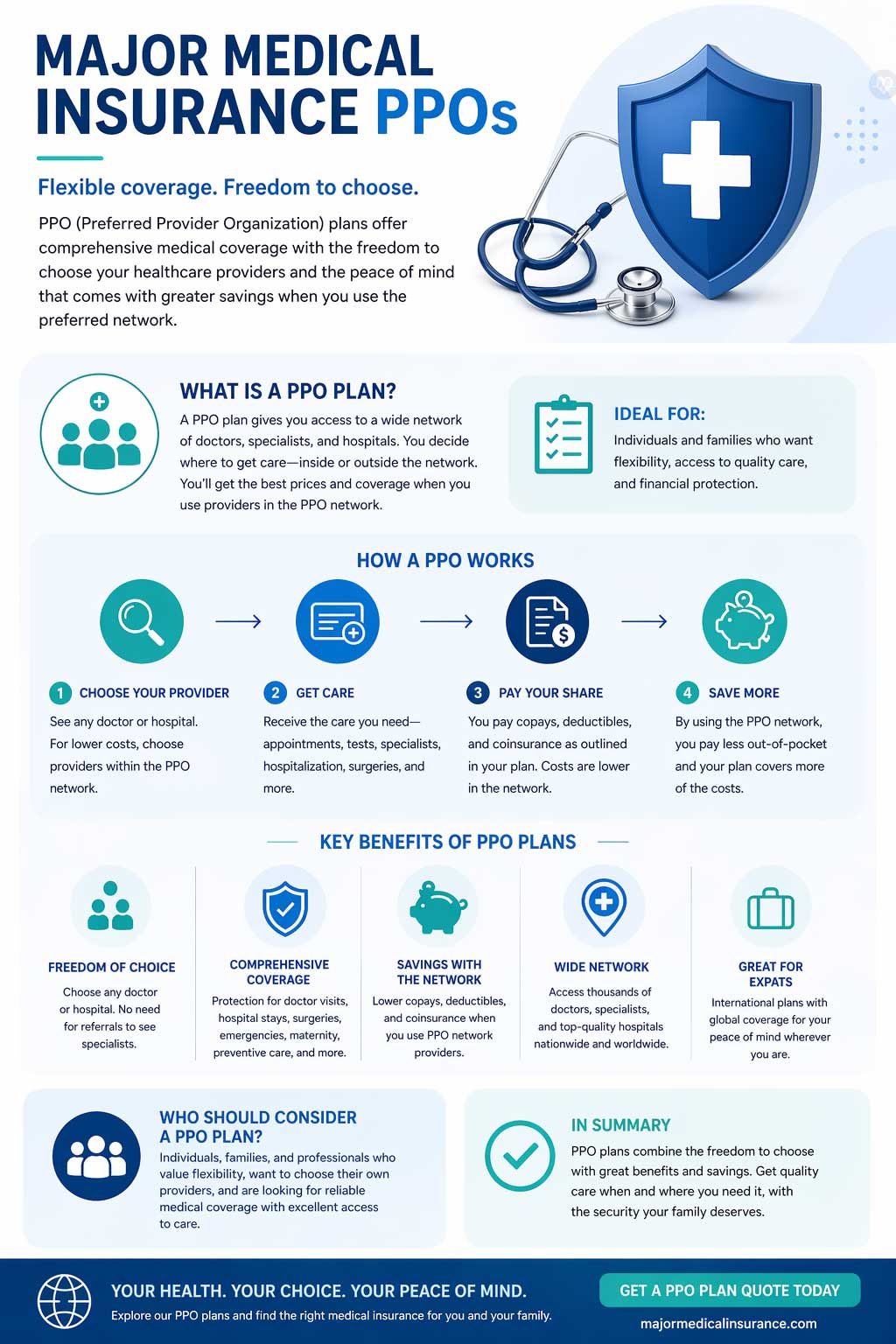
    Infographic explaining major medical insurance PPOs, including provider flexibility, network savings, key benefits, and how PPO plans work.

    What a Comprehensive PPO Usually Covers

    If you are comparing ACA-compliant individual or family coverage, Marketplace plans must cover the 10 essential health benefit categories, including outpatient care, hospitalization, emergency services, prescription drugs, mental health care, lab services, preventive services, maternity care, rehabilitative services, and pediatric services.[2]

    That is part of what makes this kind of coverage different from limited-benefit products or cash-benefit policies. For a broader breakdown, see what major medical insurance covers.

    Area What a comprehensive PPO may include Why it matters
    Hospital and emergency care Inpatient and outpatient medical protection for serious illness or injury Helps protect against major bills
    Physician services Primary care, specialists, and follow-up visits Important for people who want specialist access
    Prescription drugs Coverage depends on the formulary and tier rules Drug lists can change your real yearly cost
    Preventive care Many services are covered at no cost in-network Useful even before you meet the deductible[2]
    Remote care Some plans include virtual visits and follow-up care Can reduce friction for routine care

    PPO vs. HMO, EPO, and POS

    If you want more flexibility, a PPO often deserves a closer look. But it is not automatically the best choice for every budget. The real question is how much you value provider freedom compared with tighter network rules and lower monthly premiums. If that comparison is your main issue, read medical plans HMO vs PPO alongside this page.

    Plan Type Out-of-Network Care Referrals Best Fit
    PPO Usually covered at a higher cost Often not required People who want broader provider choice
    HMO Usually not covered except emergencies Often required People who prioritize lower cost and tighter coordination
    EPO Usually not covered except emergencies Often not required People who want some flexibility without paying for full PPO breadth
    POS Usually covered at a higher cost Often required People who want a middle ground

    What a PPO Does Not Guarantee

    A better PPO page should say clearly that a PPO does not automatically mean every out-of-network claim will be affordable, every hospital in your city is in-network, or every prescription will be covered the way you expect. It also does not eliminate prior authorization rules or other utilization controls just because the plan is more flexible than an HMO.

    • Every out-of-network claim will be paid generously
    • Every hospital in your area is in-network
    • No prior authorization rules apply
    • Your premium will be low
    • Your prescriptions will be covered the way you expect
    • Your out-of-network costs will count the same as in-network costs

    That is why the most useful comparison documents are the provider directory, prescription drug list, and the Summary of Benefits and Coverage. Federal rules require plans to provide an easy-to-read SBC so consumers can make more direct comparisons between plan options.[1][3]

    Why Out-of-Network Costs Matter So Much

    The main reason people choose PPOs is flexibility. But that flexibility can get expensive quickly if you do not understand how the plan handles out-of-network deductibles, coinsurance, and uncovered charges. It is important to check the plan brochure, provider directory, and cost-sharing summary instead of assuming that a PPO will automatically protect you from every billing issue.[3]

    The No Surprises Act added federal protections against certain surprise medical bills. Consumers now have protections for emergency care, certain non-emergency care from out-of-network providers at in-network facilities, and out-of-network air ambulance services. Those protections matter for PPO members too, because a PPO is not the same thing as blanket protection from all out-of-network charges.[4]

    A smarter way to read a PPO

    Think of a PPO as a plan that gives you more lanes, not a plan that makes every lane cheap. The network rules still matter, especially for surgery, imaging, specialty drugs, and hospital-based care.

    In-Network vs. Out-of-Network Costs

    One of the biggest financial differences in a PPO is the gap between in-network and out-of-network care. In-network providers have agreed to the plan’s negotiated rates, which usually means lower costs for members. Out-of-network providers have not agreed to those same rates, so the member may face higher deductibles, higher coinsurance, and in some cases charges that go beyond what the plan recognizes for reimbursement.[1][3]

    This is why a PPO should never be judged only by the fact that it offers some out-of-network flexibility. The important question is not just whether out-of-network care is technically available, but how expensive it becomes when you actually use it. For a broader cost breakdown, see major medical insurance cost.

    Cost Area In-Network Out-of-Network
    Negotiated pricing Usually based on contracted rates Often not protected by the same negotiated rates
    Deductible Often lower or easier to reach May be separate and higher
    Coinsurance Usually lower Often significantly higher
    Out-of-pocket protection Usually counted under the in-network out-of-pocket maximum for covered care May not count the same way and can expose you to more spending
    Billing risk Lower risk of unexpected excess charges Higher risk, depending on the service and plan rules

    Simple way to think about it

    In-network care is where PPO coverage usually works best. Out-of-network care may still be available, but it is often the more expensive lane, sometimes by a wide margin.

    Why the Difference Can Be Larger Than People Expect

    Many shoppers assume that a PPO makes out-of-network care reasonably affordable by default. That is not necessarily true. A PPO may still apply a separate out-of-network deductible, a higher coinsurance percentage, and stricter reimbursement rules. Even when the plan pays something, your share can still be much higher than it would be for the same service in-network.[3]

    That is especially important for hospital-based care, imaging, surgery, specialty treatment, and expensive follow-up services. A PPO gives you more access options, but it does not erase the cost gap between contracted providers and non-contracted providers.

    Before using out-of-network care, check:

    • Whether the plan has a separate out-of-network deductible
    • Whether out-of-network coinsurance is much higher than in-network coinsurance
    • Whether the service even counts toward the same out-of-pocket protection
    • Whether a nearby in-network provider could lower your total cost significantly

    How the No Surprises Act Fits In

    Federal surprise billing protections help in certain situations, especially for emergency services and some non-emergency care at in-network facilities. But those protections do not mean every out-of-network PPO claim will be treated like in-network care. They are important safeguards, not a substitute for reading the actual network and cost-sharing rules in your plan documents.[4]

    If provider flexibility is your top priority, a PPO may still be the right choice. But if your main goal is controlling predictable yearly spending, the better question is not just whether the plan allows out-of-network care. It is whether the added flexibility is worth the added financial risk.

    How to Compare Major Medical PPO Costs

    Random monthly premium examples age badly and often mislead readers. Real premiums vary by location, age, tobacco use, plan category, and whether dependents are covered. Your actual total cost is not just the premium. It also includes your deductible, copays, coinsurance, and other out-of-pocket costs.[3]

    Cost Item What It Means Why PPO Shoppers Should Care
    Premium Your monthly payment for coverage A lower premium may come with higher cost-sharing
    Deductible What you pay before the plan starts paying for many services A high deductible changes your real risk quickly
    Coinsurance A percentage you pay after the deductible Out-of-network coinsurance is often much higher
    Copay A set dollar amount for certain services Primary care, specialist, urgent care, and drugs may all differ
    Out-of-pocket maximum The most you pay in a plan year for covered in-network services A key financial safety feature in major medical coverage[3]

    Should You Consider a High-Deductible PPO?

    Some PPOs are designed as high-deductible health plans. That can work for people who want lower monthly premiums and are comfortable carrying more upfront risk, especially if they want an HSA-eligible design. For 2026, the IRS says an HSA-qualified HDHP generally must have a minimum deductible of $1,700 for self-only coverage or $3,400 for family coverage, with annual out-of-pocket limits generally not above $8,500 for self-only coverage or $17,000 for family coverage, other than bronze and catastrophic plans.[5]

    That does not mean a high-deductible PPO is automatically better. It is usually a stronger fit for people who use less routine care, can absorb a large deductible if something goes wrong, and want the tax advantages of HSA contributions.

    What to Check Before You Enroll

    Before enrolling, compare more than the logo on the card.

    • Whether your preferred doctors and hospitals are in-network
    • Whether your prescriptions are on the formulary
    • How the plan handles out-of-network deductibles and coinsurance
    • What the in-network out-of-pocket maximum is
    • Whether telehealth or remote follow-up options are included in a useful way
    • Whether referrals or prior authorizations apply to the services you use most

    Bottom Line

    A major medical PPO can be a smart choice when you want access to more doctors and specialists without relying on referrals for every step. The tradeoff is that flexibility often comes with higher premiums, more complicated out-of-network cost-sharing, and a bigger need to read the details carefully. The best PPO is not the one with the broadest marketing claim. It is the one whose network, deductible, formulary, and out-of-pocket protection fit your real health needs.

    References

    1. HealthCare.gov, Health insurance plan & network types: HMOs, PPOs, and more and 3 things to know before you pick a health insurance plan.
      https://www.healthcare.gov/choose-a-plan/plan-types/ |
      https://www.healthcare.gov/choose-a-plan/comparing-plans/
    2. HealthCare.gov, What Marketplace health insurance plans cover and Preventive health services.
      https://www.healthcare.gov/coverage/what-marketplace-plans-cover/ |
      https://www.healthcare.gov/coverage/preventive-care-benefits/
    3. HealthCare.gov, Your total costs for health care: Premium, deductible, and out-of-pocket costs, Out-of-pocket maximum/limit, and CMS, Summary of Benefits & Coverage & Uniform Glossary.
      https://www.healthcare.gov/choose-a-plan/your-total-costs/ |
      https://www.healthcare.gov/glossary/out-of-pocket-maximum-limit/ |
      https://www.cms.gov/marketplace/health-plans-issuers/summary-benefits-coverage
    4. CMS, Ending Surprise Medical Bills.
      https://www.cms.gov/nosurprises/ending-surprise-medical-bills
    5. IRS, Internal Revenue Bulletin: 2026-02.
      https://www.irs.gov/irb/2026-02_IRB
  • Major Medical Insurance Blue Cross

    By MajorMedicalInsurance.com Editorial Team
    Published on · Updated on

    Blue Cross major medical insurance is often one of the first options people compare when they want broad, dependable health coverage. That makes sense. Blue Cross Blue Shield is one of the best-known names in U.S. health insurance, but it is important to understand what that brand actually represents before you choose a plan.

    Blue Cross Blue Shield is not one single insurer offering one identical product nationwide. The Blue Cross Blue Shield Association is an association of independent, locally operated companies, so plan availability, provider networks, pricing, and member experience can differ depending on your state and local BCBS company.[1] If you want a broader foundation first, start with our guide to major medical health insurance. If you want to compare BCBS with other carriers, also review top major medical insurance providers.

    Quick Answer

    Blue Cross major medical insurance can be a strong option if your local BCBS company offers a plan with the right network, deductible, prescription coverage, and total cost for your needs. The brand is large and widely recognized, but the best Blue Cross plan for you depends on your ZIP code, doctors, medications, and whether you want an HMO, PPO, EPO, or another network design.[2] [3]

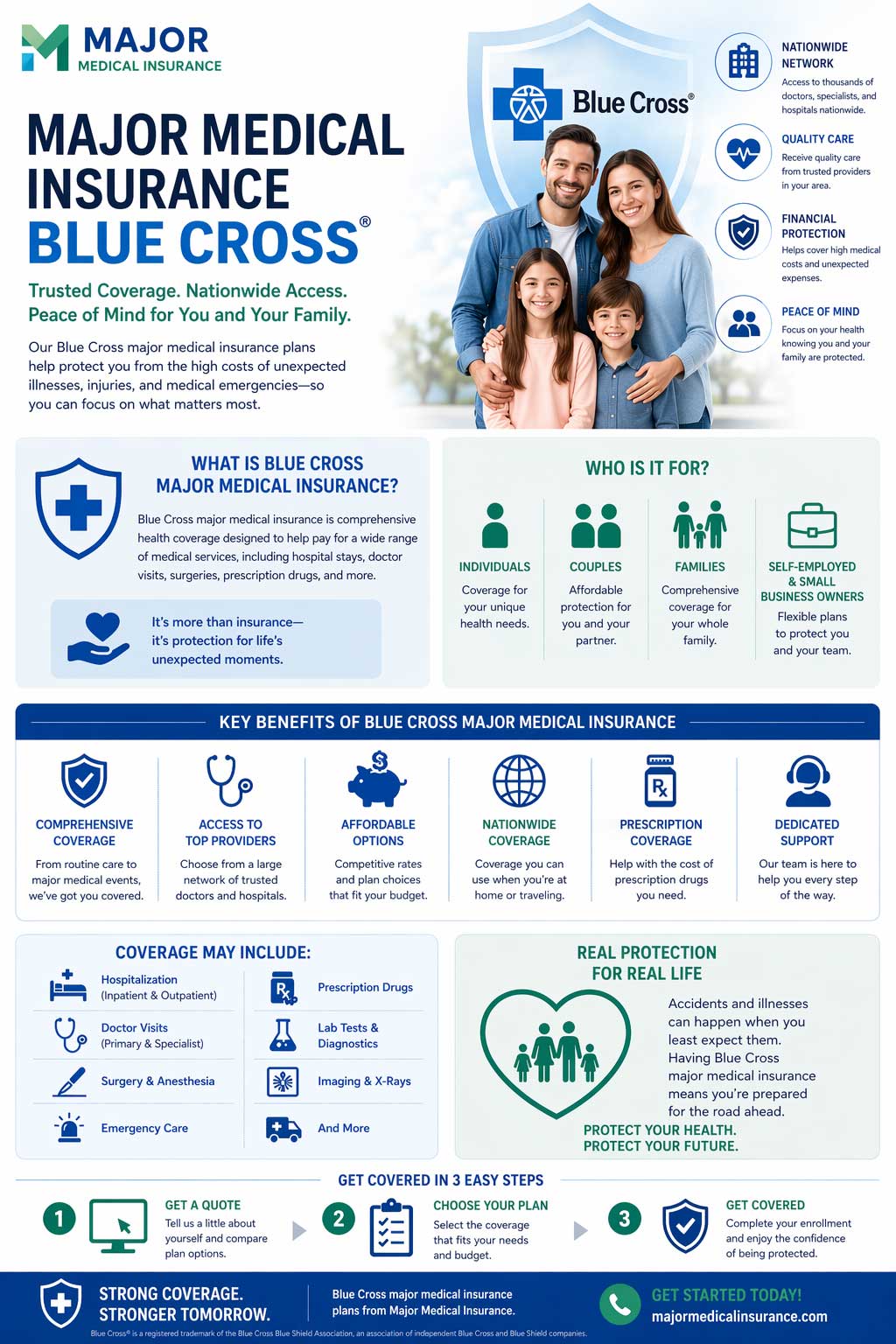
    Infographic for Major Medical Insurance about Blue Cross major medical insurance, showing nationwide network access, trusted provider care, financial protection, who the coverage is for, key benefits, common services included, and a 3-step process to get covered.

    What “Blue Cross” Really Means

    One of the biggest mistakes people make is assuming every Blue Cross plan works the same way across the country. It does not. BCBS companies operate locally, and the Association’s company directory shows that different Blue-branded companies serve different states and regions.[1]

    That local-company structure matters because your provider network, plan choices, service area, customer support experience, and pricing can all depend on which BCBS company serves your area. It is also one reason Blue Cross can be strong for some shoppers and only average for others. The right question is not just “Is Blue Cross good?” but “Is my local BCBS plan a good fit for my needs?”

    Large National Presence

    BCBS says one in three Americans is covered by the Blue System, which helps explain why so many shoppers start here.[1]

    Local Plan Differences

    Plan details vary by local BCBS company, so you still need to review the exact plan in your state.[1]

    Broad Market Presence

    BCBS companies offer multiple coverage lines, but what is available to you still depends on the local company and market in your area.[1]

    Compare Locally

    The brand matters less than whether the local BCBS company’s network and plan design work for your actual care needs.

    What a Blue Cross Major Medical Plan May Cover

    If you are looking at an ACA-compliant individual or family major medical plan through a BCBS company, Marketplace rules still apply. That means Marketplace plans must cover the same 10 essential health benefit categories, including hospitalization, outpatient care, emergency services, prescription drugs, maternity and newborn care, mental health and substance use treatment, rehabilitation services, preventive services, and pediatric services.[2]

    That is why a Blue Cross plan can be a solid major medical option: it can provide broad protection for both routine care and serious medical events, rather than functioning like a narrow fixed-benefit or gap policy. If you want a broader coverage breakdown before you compare brands, read what major medical insurance covers.

    Core Coverage Area Why It Matters
    Hospital & Emergency Care Helps with major, high-cost events like hospitalization, surgery, and emergency treatment.[2]
    Outpatient & Physician Care Supports office visits, specialist care, labs, imaging, and outpatient treatment.[2]
    Prescription Coverage Important if you take regular medications or want stronger protection against pharmacy costs.[2]
    Preventive Benefits Many preventive services are covered at no cost when delivered in-network.[2]

    Plan Categories and Network Types

    Blue Cross individual and family plans can fall into Marketplace metal levels such as Bronze, Silver, Gold, and Platinum. These categories do not measure the quality of care. They describe how costs are generally shared between you and the plan.[3]

    Network design matters just as much. Plans may use HMO, PPO, EPO, and POS structures, each with different rules for in-network care, referrals, and out-of-network access.[3] That means two Blue Cross plans can feel very different in real life even if both are legitimate major medical coverage.

    Bronze / Silver / Gold / Platinum

    Metal levels help you compare the tradeoff between monthly premium and out-of-pocket spending when you use care.[3]

    HMO

    Often lower-cost, but routine care generally stays in-network except for emergencies.[3]

    PPO

    Usually offers more provider flexibility, but often at a higher cost.[3]

    EPO / POS

    These can sit somewhere between HMO and PPO designs depending on plan rules.[3]

    Why Some Shoppers Prefer Blue Cross

    There are a few reasons BCBS often stays on the shortlist. The brand is familiar, the local-company footprint is extensive, and for some employer coverage options BCBS highlights broad national PPO access through BlueCard PPO. BCBS says BlueCard PPO is the nation’s leading PPO network and spans more than 2.2 million unique, in-network providers in that employer context.[4]

    That said, you should be careful not to generalize employer-network marketing across every individual and family plan. The smartest approach is to treat BCBS as a serious brand to compare, then verify the exact local plan’s doctors, hospitals, drug list, deductible, and cost-sharing before you enroll.

    What to check before choosing a BCBS plan

    • Whether your doctors, specialists, hospitals, and pharmacies are in-network
    • Whether your prescriptions are on the plan formulary
    • How the deductible, copays, coinsurance, and out-of-pocket maximum work together
    • Whether an HMO, PPO, EPO, or POS structure fits your preferences[3]
    • Whether you are comparing major medical coverage or something narrower

    When Blue Cross May Not Be the Best Fit

    Blue Cross is not automatically the best choice just because the brand is large. Depending on your area, another insurer may price better, offer a stronger local network, or fit your prescriptions more cleanly. That is one reason no single carrier is the universal winner for every shopper.

    If you are already Medicare-eligible, your next comparison may belong in Medicare rather than in the individual-market major medical category. And if your main question is network freedom versus lower monthly cost, it can help to compare this brand discussion with medical plans HMO vs PPO.

    How to Compare a Blue Cross Plan the Right Way

    The best way to compare Blue Cross medical insurance is to start with your needs, not the logo. Think about your doctors, medications, expected healthcare use, and comfort with network restrictions. Then compare total cost instead of just the monthly premium.

    Simple comparison checklist

    • Confirm network fit first
    • Compare Bronze, Silver, Gold, and Platinum categories based on your expected usage[3]
    • Review deductible and out-of-pocket maximum together, not in isolation
    • Check preventive benefits and prescription coverage carefully
    • Compare BCBS against at least a few other carriers before you decide

    FAQ

    Is Blue Cross Blue Shield one company everywhere?

    No. Blue Cross Blue Shield is an association of independent, locally operated companies, so plans and networks can vary by state and service area.[1]

    Do Blue Cross Marketplace plans have to cover the same essential benefits as other ACA plans?

    Yes. ACA Marketplace plans must cover the same 10 essential health benefits, even though pricing and network design can still differ by company and plan.[2]

    Does Blue Cross cover preventive care?

    For ACA-compliant Marketplace plans, many preventive services are covered at no cost when you use an in-network provider.[2]

    How do I know if a Blue Cross plan is right for me?

    Check your local BCBS company’s network, formulary, deductible, out-of-pocket maximum, and plan type. Then compare that plan against your actual healthcare needs and at least a few competing options.

    Compare the local plan, not just the logo

    Blue Cross can be a strong major medical option, but the right plan still depends on your local network, total cost, and coverage details. Start with the basics, then compare providers and plan types carefully.

    Compare Providers
    Review Major Medical Basics

    References

    1. Blue Cross Blue Shield, Local BCBS Companies and Licensees and Blue Cross Blue Shield System.
      https://www.bcbs.com/about-us/blue-cross-blue-shield-system/state-health-plan-companies |
      https://www.bcbs.com/about-us/blue-cross-blue-shield-system
    2. HealthCare.gov, What Marketplace health insurance plans cover and Preventive health services.
      https://www.healthcare.gov/coverage/what-marketplace-plans-cover/ |
      https://www.healthcare.gov/coverage/preventive-care-benefits/
    3. HealthCare.gov, Health plan categories: Bronze, Silver, Gold & Platinum and Health insurance plan & network types: HMOs, PPOs, and more.
      https://www.healthcare.gov/choose-a-plan/plans-categories/ |
      https://www.healthcare.gov/choose-a-plan/plan-types/
    4. Blue Cross Blue Shield, Employer Health Insurance and BlueCard PPO.
      https://www.bcbs.com/explore-affordable-health-plans/employer-health-insurance
  • Major Medical Health Insurance

    By MajorMedicalInsurance.com Editorial Team
    Published on · Updated on

    Major medical health insurance is the type of coverage most people mean when they talk about “real” health insurance. It is designed to help pay for a broad range of medically necessary care, including hospital treatment, physician services, prescription drugs, preventive care, emergency care, maternity care, mental health treatment, and more. In today’s market, that usually means comprehensive coverage rather than a narrow cash-benefit or temporary policy.[1]

    If you are shopping for coverage under the Affordable Care Act, start with our Obama Care ACA guide. If you want a deeper breakdown of benefits, also read what major medical insurance covers. And if you are comparing how network structure affects flexibility, our guide to medical plans HMO vs PPO can help before you choose a plan.

    Quick Answer

    A strong major medical plan is built to protect you from high medical bills while giving you access to broad, ongoing healthcare. Marketplace plans cover essential health benefits, must cover treatment for pre-existing conditions, and generally include certain in-network preventive services at no extra cost to you.[1] [2]

    What Major Medical Health Insurance Usually Covers

    Comprehensive major medical coverage is built around broad protection rather than a limited payout. Under current Marketplace rules, plans must cover 10 categories of essential health benefits, including hospitalization, outpatient care, emergency services, prescription drugs, maternity and newborn care, mental health and substance use treatment, laboratory services, rehabilitative services, preventive and wellness services, and pediatric services.[1]

    Hospital and Emergency Care

    Hospital stays, surgeries, emergency care, and related treatment are core parts of comprehensive coverage.[1]

    Doctor and Outpatient Services

    Office visits, specialist care, outpatient treatment, labs, imaging, and follow-up care are typically included.[1]

    Prescription and Mental Health Benefits

    Comprehensive plans generally include prescription drug coverage and behavioral health treatment.[1]

    Preventive Care

    Many preventive services are generally covered at no cost when you use an in-network provider.[2]

    Another major difference between comprehensive coverage and weaker alternatives is pre-existing-condition protection. Marketplace plans must cover treatment for pre-existing medical conditions, and they cannot reject you, charge you more, or refuse to pay for essential health benefits because of your health history. For a more detailed breakdown, see pre-existing conditions and major medical insurance.[2]

    Major Medical vs. Other Coverage Types

    One of the biggest mistakes shoppers make is assuming every health-related product works the same way. It does not. Major medical insurance is broad, regulated coverage. Other products may be temporary, limited, or supplemental. That is why you should compare what the product actually does before focusing on brand names alone.[4]

    Coverage Type How It Works Best Use
    Major Medical Broad health coverage built around essential benefits, cost-sharing rules, and protection against major bills.[1] Primary health coverage for individuals and families
    Short-Term Medical Temporary coverage designed to fill short gaps and generally not subject to the same consumer protections as comprehensive ACA coverage.[4] Short temporary gaps, if appropriate for your situation
    Hospital Indemnity Generally pays fixed cash amounts for covered events and is not a substitute for comprehensive coverage.[4] Supplemental financial support layered on top of other coverage
    Supplemental Coverage Extra coverage that may help with certain gaps or cash-flow needs, but it should be evaluated alongside your main health plan. Adding support to existing comprehensive coverage

    How Plan Types Affect Flexibility

    Even when two plans are both major medical, they may work very differently. Marketplace plans come in network structures like HMO, PPO, EPO, and POS. Some mainly steer you toward in-network doctors and hospitals, while others offer more flexibility for out-of-network care at a higher cost.[3]

    HMO

    Often lower-cost, but usually restricts routine care to the plan’s network except in emergencies.[3]

    PPO

    Usually offers more provider choice and some out-of-network flexibility, but often at a higher cost.[3]

    EPO

    Usually keeps care in-network like an HMO, but may differ in referrals and network design.[3]

    POS

    Blends features of managed care and out-of-network access, depending on the plan’s rules.[3]

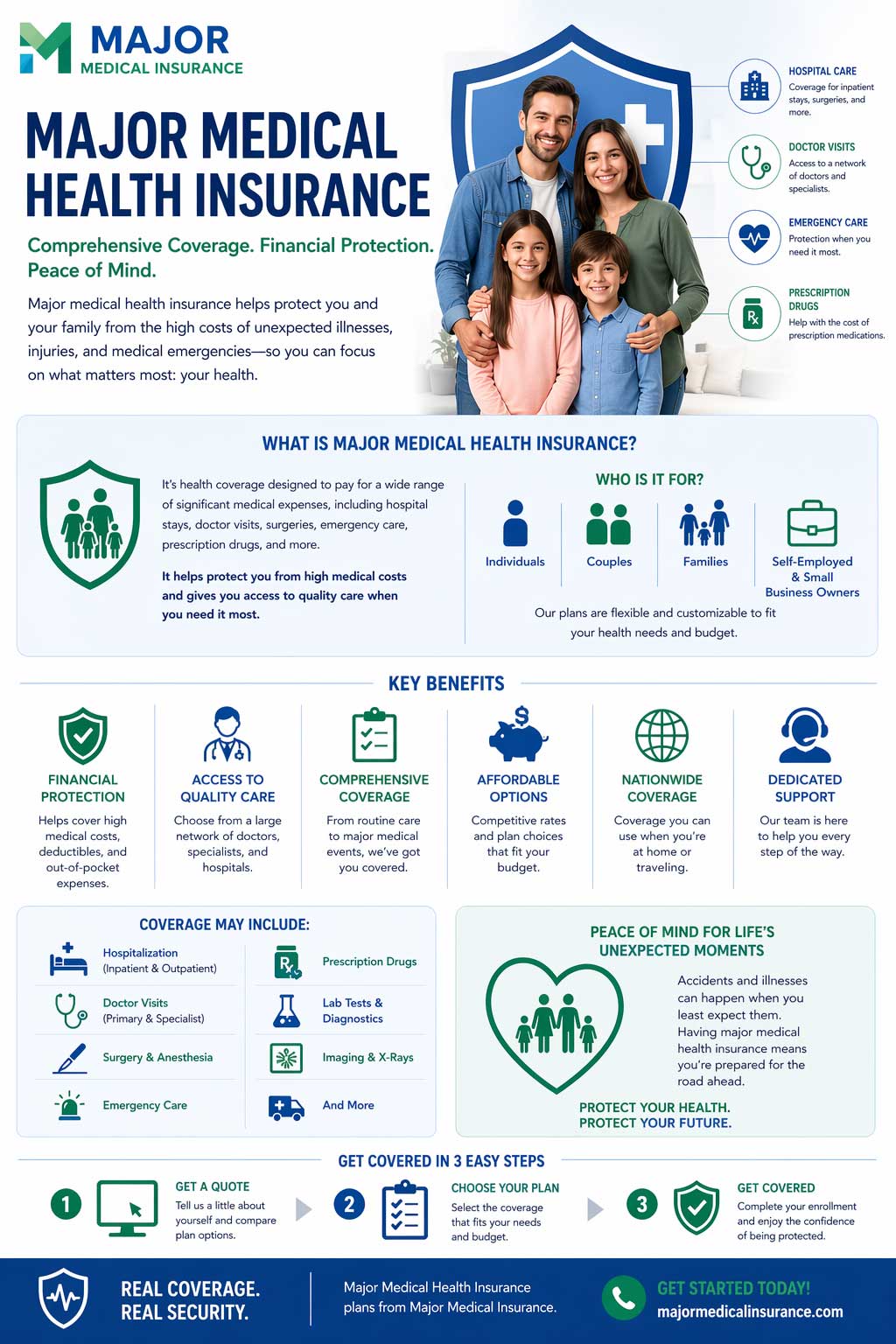
    Infographic for Major Medical Insurance explaining major medical health insurance, including hospital care, doctor visits, emergency care, prescription drug coverage, key benefits, who the coverage is for, common medical services included, and a simple 3-step process to get covered.

    How Costs Work in a Major Medical Plan

    The monthly premium is only one part of the real cost. You also need to compare the deductible, copays, coinsurance, and the out-of-pocket maximum. In practical terms, the out-of-pocket maximum is the most you pay for covered services in a plan year before the plan pays 100% of covered services for the rest of the year under the plan’s rules.[3]

    What to Compare

    • Premium: what you pay each month to keep the plan active
    • Deductible: what you usually pay before the plan starts paying for many covered services[3]
    • Copay: a set dollar amount for certain covered services
    • Coinsurance: your percentage share of covered costs after the deductible in many cases[3]
    • Out-of-pocket maximum: the annual cap on covered cost-sharing under the plan’s rules[3]

    Marketplace plans are also grouped into Bronze, Silver, Gold, and Platinum categories. These metal levels do not measure care quality. They describe how costs are generally split between you and the plan.[3]

    Metal Level Typical Premium Trend Typical Out-of-Pocket Trend
    Bronze Lower monthly premium Higher out-of-pocket exposure
    Silver Mid-range Mid-range
    Gold Higher monthly premium Lower out-of-pocket costs when you use care
    Platinum Higher monthly premium Lower cost-sharing when you use care

    If you are comparing brands instead of only plan structure, our guide to top major medical insurance providers is the next step after this page.

    How to Choose the Right Major Medical Plan

    The best plan is rarely the one with the cheapest premium alone. A better approach is to compare total cost, prescription coverage, provider access, and enrollment timing together. If you are outside Open Enrollment, you may need a qualifying event to unlock a Special Enrollment Period.[3]

    Smart Shopping Checklist

    • Confirm that your doctors, specialists, hospitals, and pharmacies are in-network
    • Check whether your prescriptions are on the plan formulary
    • Compare the deductible, coinsurance, and out-of-pocket maximum together
    • Think about how often you actually use medical care, not just what you hope to spend
    • Review whether an HMO, PPO, EPO, or POS structure fits your preferences[3]
    • Make sure you are comparing major medical coverage, not only temporary or supplemental products[4]

    Why This Coverage Matters for Health and Financial Stability

    Major medical health insurance matters because it combines ongoing access to care with protection against very large medical bills. It supports preventive services, covers treatment for pre-existing conditions, and creates a structure for managing care across doctor visits, prescriptions, emergency services, and hospital treatment.[1] [2] [3]

    That does not mean every plan is equal. Some are stronger for low monthly premiums, others are better for regular prescriptions or ongoing specialist care, and some are a better fit only when paired with extra support. The key is to understand what is primary comprehensive coverage and what is simply an add-on.

    FAQ

    Is major medical health insurance the same as Obamacare?

    Not always in casual conversation, but many people use the term when talking about ACA-compliant comprehensive coverage. Marketplace plans under the ACA are major examples of comprehensive major medical insurance.[1]

    Does major medical insurance cover pre-existing conditions?

    Marketplace plans must cover treatment for pre-existing conditions and cannot charge you more or deny essential health benefit coverage because of your health history.[2]

    Is short-term medical the same as major medical?

    No. Short-term and fixed-indemnity products are different from comprehensive coverage and should not be treated as automatic substitutes for a full major medical plan.[4]

    How do I know which plan type is best?

    Start with your doctors, prescriptions, expected usage, and budget. Then compare the network type, metal level, deductible, and out-of-pocket maximum instead of choosing by brand alone.[3]

    Need help understanding your options?

    Use this page as your foundation, then compare benefits, carriers, and plan types before you enroll.

    Compare Providers
    Review Coverage

    References

    1. HealthCare.gov, What Marketplace health insurance plans cover.
      https://www.healthcare.gov/coverage/what-marketplace-plans-cover/
    2. HealthCare.gov, Marketplace health plans cover pre-existing conditions and Preventive health services.
      https://www.healthcare.gov/coverage/pre-existing-conditions/ |
      https://www.healthcare.gov/coverage/preventive-care-benefits/
    3. HealthCare.gov, Health plan categories: Bronze, Silver, Gold & Platinum, Health insurance plan & network types: HMOs, PPOs, and more, and Your total costs for health care: Premium, deductible, and out-of-pocket costs.
      https://www.healthcare.gov/choose-a-plan/plans-categories/ |
      https://www.healthcare.gov/choose-a-plan/plan-types/ |
      https://www.healthcare.gov/choose-a-plan/your-total-costs/
    4. CMS, Short-Term, Limited-Duration Insurance and Independent, Noncoordinated Excepted Benefits Coverage.
      https://www.cms.gov/newsroom/fact-sheets/short-term-limited-duration-insurance-and-independent-noncoordinated-excepted-benefits-coverage-cms

    About the Author

    Major Medical Insurance Editorial Team

    This article was reviewed and updated using current federal health coverage resources. It is intended for general educational purposes and should not replace official plan documents, Marketplace materials, or licensed advice tailored to your state, eligibility, and medical needs.

  • Major Medical Insurance Plans

    By MajorMedicalInsurance.com Editorial Team
    Published on · Updated on

    “Major medical insurance” is a consumer term often used for comprehensive health coverage that helps protect against large medical bills. In practice, people usually compare these plans by where the coverage comes from, such as the Marketplace, an employer, COBRA, Medicare, or Medicaid, and by how the plan is structured, such as HMO, PPO, EPO, or POS.

    Quick Answer

    A serious way to compare major medical plans is to separate plan category from plan design. Marketplace plans are grouped into Bronze, Silver, Gold, Platinum, and sometimes Catastrophic, while HMO, PPO, EPO, and POS describe how provider networks and referrals work. Those are not the same thing, and mixing them up is one of the biggest reasons shoppers get confused.

    Start With the Right Framework

    Many older insurance articles treat every health plan label as if it means the same kind of choice. That leads to confusion. A better framework is to divide major medical coverage into three separate questions:

    Question What It Tells You Examples
    Where does the coverage come from? Whether the plan is Marketplace, job-based, COBRA, Medicare, or Medicaid Marketplace plan, employer plan, COBRA, Medicare, Medicaid
    How is the plan structured? How provider networks, referrals, and out-of-network care work HMO, PPO, EPO, POS
    How are costs split? How premiums and out-of-pocket costs are balanced Bronze, Silver, Gold, Platinum, Catastrophic

    This structure is much more useful than lumping every plan label together. It lets readers compare coverage in a way that matches how official Marketplace and program materials actually describe plan options.

    What Counts as Serious Major Medical Coverage

    For most consumers, major medical coverage means health insurance that provides meaningful protection against high medical costs and broad ongoing benefits. In practical terms, that usually means Marketplace plans, job-based coverage, Medicare, or Medicaid, depending on your situation.

    Marketplace qualified health plans must cover the essential health benefits. All Marketplace plans cover the 10 essential health benefit categories, including hospitalization, emergency services, prescription drugs, maternity care, mental health services, lab services, rehabilitative care, pediatric services, outpatient care, and preventive services. Readers who want a broader overview can also review what major medical insurance covers.

    What serious coverage should do

    • Help cover expensive care such as hospitalization and surgery
    • Include broad medical benefits rather than one narrow cash benefit
    • Limit annual out-of-pocket spending for covered in-network care
    • Include preventive services, generally at no cost when received in-network
    Infographic for Major Medical Insurance explaining major medical insurance plans, including hospital care, doctor visits, emergency care, prescription drug coverage, key benefits, who the plans are for, common services covered, and a simple 3-step enrollment process.

    Marketplace plans must also cover treatment for pre-existing conditions. They cannot reject you, charge you more, or refuse to pay for essential health benefits because of your health history.

    Marketplace Plans: Bronze, Silver, Gold, Platinum, and Catastrophic

    Marketplace plan categories are about cost-sharing, not quality of care. Bronze plans generally have lower monthly premiums and higher out-of-pocket costs when you use care. Platinum plans generally have higher monthly premiums and lower out-of-pocket costs when you use care. Silver and Gold sit in the middle. Catastrophic plans are available only in certain cases, such as for many people under 30 or people who qualify for a hardship or affordability exemption.

    Marketplace Category Typical Tradeoff Who May Prefer It
    Bronze Lower premium, higher out-of-pocket costs when care is used Someone expecting low routine use who wants lower monthly cost
    Silver Balanced premium and cost-sharing A common comparison point for many shoppers
    Gold Higher premium, lower out-of-pocket costs than Bronze or Silver People expecting more regular care
    Platinum Highest premium, lowest out-of-pocket costs among metal levels People who value lower cost at point of care
    Catastrophic Lower premium, very high deductible, same essential health benefits, plus at least 3 primary care visits before deductible People who meet Catastrophic eligibility rules

    Network Types: HMO, PPO, EPO, and POS

    Network type answers a different question: how much flexibility do you have when choosing doctors and hospitals, and do referrals matter? If network freedom is your main concern, compare this with medical plans HMO vs PPO.

    A practical comparison

    • HMO: Usually limits coverage to doctors and facilities in the network except for emergencies, and often requires coordination through a primary care doctor.
    • PPO: Generally offers more flexibility to use out-of-network providers, but you usually pay more when you do.
    • EPO: Usually does not cover out-of-network care except in an emergency, but often does not require referrals the way some HMOs do.
    • POS: Blends features of HMO and PPO arrangements and may require referrals for specialists while still offering some out-of-network coverage at higher cost.

    Job-Based Coverage and COBRA

    Employer-sponsored insurance remains one of the most common ways Americans get comprehensive major medical coverage. In many job-based plans, the employer pays part of the monthly premium. If the offer is considered affordable and meets minimum value, the employee generally will not qualify for Marketplace premium tax credits instead.

    COBRA is not a separate health plan design like HMO or PPO. It is a temporary continuation right that can let workers and family members keep group health benefits for limited periods after certain qualifying events, such as job loss or reduced hours. In many cases, COBRA lasts 18 to 36 months, and the person keeping coverage may have to pay the entire premium plus up to a 2% administrative fee.

    Important COBRA reality check

    COBRA can preserve continuity of care, but it is often expensive because the employer may no longer be paying its share. It is best understood as a temporary bridge, not automatically the cheapest option.

    Medicaid and Medicare Are Not the Same Thing

    Eligibility rules are not the same across major medical options. Medicaid is jointly funded by states and the federal government and provides coverage to eligible low-income adults, children, pregnant women, older adults, and people with disabilities. Eligibility rules and covered services can vary by state within federal requirements.

    Medicare is a federal program with two main ways to get coverage: Original Medicare or Medicare Advantage. Original Medicare includes Part A and Part B, while Medicare Advantage is an alternative offered by private plans approved by Medicare. People in Original Medicare may also choose drug coverage and may buy Medigap to help with out-of-pocket costs, but Medigap is different from Medicare Advantage and you do not use both for the same purpose.

    What to Compare Before Choosing a Plan

    The most reliable way to compare major medical plans is not to shop by buzzwords. Shop by documents and cost structure. Plans must provide a Summary of Benefits and Coverage that outlines key benefits, cost-sharing rules, and important coverage limitations or exceptions.

    Use this checklist when comparing plans

    • Monthly premium
    • Deductible
    • Copays and coinsurance
    • Annual out-of-pocket maximum
    • Provider network and hospital access
    • Prescription drug formulary
    • Referral and prior authorization rules
    • Whether preventive care is covered at no cost in-network

    For covered in-network care, the out-of-pocket maximum is one of the most important protections in major medical coverage. Once you reach that plan limit for covered services in a plan year, the plan pays 100% of covered services for the rest of the year under the plan’s rules. Depending on the plan, related services such as telehealth may also be available for routine follow-up or non-emergency care.

    How to Compare Major Medical Insurance Plans

    Comparing major medical insurance plans is easier when you stop looking at one number in isolation. A low premium may look attractive at first, but it does not automatically mean the plan is the better value. A serious comparison should look at total yearly risk, provider access, prescription coverage, referral rules, and the plan’s cost-sharing structure.[5]

    A practical way to compare plans is to review the Summary of Benefits and Coverage for each option side by side. That document helps you compare deductibles, copays, coinsurance, annual out-of-pocket maximums, and important coverage limits or exceptions. If you also need help understanding the cost side, see major medical insurance cost and medical plans HMO vs PPO.[5]

    The best way to compare plans

    Compare plans by total cost, network access, drug coverage, and real-world use, not just by the monthly premium or a marketing label like PPO or Gold.

    What to Compare Why It Matters What to Check
    Monthly premium This is your fixed monthly cost Whether the premium fits your monthly budget
    Deductible and cost-sharing These affect what you pay when you actually use care Deductible, copays, coinsurance, and service-level costs
    Out-of-pocket maximum Shows your maximum covered in-network risk for the year The annual cap for covered in-network services
    Provider network Affects doctor, hospital, and specialist access Whether your doctors and preferred hospitals are in-network
    Prescription drug coverage Drug costs can change the real value of a plan Formulary tiers, prior authorization, and refill rules
    Referrals and prior authorization These rules affect convenience and access to care Whether specialist referrals or advance approvals are required

    Compare Plans Based on Your Expected Use of Care

    The right plan for one person may be the wrong plan for another. Someone who mainly wants protection against major emergencies may focus more on premium and worst-case annual exposure. Someone with regular prescriptions, specialist visits, therapy, maternity care, or ongoing treatment may care more about predictable cost-sharing and a stronger provider network.[2][5]

    Ask these practical questions

    • Do I expect only basic preventive care, or regular medical use?
    • Are my current doctors and hospitals in the network?
    • Do I take prescriptions that could become expensive under the wrong formulary?
    • Would I rather pay more per month or take more risk when I need care?
    • Will I need flexibility to see specialists without extra administrative steps?

    Do Not Compare Plan Labels in the Wrong Way

    Many shoppers accidentally compare things that do not answer the same question. Bronze, Silver, Gold, and Platinum describe how costs are shared. HMO, PPO, EPO, and POS describe how provider networks and referrals work. Marketplace, employer coverage, COBRA, Medicare, and Medicaid describe where coverage comes from. A good comparison keeps those three layers separate instead of mixing them together.[1]

    That is why a PPO is not automatically “better” than an HMO, and a Gold plan is not automatically “better” than a Bronze plan for every shopper. The better plan is the one that matches your budget, your provider needs, and your expected use of care.

    Smart comparison rule

    First compare where the coverage comes from. Then compare the network type. Then compare premium, deductible, copays, coinsurance, prescription rules, and annual out-of-pocket protection.

    If you want a broader coverage overview before making a final choice, it also helps to review what major medical insurance covers and top major medical insurance providers.

    What Major Medical Coverage Is Not

    Consumers should also understand the difference between comprehensive coverage and supplemental or fixed-indemnity products. Hospital indemnity and other fixed indemnity insurance are not a substitute for comprehensive coverage. They are generally designed to pay a fixed cash benefit and may help with non-medical expenses or out-of-pocket costs, but they do not replace the broad protection of a major medical plan.

    It is also important not to confuse comprehensive major medical coverage with short-term medical plans, which may not offer the same protections, benefit structure, or long-term stability as ACA-compliant coverage.

    Bottom Line

    A better major medical insurance guide does not treat HMO, PPO, Bronze, COBRA, Medicare, and Medicaid as if they were all the same type of choice. They are different layers of the decision. First identify where the coverage comes from. Then compare how the network works. Then compare the premium, deductible, coinsurance, provider access, and annual out-of-pocket protection. For readers who want to continue researching, it also helps to compare top major medical insurance providers before making a decision.

    References

    1. HealthCare.gov, Health plan categories: Bronze, Silver, Gold & Platinum, Catastrophic health plans, and Health insurance plan & network types: HMOs, PPOs, and more.
      https://www.healthcare.gov/choose-a-plan/plans-categories/ |
      https://www.healthcare.gov/choose-a-plan/catastrophic-health-plans/ |
      https://www.healthcare.gov/choose-a-plan/plan-types/
    2. HealthCare.gov, What Marketplace health insurance plans cover and Marketplace health plans cover pre-existing conditions.
      https://www.healthcare.gov/coverage/what-marketplace-plans-cover/ |
      https://www.healthcare.gov/coverage/pre-existing-conditions/
    3. HealthCare.gov, Options if you have job-based health insurance; U.S. Department of Labor, COBRA Continuation Coverage.
      https://www.healthcare.gov/have-job-based-coverage/ |
      https://www.dol.gov/agencies/ebsa/laws-and-regulations/laws/cobra
    4. Medicaid.gov, Eligibility Policy; Medicare.gov, Your coverage options and What’s Medicare Supplement Insurance (Medigap)?.
      https://www.medicaid.gov/medicaid/eligibility-policy |
      https://www.medicare.gov/basics/get-started-with-medicare/get-more-coverage/your-coverage-options |
      https://www.medicare.gov/health-drug-plans/medigap
    5. CMS, Summary of Benefits & Coverage; HealthCare.gov, Preventive health services and Out-of-pocket maximum/limit; CMS, Short-Term, Limited-Duration Insurance and Independent, Noncoordinated Excepted Benefits Coverage.
      https://www.cms.gov/marketplace/health-plans-issuers/summary-benefits-coverage |
      https://www.healthcare.gov/coverage/preventive-care-benefits/ |
      https://www.healthcare.gov/glossary/out-of-pocket-maximum-limit/ |
      https://www.cms.gov/newsroom/fact-sheets/short-term-limited-duration-insurance-and-independent-noncoordinated-excepted-benefits-coverage-cms
  • Telemedicine

    By MajorMedicalInsurance.com Editorial Team
    Published on · Updated on

    Telemedicine can make care more convenient, but good coverage depends on the details of your health plan. Many people assume every virtual visit is covered the same way, always costs less, or replaces in-person care. In reality, telemedicine is best understood as a care delivery method inside a broader insurance plan, not as a guarantee of free or unlimited virtual care.

    Quick Answer

    Telehealth, often called telemedicine in consumer content, can include video visits, phone-based care, secure messaging, and in some cases remote patient monitoring. Many private health plans cover at least some telehealth services, but the covered service, provider type, network rules, and cost-sharing can vary. In a major medical plan, telemedicine is usually one way covered care is delivered, not a separate promise that every virtual visit is free or handled the same way.

    What Telemedicine Usually Includes

    Telemedicine is no longer limited to a basic video call. Depending on the provider and your plan, it may include live video visits, phone-based care, secure patient portal messaging, and remote patient monitoring tools that let patients share health information such as blood pressure or glucose readings with their care team.

    Common situations where telemedicine may help

    • Mental health or substance use counseling
    • Medication reviews and refill follow-ups
    • Reviewing lab or imaging results
    • Minor illnesses like headaches, colds, stomach issues, or some infections
    • Skin concerns that can be seen on camera
    • Post-surgery follow-up
    • Physical or occupational therapy visits
    • Remote monitoring for ongoing health conditions
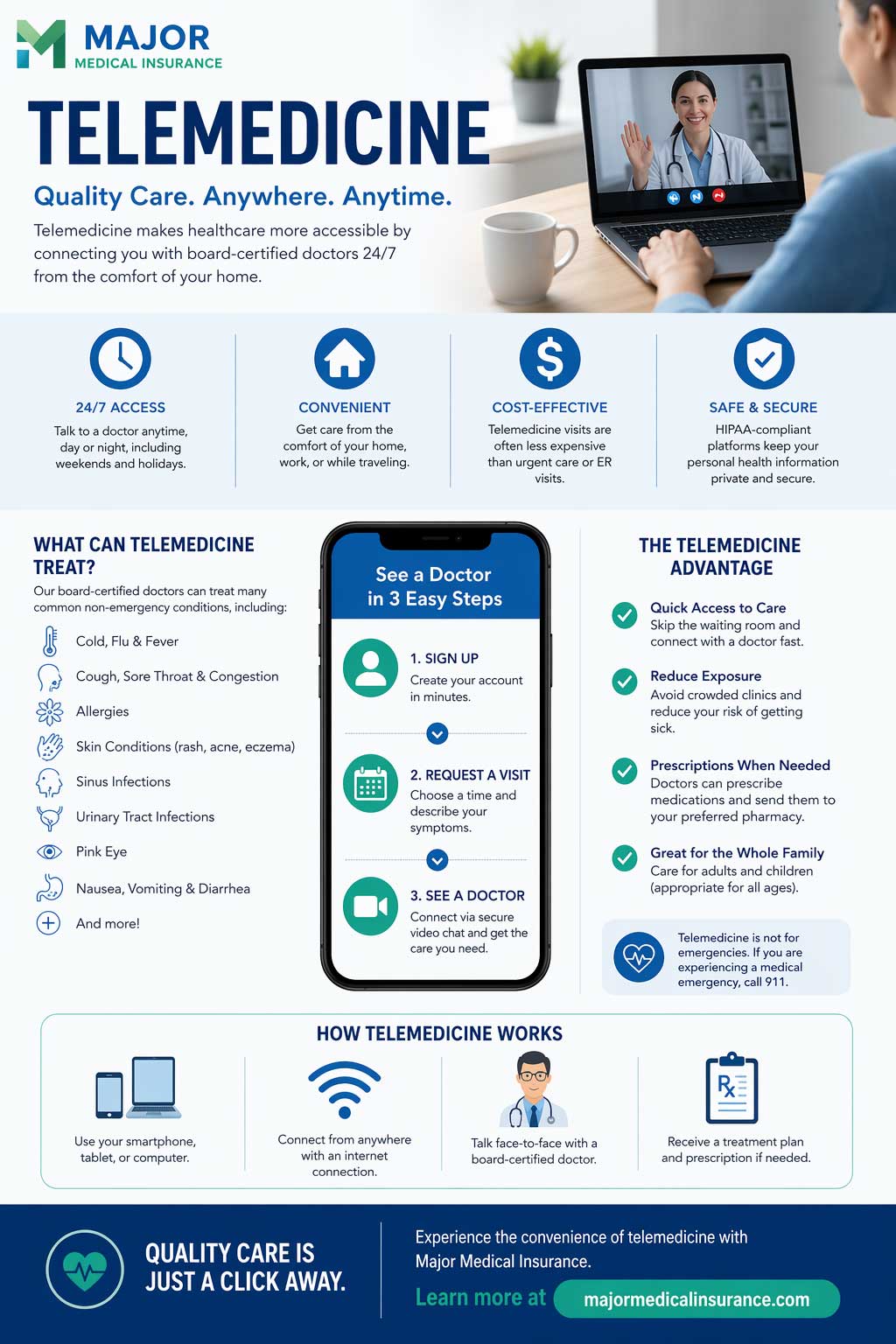
    Infographic for Major Medical Insurance about telemedicine, showing 24/7 access to doctors, convenient at-home care, lower-cost visits, secure virtual appointments, common conditions treated, and a 3-step process to connect with a doctor online.

    How Major Medical Insurance Fits In

    For a site focused on major medical coverage, the key point is this: telemedicine is usually part of the plan’s broader medical benefits. It may show up under outpatient care, behavioral health, preventive services, or chronic care management. Marketplace plans must cover broad essential health benefit categories, but telemedicine is still governed by the specific plan’s coverage rules, network, and cost-sharing.

    If you want the broader coverage context first, compare this page with major medical health insurance and what major medical insurance covers.

    Coverage Type What to Expect Important Caveat
    Employer or individual private plan Many insurers cover at least some telehealth services Coverage, copays, network rules, and reimbursement vary by insurer and state
    Marketplace major medical plan Telemedicine may be part of outpatient, behavioral health, preventive, or chronic care benefits Specific covered virtual services still vary by plan documents and state rules
    Medicare Broad telehealth flexibilities remain in place through December 31, 2027 Rules differ by service type, and some policies change after 2027
    Medicaid Telehealth is widely used, but states have broad flexibility State rules differ on eligible services, providers, technology, and payment

    Do Telemedicine Visits Always Cost Less?

    Not necessarily. Telemedicine can save time, travel, childcare costs, and missed work, which is one reason many people find it valuable. But it is not accurate to promise that every telemedicine visit is cheaper than in-person care. Depending on the plan, copays, coinsurance, deductibles, and network rules may still apply.

    A better way to explain value

    Telemedicine may reduce friction more consistently than it reduces total medical spending. For many people, the biggest benefit is easier access, faster follow-up, and less disruption to daily life.

    When an In-Person Visit Is Still Better

    Telemedicine is useful, but it is not a full replacement for hands-on care. Some conditions still need an in-person examination, testing, imaging, or procedures. That is especially true when symptoms are severe, the diagnosis is uncertain, or a physical exam is central to safe treatment. A hybrid model, virtual when appropriate and in-person when necessary, is usually the most realistic way to think about telemedicine inside a major medical plan.

    Do not rely on telemedicine alone for emergencies

    Emergency symptoms such as chest pain, severe shortness of breath, stroke symptoms, major trauma, or other urgent warning signs need emergency care, not a routine virtual visit.

    What Patients Should Check Before Booking a Virtual Visit

    Before scheduling, patients should confirm the visit is covered the way they expect.

    Question Why It Matters
    Is the provider in-network? Out-of-network telehealth may cost more or be denied
    Is video required, or is audio-only allowed? Some programs and services have different rules for phone-only care
    What will I pay? Copay, coinsurance, or deductible rules may still apply
    Does the plan require a specific telehealth vendor or portal? Some insurers steer members to preferred virtual care platforms
    Can prescriptions, referrals, labs, or imaging be handled after the visit? A virtual visit may still lead to in-person follow-up

    Privacy and Data Security Matter

    Telemedicine should not be presented as casual messaging with no safeguards. Similar to in-person care, telehealth appointments, messages, and related health and billing information are protected by HIPAA when covered providers and health plans are involved, and providers are expected to use platforms that support secure communications and data storage.

    Patients also play a role in protecting their privacy. A private location, headphones, secure devices, strong passwords, and avoiding public networks can all help reduce unnecessary exposure of health information.

    Practical privacy tip

    A telemedicine visit is often most effective when the patient is in a quiet, private place with good lighting, a stable connection, and any relevant medication list, blood pressure log, or recent test results ready to share.

    Telemedicine and Medicare

    If your telemedicine questions are tied to Medicare coverage, it also helps to compare this page with Medicare Advantage, since Medicare telehealth rules and plan administration can differ from the private individual-market experience.

    Bottom Line

    Telemedicine deserves a place in modern major medical coverage, but it should be explained honestly. It can improve convenience and access, help with follow-up care, medication management, behavioral health, and some routine medical needs. At the same time, coverage rules, cost-sharing, audio-only availability, network access, and follow-up requirements differ by insurer, state, and public program. A strong insurance page should help readers understand those differences instead of assuming all virtual care works the same way.

    References

    1. U.S. Department of Health and Human Services, Why use telehealth? and What can be treated through telehealth?
      https://telehealth.hhs.gov/patients/why-use-telehealth |
      https://telehealth.hhs.gov/patients/what-can-be-treated-through-telehealth
    2. U.S. Department of Health and Human Services, Private insurance coverage for telehealth.
      https://telehealth.hhs.gov/providers/billing-and-reimbursement/private-insurance-coverage-for-telehealth
    3. HealthCare.gov, What Marketplace health insurance plans cover.
      https://www.healthcare.gov/coverage/what-marketplace-plans-cover/
    4. Centers for Medicare & Medicaid Services, Telehealth FAQ (updated February 26, 2026); Medicaid.gov, Telehealth.
      https://www.cms.gov/files/document/telehealth-faq-updated-02-26-2026.pdf |
      https://www.medicaid.gov/medicaid/benefits/telehealth
    5. U.S. Department of Health and Human Services, Privacy laws and policy guidance and Telehealth Privacy and Security Tips for Patients.
      https://telehealth.hhs.gov/providers/best-practice-guides/privacy-and-security-telehealth/privacy-laws-and-policy-guidance |
      https://www.hhs.gov/hipaa/for-professionals/privacy/guidance/telehealth-privacy-security/index.html