

By MajorMedicalInsurance.com Editorial Team
Published on April 18, 2026 · Updated on April 19, 2026
Supplemental Health Guide
Supplemental coverage is extra insurance meant to add a layer of protection on top of your primary health coverage or, in some cases, to help with specific costs or benefit gaps. Depending on the product, it may pay fixed cash benefits, help with Original Medicare cost-sharing, or add benefits such as dental or vision. It is usually narrower than comprehensive medical insurance and should not be treated as a full replacement for primary coverage.[1][2]
What it is
Extra coverage designed to help with specific gaps, extra services, or out-of-pocket costs rather than replace broad medical insurance.[1][2]
What it is not
Many supplemental products are not comprehensive coverage and may not include the federal protections people expect from major medical insurance.[1][5]
Where it can help
It may help with hospital cash benefits, Medicare cost-sharing, or extra services like dental and vision, depending on the policy.[1][2][3]
What to compare
The most important questions are what the policy actually pays, what it excludes, and whether you already have adequate primary coverage.[4]
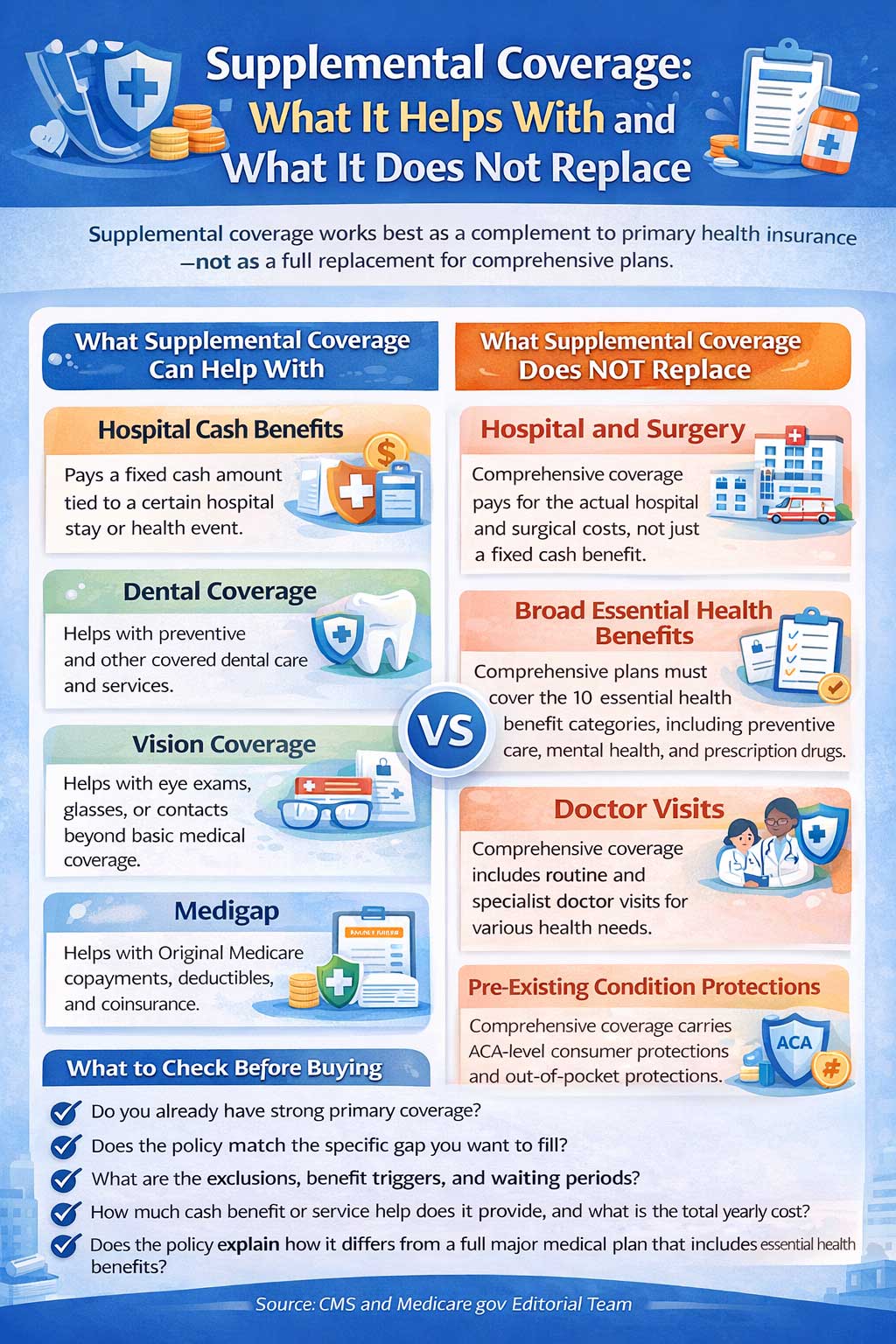
What supplemental coverage really means
In practical consumer terms, supplemental coverage means an extra policy layered over your main coverage strategy. It can help in different ways depending on the product. Some policies pay a fixed cash amount when a health-related event happens. Others are designed to cover a narrower category of services, such as dental or vision. Medicare beneficiaries may also use supplemental coverage in the form of Medigap to help pay deductibles, copayments, and coinsurance in Original Medicare.[1][2][3]
That does not mean all supplemental products work the same way. Some are true medical complements, while others are limited-benefit or excepted-benefit products. Because of that, a supplemental policy should generally be evaluated as support coverage, not as your only coverage plan. If you still need a stronger primary coverage foundation, start by reviewing broader options such as ACA-compliant coverage instead of trying to build your health protection around a narrow supplement.
Common types of supplemental coverage
When supplemental coverage can add value
- You already have primary medical coverage, but want help with certain out-of-pocket exposure or service gaps.[1]
- Your main plan does not include adult dental or adult vision, and you want targeted extra coverage for those services.[3]
- You are in Original Medicare and want extra protection from deductibles, copayments, and coinsurance through Medigap.[2]
- You want fixed cash benefits that could help with non-medical costs during a covered health event.[1]
When supplemental coverage is often misunderstood
- When people assume it covers the same broad services as major medical insurance.[1][4]
- When shoppers buy a cash-benefit policy thinking it will function like comprehensive hospital and doctor coverage.
- When buyers focus only on premium and ignore exclusions, benefit triggers, waiting periods, and total likely cost.[4]
- When a person needs real primary health coverage but buys only a narrow supplement or limited-benefit product instead.[1]
Major Medical vs. Supplemental Insurance
Major medical insurance and supplemental insurance do not serve the same purpose. Major medical coverage is designed to act as your main health insurance layer for hospitalization, physician services, preventive care, prescription drugs, and other core medical benefits. Supplemental insurance is usually narrower. It is generally meant to add support for a specific gap, service, or out-of-pocket exposure rather than replace comprehensive medical coverage.[1][4]
That difference matters because many consumers assume a supplemental product will function like full medical insurance when it often will not. A hospital indemnity policy may pay fixed cash benefits. A dental or vision plan may help with a narrow category of care. A Medigap plan may help with Original Medicare cost-sharing. But those products are not built to replace the broader protection of major medical insurance.[1][2][3]
In simple terms, major medical insurance is usually the foundation, while supplemental insurance is usually the add-on. If a person still needs real primary coverage, the safer starting point is usually a comprehensive plan rather than trying to build protection around a narrow supplement alone. If you want to compare limited protection with broader coverage, it also helps to review short-term medical coverage and hospital indemnity insurance.
Important protections and limitations to understand
Another issue people miss is that not every supplemental policy carries the same billing protections as comprehensive health insurance. CMS explains that No Surprises Act balance-billing protections generally do not apply to hospital indemnity policies or to items and services covered by stand-alone dental or vision plans.[5]
That does not make supplemental coverage useless. It just means you need to match the product to the job. A fixed-indemnity policy can sometimes help as a cash-support layer. A dental policy can help with routine oral care. A Medigap plan can make Original Medicare more predictable. But none of those products should be evaluated as if they all solve the same problem.
How to evaluate a supplemental policy before you buy
- Start by identifying the gap you are trying to solve: hospital cash exposure, dental, vision, Medicare cost-sharing, or something else.
- Check whether you already have primary health coverage that meets your main medical needs.[4]
- Read the benefit trigger carefully. Some supplemental plans pay only when a specific event occurs, not whenever you receive care.[1]
- Review exclusions, waiting periods, separate premiums, and whether adult benefits are limited or optional.[3]
- Compare total yearly cost, not just premium. Deductibles, copayments, and out-of-pocket costs can materially change value on the primary-plan side too.[4]
- If you are Medicare-eligible, make sure you understand whether Medigap or Medicare Advantage is the better fit for your situation, because they do not function the same way.[2]
Bottom line
Supplemental coverage can be useful when it is matched to a real gap: hospital cash exposure, dental care, vision care, or Medicare cost-sharing. But it usually works best as extra support layered on top of primary medical coverage, not as a replacement for it. The right way to buy it is to define the gap first, review the policy terms carefully, and compare it against the broader protection you may still need.[1][2][4][5]
References
- CMS — Short-Term, Limited-Duration Insurance and Independent, Noncoordinated Excepted Benefits Coverage ↩
- Medicare.gov — Get Medigap Basics | Medicare.gov — Learn How Medigap Works ↩
- HealthCare.gov — Dental Coverage in the Marketplace | HealthCare.gov — Vision Coverage Glossary ↩
- HealthCare.gov — What Marketplace Plans Cover | HealthCare.gov — Your Total Costs for Health Care ↩
- CMS — No Surprises Act Overview of Key Consumer Protections ↩
MajorMedicalInsurance.com Editorial Team
This article was prepared using current CMS, HealthCare.gov, and Medicare materials to explain how supplemental coverage works in the United States, where it may add value, and where it should not be mistaken for full primary medical coverage. It is intended for educational purposes and should be reviewed alongside official plan documents and licensed guidance before enrollment.
Reviewed for clarity, consumer usefulness, and alignment with current public health coverage guidance.