Author: admin

  • Dental Insurance

    What Is Dental Insurance?

    Dental insurance helps cover the cost of preventive, basic, and major dental care. It is designed to reduce out-of-pocket expenses for routine checkups, fillings, and more complex procedures.

    Many people compare dental plans alongside major medical health insurance to understand how oral care fits into their overall healthcare coverage.

    What Dental Insurance Covers

    Preventive Care

    Cleanings, exams, and X-rays are often covered at 100%.

    Basic Services

    Fillings, extractions, and minor procedures are partially covered.

    Major Procedures

    Crowns, bridges, and dentures are typically covered at lower percentages.

    Types of Dental Plans

    Plan Type Description
    PPO Flexible network with in and out-of-network options
    HMO Lower cost but limited to network dentists
    Indemnity Traditional reimbursement-based plans

    These structures are similar to HMO vs PPO health plans used in broader medical insurance.

    Costs and Coverage Limits

    Dental insurance is generally affordable, but plans often include annual maximums. Compared to major medical insurance costs, premiums are lower but coverage limits are also smaller.

    Dental Insurance vs Medical Insurance

    Feature Dental Medical
    Coverage Oral health Full healthcare
    Limits Annual caps Higher coverage limits

    Many individuals combine dental insurance with supplemental coverage for better protection.

    How Dental Insurance Works in Practice

    Dental insurance typically operates on a tiered coverage structure, where preventive care is covered at the highest level, followed by basic services and then major procedures. Most plans include an annual deductible that must be met before coverage applies to non-preventive services.

    After meeting the deductible, insurers usually pay a percentage of the cost while the policyholder covers the remaining portion. This cost-sharing model helps reduce expenses but still requires careful planning, especially for major dental work.

    Many plans also include waiting periods for certain procedures. For example, basic treatments may require a few months before coverage begins, while major procedures like crowns or dentures may have longer waiting periods.

    Understanding Annual Maximums

    One of the most important features of dental insurance is the annual maximum. This is the total amount your insurer will pay for covered services within a year. Once you reach this limit, you are responsible for any additional costs.

    Annual maximums typically range from $1,000 to $2,000, depending on the plan. While this may be sufficient for routine care, it may not fully cover extensive treatments.

    Because of this limitation, many individuals combine dental insurance with supplemental coverage to better manage high-cost procedures.

    Choosing the Right Dental Insurance Plan

    Selecting the right dental plan depends on your expected dental care needs, budget, and preferred providers. If you anticipate frequent dental visits, a plan with strong preventive and basic coverage may offer better value.

    For individuals who expect major procedures, it is important to evaluate coverage percentages, waiting periods, and annual limits. Comparing multiple providers can help identify plans with more favorable benefits.

    Many users compare options alongside top insurance providers to ensure they are selecting a reliable company with strong customer support and network access.

    Network vs Out-of-Network Dentists

    Dental insurance plans often use provider networks to control costs. Visiting an in-network dentist typically results in lower out-of-pocket expenses because negotiated rates apply.

    Out-of-network providers may still be covered under PPO plans, but reimbursement rates are usually lower, meaning you may pay more for the same service.

    Understanding how networks function is similar to reviewing HMO vs PPO plan structures, which also determine provider flexibility and costs.

    When Dental Insurance Makes the Most Sense

    Dental insurance is particularly valuable for individuals who prioritize preventive care and want predictable costs for routine services. Regular checkups and cleanings can help prevent more serious and expensive dental issues over time.

    It is also beneficial for families, where multiple members require ongoing dental care. Even with annual limits, the cost savings on preventive and basic procedures can add up quickly.

    However, if you only require occasional dental visits, it may be worth comparing the total cost of premiums versus paying out-of-pocket for services.

    Key Takeaways Before Choosing a Plan

    • Check the annual maximum and coverage percentages
    • Understand waiting periods for major procedures
    • Verify your dentist is in-network
    • Compare multiple providers before enrolling
    • Evaluate total yearly cost, not just monthly premiums

    Taking the time to review these factors can help you avoid unexpected expenses and select a plan that aligns with your dental care needs.

    FAQs

    Does dental insurance cover braces?

    Some plans include orthodontics, but often with limits.

    Are cleanings free?

    Most plans cover preventive care at 100%.

    Is dental insurance worth it?

    Yes, especially if you expect regular dental visits.

    Compare Dental Insurance Plans

    Find affordable coverage and protect your oral health today.

    Get Your Quote
  • Pre-Existing Conditions and Major Medical Insurance

    By MajorMedicalInsurance.com Editorial Team
    Published on April 19, 2026 · Updated on April 19, 2026

    Coverage Guide

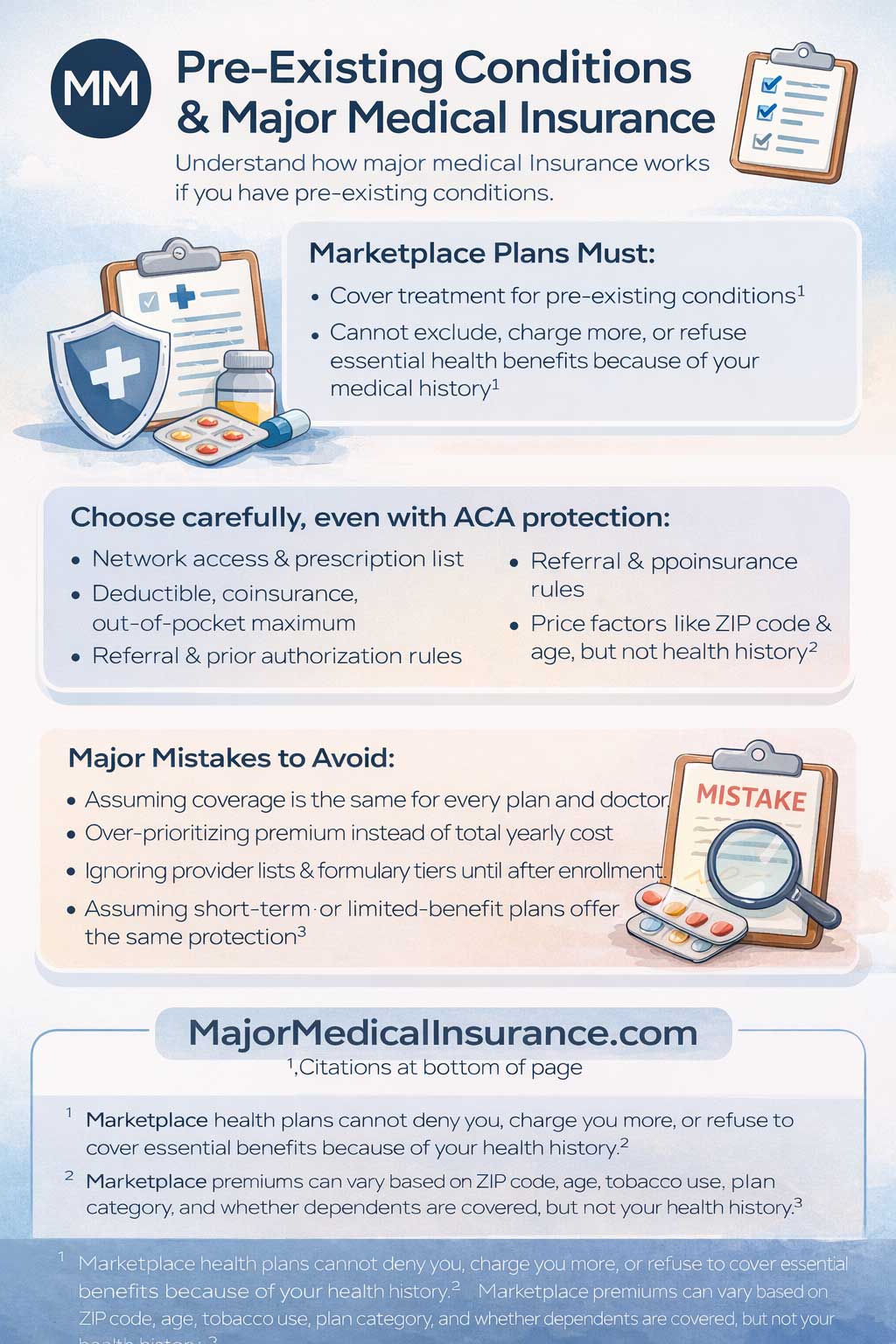
    Pre-existing conditions do not block you from getting ACA-compliant major medical coverage. In today’s U.S. Marketplace, insurers cannot reject you, charge you more, or refuse to cover essential health benefits because of a condition you had before coverage started.[1][2]

    Quick answer

    ACA-compliant major medical plans must cover treatment for pre-existing conditions and cannot charge more based on your health history.[1][2]

    What still changes price

    Marketplace premiums can vary by location, age, tobacco use, plan category, and whether dependents are covered, but not by medical history.[2]

    When to enroll

    You can enroll during Open Enrollment or after certain qualifying life events, including losing health coverage.[3]

    What to avoid assuming

    Not every health product follows the same rules. Short-term plans are not subject to the ACA’s core protections for pre-existing conditions.[4]

    What counts as a pre-existing condition?

    In plain language, a pre-existing condition is a health issue you had before new coverage starts. That could include something ongoing, such as asthma, diabetes, high blood pressure, arthritis, depression, cancer history, or another condition that requires monitoring, prescriptions, specialist care, or recurring treatment. For consumers shopping for comprehensive coverage, the most important point is not whether the condition has a label. It is whether the new plan can legally use that condition against you.

    Under current Marketplace rules, ACA-compliant coverage must cover treatment for pre-existing conditions. If you want the broader foundation first, compare this with major medical health insurance and Obama Care / ACA.[1]

    Infographic about pre-existing conditions and major medical insurance, explaining ACA protections, plan comparison factors, and common mistakes to avoid when choosing coverage.

    Does major medical insurance cover pre-existing conditions?

    For ACA-compliant individual and Marketplace coverage, yes. HealthCare.gov states that Marketplace plans must cover treatment for pre-existing medical conditions. Insurers cannot reject you, charge you more, or refuse to pay for essential health benefits because of a condition you had before coverage started.[1]

    That protection is one of the biggest reasons comprehensive major medical coverage is different from narrower or lower-quality products. It means people shopping for serious health coverage should focus less on whether their condition makes them “uninsurable” and more on whether the plan’s network, prescriptions, deductible, and out-of-pocket exposure actually fit their medical needs.

    Question ACA-compliant major medical coverage Why it matters
    Can the plan deny you because of a pre-existing condition? No.[1] You are not excluded from coverage because of your health history.
    Can the plan charge more because of your condition? No. Health status and medical history cannot affect the premium.[2] Price is not supposed to rise just because you have a diagnosis.
    Can the plan refuse essential health benefits for that condition? No.[1] Coverage protections apply to essential health benefits, not just enrollment.
    Do you still need to compare plan details carefully? Yes. Coverage exists, but network access, formulary rules, and cost-sharing can still differ a lot.

    What still matters even with ACA protection

    “Covered” does not mean every plan works equally well for chronic or ongoing care. A plan can comply with pre-existing condition rules and still be a poor fit if your doctors are out of network, your medications sit in expensive tiers, or the deductible is too high for the way you use care.

    What can still affect your premium?

    Health history is not one of the factors that can set a Marketplace premium. HealthCare.gov says premiums can vary based on location, age, tobacco use, plan category, and whether the plan covers dependents.[2] That means two people can see different prices even when neither is being rated based on a pre-existing condition.

    Price factors that can apply

    • ZIP code or rating area
    • Age
    • Tobacco use
    • Plan category
    • Whether dependents are covered[2]

    What cannot set the premium

    • Your medical history
    • Your diagnosis history
    • Your current health condition
    • Your sex[2]

    How to shop for major medical coverage if you have ongoing health needs

    If you have a chronic condition or need regular treatment, the smartest comparison is not just premium. It is premium plus network, prescription coverage, specialist access, deductible, coinsurance, and annual out-of-pocket exposure. Our guide to major medical insurance cost can help with that broader decision.

    What to compare Why it matters for pre-existing conditions
    Provider network You may want to keep current doctors, specialists, hospitals, or treatment centers in-network.
    Drug formulary A plan may cover prescriptions broadly but still place your medications in expensive tiers or require prior authorization.
    Deductible and coinsurance Frequent care can make cost-sharing more important than the premium headline.
    Out-of-pocket maximum This helps define your worst-case covered in-network spending in a bad medical year.
    Referral and prior authorization rules Administrative hurdles can materially affect continuity of care.

    Practical shopping rule

    If you expect regular prescriptions, therapy, specialist visits, imaging, infusions, or follow-up care, a higher-premium plan can still be the better value if it lowers your real treatment costs and gives you better network access.

    When can you enroll?

    Open Enrollment is the main annual window, but many people can enroll outside it through a Special Enrollment Period. HealthCare.gov says losing qualifying health coverage is one of the life events that can make you eligible for a Special Enrollment Period.[3] If you are timing coverage around a job change or another transition, compare this with major medical insurance enrollment.

    Common SEP examples

    • Losing qualifying health coverage
    • Moving
    • Getting married
    • Having a baby or adopting a child[3]

    Why short-term plans are not the same thing

    This is where many shoppers get into trouble. Short-term, limited-duration insurance is not subject to the ACA’s core consumer protections for pre-existing conditions.[4] That means a person who needs strong protection for ongoing care should be careful not to treat a short-term plan as equivalent to ACA-compliant major medical coverage.

    If you want the differences laid out more directly, see short-term medical. For shoppers with real pre-existing condition concerns, the safer baseline is usually comprehensive major medical coverage rather than a temporary gap product.

    Common mistakes to avoid

    • Assuming “covered” means every plan handles your doctors, drugs, and treatment the same way.
    • Shopping only by premium instead of total yearly cost.
    • Ignoring the provider directory until after enrollment.
    • Ignoring formulary tiers and prior authorization rules for regular medications.
    • Assuming a short-term or limited-benefit product gives the same protection as ACA-compliant major medical coverage.

    Bottom line

    Pre-existing conditions do not prevent you from getting ACA-compliant major medical insurance, and they should not increase your Marketplace premium or block essential health benefit coverage.[1][2] The real job is choosing the right plan structure: network, prescriptions, deductible, out-of-pocket maximum, and enrollment timing. For people managing ongoing health needs, that practical comparison matters more than fear of being denied.

  • Supplemental Coverage

    By MajorMedicalInsurance.com Editorial Team
    Published on April 18, 2026 · Updated on April 19, 2026

    Supplemental Health Guide

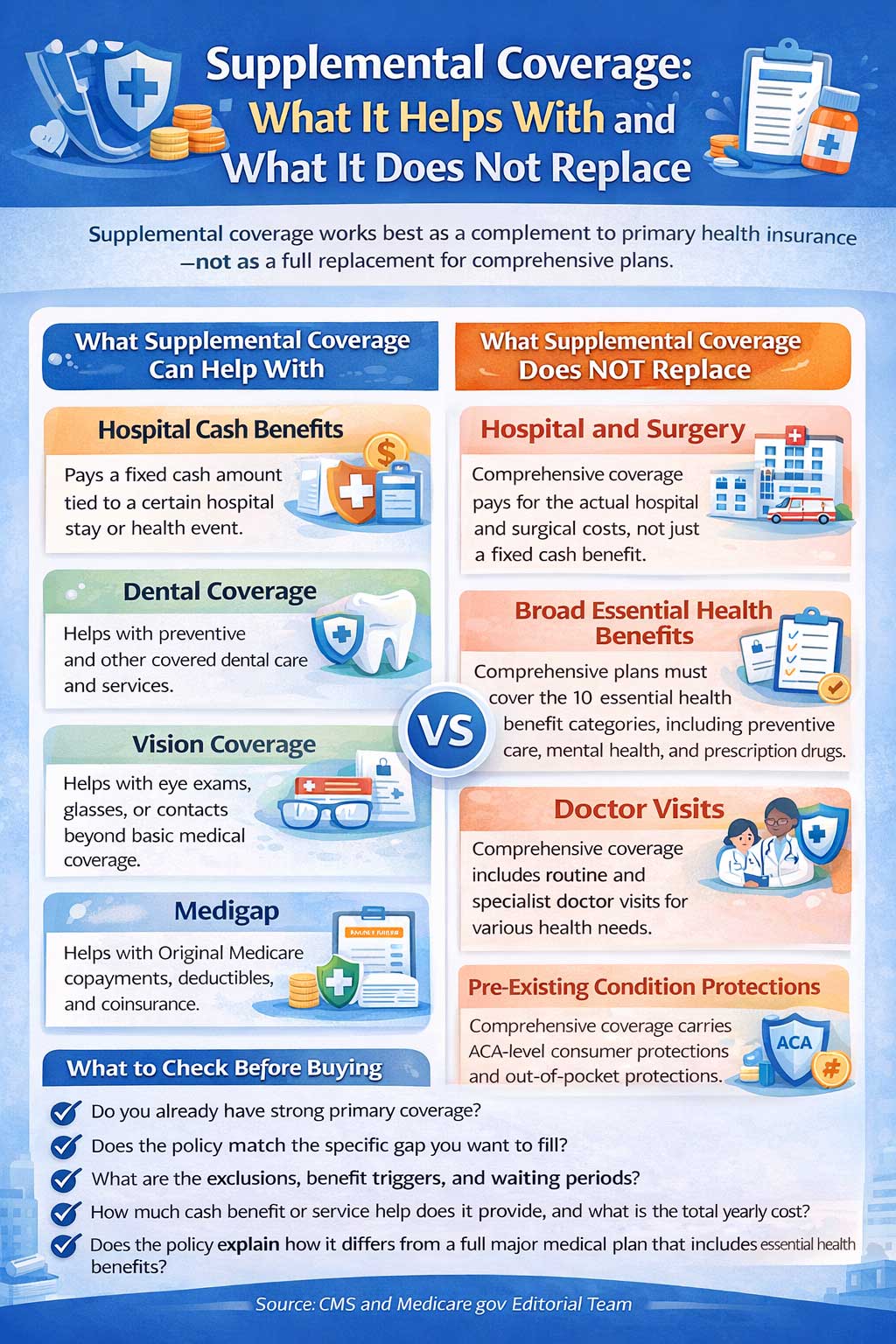
    Supplemental coverage is extra insurance meant to add a layer of protection on top of your primary health coverage or, in some cases, to help with specific costs or benefit gaps. Depending on the product, it may pay fixed cash benefits, help with Original Medicare cost-sharing, or add benefits such as dental or vision. It is usually narrower than comprehensive medical insurance and should not be treated as a full replacement for primary coverage.[1][2]

    What it is

    Extra coverage designed to help with specific gaps, extra services, or out-of-pocket costs rather than replace broad medical insurance.[1][2]

    What it is not

    Many supplemental products are not comprehensive coverage and may not include the federal protections people expect from major medical insurance.[1][5]

    Where it can help

    It may help with hospital cash benefits, Medicare cost-sharing, or extra services like dental and vision, depending on the policy.[1][2][3]

    What to compare

    The most important questions are what the policy actually pays, what it excludes, and whether you already have adequate primary coverage.[4]

    Infographic titled Supplemental Coverage: What It Helps With and What It Does Not Replace showing hospital cash benefits, dental, vision, and Medigap while explaining that supplemental coverage does not replace comprehensive medical insurance.

    What supplemental coverage really means

    In practical consumer terms, supplemental coverage means an extra policy layered over your main coverage strategy. It can help in different ways depending on the product. Some policies pay a fixed cash amount when a health-related event happens. Others are designed to cover a narrower category of services, such as dental or vision. Medicare beneficiaries may also use supplemental coverage in the form of Medigap to help pay deductibles, copayments, and coinsurance in Original Medicare.[1][2][3]

    That does not mean all supplemental products work the same way. Some are true medical complements, while others are limited-benefit or excepted-benefit products. Because of that, a supplemental policy should generally be evaluated as support coverage, not as your only coverage plan. If you still need a stronger primary coverage foundation, start by reviewing broader options such as ACA-compliant coverage instead of trying to build your health protection around a narrow supplement.

    Common types of supplemental coverage

    Type of supplemental coverage What it may help with Key limitation to understand
    Hospital indemnity / fixed indemnity coverage May pay a fixed cash amount tied to hospitalization or another covered health event.[1] It is not a substitute for comprehensive coverage and can sit outside some protections people expect from major medical plans.[1][5]
    Dental coverage May help with preventive visits, basic services, and sometimes more advanced dental care depending on the policy.[3] Separate dental plans can have their own premiums and waiting periods may apply for some services.[3]
    Vision coverage May help with eye exams, lenses, and glasses, especially when adult vision is not included in the main plan.[3] The Marketplace does not offer stand-alone vision plans, and only some Marketplace plans include adult vision coverage.[3]
    Medicare Supplement Insurance (Medigap) Helps pay Original Medicare out-of-pocket costs like copayments, coinsurance, and deductibles.[2] You must have Original Medicare to buy it, and it does not work like Medicare Advantage.[2]

    When supplemental coverage can add value

    • You already have primary medical coverage, but want help with certain out-of-pocket exposure or service gaps.[1]
    • Your main plan does not include adult dental or adult vision, and you want targeted extra coverage for those services.[3]
    • You are in Original Medicare and want extra protection from deductibles, copayments, and coinsurance through Medigap.[2]
    • You want fixed cash benefits that could help with non-medical costs during a covered health event.[1]

    When supplemental coverage is often misunderstood

    • When people assume it covers the same broad services as major medical insurance.[1][4]
    • When shoppers buy a cash-benefit policy thinking it will function like comprehensive hospital and doctor coverage.
    • When buyers focus only on premium and ignore exclusions, benefit triggers, waiting periods, and total likely cost.[4]
    • When a person needs real primary health coverage but buys only a narrow supplement or limited-benefit product instead.[1]

    Major Medical vs. Supplemental Insurance

    Major medical insurance and supplemental insurance do not serve the same purpose. Major medical coverage is designed to act as your main health insurance layer for hospitalization, physician services, preventive care, prescription drugs, and other core medical benefits. Supplemental insurance is usually narrower. It is generally meant to add support for a specific gap, service, or out-of-pocket exposure rather than replace comprehensive medical coverage.[1][4]

    That difference matters because many consumers assume a supplemental product will function like full medical insurance when it often will not. A hospital indemnity policy may pay fixed cash benefits. A dental or vision plan may help with a narrow category of care. A Medigap plan may help with Original Medicare cost-sharing. But those products are not built to replace the broader protection of major medical insurance.[1][2][3]

    In simple terms, major medical insurance is usually the foundation, while supplemental insurance is usually the add-on. If a person still needs real primary coverage, the safer starting point is usually a comprehensive plan rather than trying to build protection around a narrow supplement alone. If you want to compare limited protection with broader coverage, it also helps to review short-term medical coverage and hospital indemnity insurance.

    Question Supplemental coverage Primary medical coverage
    Main role Adds targeted benefits or extra financial support. Provides the main structure for medical coverage.
    Scope Usually narrower and tied to a service, event, or cost gap.[1] Usually broader and built around medically necessary care categories.[4]
    Typical use Helps with gaps, cash benefits, dental, vision, or Medicare cost-sharing. Covers routine and major medical care under the plan design.
    Should it stand alone? Usually no, unless you fully understand its limited role and scope.[1] Yes, this is generally the main health insurance layer.

    Important protections and limitations to understand

    Another issue people miss is that not every supplemental policy carries the same billing protections as comprehensive health insurance. CMS explains that No Surprises Act balance-billing protections generally do not apply to hospital indemnity policies or to items and services covered by stand-alone dental or vision plans.[5]

    That does not make supplemental coverage useless. It just means you need to match the product to the job. A fixed-indemnity policy can sometimes help as a cash-support layer. A dental policy can help with routine oral care. A Medigap plan can make Original Medicare more predictable. But none of those products should be evaluated as if they all solve the same problem.

    How to evaluate a supplemental policy before you buy

    1. Start by identifying the gap you are trying to solve: hospital cash exposure, dental, vision, Medicare cost-sharing, or something else.
    2. Check whether you already have primary health coverage that meets your main medical needs.[4]
    3. Read the benefit trigger carefully. Some supplemental plans pay only when a specific event occurs, not whenever you receive care.[1]
    4. Review exclusions, waiting periods, separate premiums, and whether adult benefits are limited or optional.[3]
    5. Compare total yearly cost, not just premium. Deductibles, copayments, and out-of-pocket costs can materially change value on the primary-plan side too.[4]
    6. If you are Medicare-eligible, make sure you understand whether Medigap or Medicare Advantage is the better fit for your situation, because they do not function the same way.[2]

    Bottom line

    Supplemental coverage can be useful when it is matched to a real gap: hospital cash exposure, dental care, vision care, or Medicare cost-sharing. But it usually works best as extra support layered on top of primary medical coverage, not as a replacement for it. The right way to buy it is to define the gap first, review the policy terms carefully, and compare it against the broader protection you may still need.[1][2][4][5]

    MM

    MajorMedicalInsurance.com Editorial Team

    This article was prepared using current CMS, HealthCare.gov, and Medicare materials to explain how supplemental coverage works in the United States, where it may add value, and where it should not be mistaken for full primary medical coverage. It is intended for educational purposes and should be reviewed alongside official plan documents and licensed guidance before enrollment.

    Reviewed for clarity, consumer usefulness, and alignment with current public health coverage guidance.

  • Short Term Medical

    By MajorMedicalInsurance.com Editorial Team
    Published on April 18, 2026 · Updated on April 19, 2026

    Temporary Health Coverage Guide

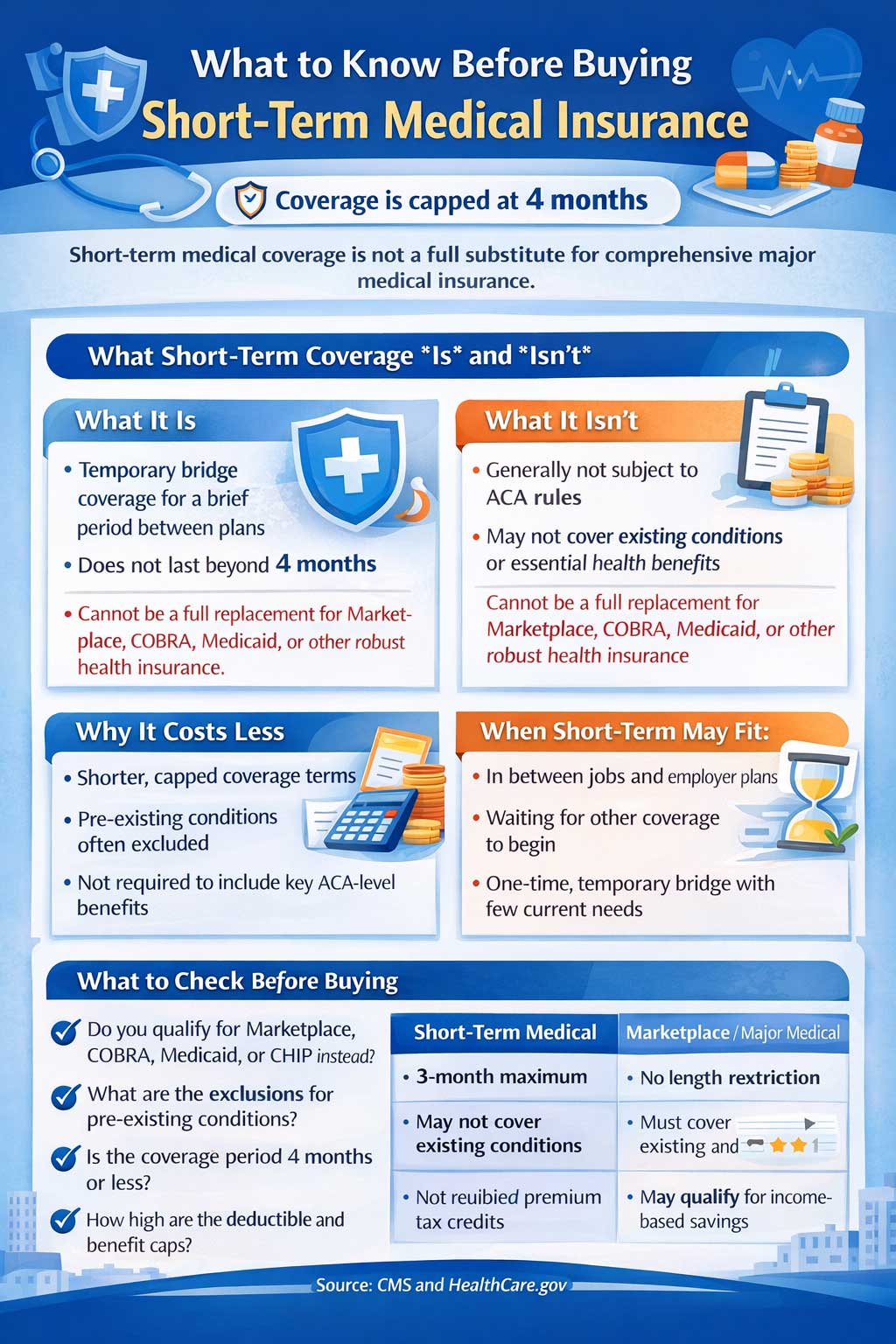
    Short-term medical insurance, often called short-term limited-duration insurance, is designed to help fill a temporary gap in coverage rather than replace comprehensive health insurance for the long run.[1] Federal rules now limit these plans to an initial term of no more than 3 months and a total maximum coverage period of 4 months, including renewals or extensions.[2]

    What it is

    A temporary policy meant to bridge short coverage gaps, not serve as a full substitute for ACA-compliant major medical coverage.[1]

    What it is not

    It is generally not built under the same federal consumer protections that apply to comprehensive Marketplace coverage.[1][3]

    Why people consider it

    It may appeal to people between jobs or waiting for another source of coverage to begin.[1]

    What to do first

    Before buying one, check whether you qualify for Marketplace coverage, a Special Enrollment Period, COBRA, Medicaid, CHIP, or another employer-based option.[5]

    Infographic titled What to Know Before Buying Short-Term Medical Insurance explaining that short-term coverage is temporary, capped at 4 months, generally not subject to ACA rules, may exclude pre-existing conditions and essential health benefits, and should be compared with Marketplace or other comprehensive options first.

    What short-term medical insurance really means

    Short-term medical coverage can look attractive because the monthly premium is often lower than a comprehensive major medical plan. The trade-off is that the policy is not built to the same standard as Marketplace coverage. That means you should not assume it covers pre-existing conditions, all essential health benefits, or the same level of cost protection that ACA-compliant plans provide.[1][3]

    In other words, short-term medical insurance can be useful in narrow situations, but it works best when you treat it as temporary, limited coverage and read the exclusions closely. People who need broader protection for ongoing care, prescription costs, maternity needs, or chronic conditions usually need to compare it against stronger options such as major medical insurance plans or other comprehensive coverage first.

    Short-term medical vs. comprehensive coverage

    Category Short-Term Medical Marketplace / Major Medical Coverage
    Main purpose Temporary bridge coverage during a short gap.[1] Comprehensive ongoing health coverage.
    Federal duration rule Initial term no more than 3 months; total maximum 4 months including renewals or extensions.[2] Not subject to the short-term duration cap.
    Pre-existing conditions Not protected by the ACA rules that require Marketplace plans to cover pre-existing conditions.[1][3] Marketplace plans must cover pre-existing conditions.[3]
    Essential health benefits Not required to cover the ACA’s essential health benefits.[1] Marketplace plans cover the 10 essential health benefits.[3]
    Out-of-pocket protection Varies by policy and may not provide the same overall cost protections as ACA-compliant plans. For 2026, the Marketplace out-of-pocket limit cannot exceed $10,600 for an individual or $21,200 for a family.[4]

    When short-term medical may make sense

    • You are between health plans and need a very short bridge.[1]
    • You are waiting for new employer coverage to begin and need temporary protection.
    • You want some limited financial protection for a narrow time period while you finalize long-term coverage.

    When it is usually the wrong fit

    • You have an ongoing condition and need dependable coverage for pre-existing care.[1][3]
    • You need comprehensive benefits such as maternity, mental health treatment, prescription coverage, or broader preventive care protections.[3]
    • You want stronger overall consumer protection and predictable long-term coverage.
    • You may qualify for Marketplace coverage, COBRA, Medicaid, CHIP, or another comprehensive alternative instead.[5]

    What people often misunderstand

    Lower premiums do not automatically mean better value. Short-term medical plans can cost less because they are not built to the same comprehensive standard as Marketplace plans. A cheaper monthly payment can still leave you more exposed if the policy excludes a condition, limits a benefit category, or provides less protection than an ACA-compliant plan.[1][3]

    The most useful comparison is not premium alone. It is premium plus exclusions, deductible, coinsurance, network rules, prescription handling, and what happens if you need expensive care during the time you are insured.

    What to check before buying a short-term policy

    1. Check whether you qualify for a Special Enrollment Period before you shop for short-term coverage.[5]
    2. Read the policy’s exclusions carefully, especially around pre-existing conditions and high-cost services.[1]
    3. Verify the exact coverage period so you do not confuse a short bridge with a long-term solution.[2]
    4. Review the deductible, coinsurance, benefit caps, and whether the provider network is limited.
    5. Do not assume prescription drugs, maternity care, mental health care, or preventive care will work the same way they do under an ACA-compliant plan.[3]
    6. Compare the policy against a real comprehensive alternative before deciding.

    Smarter alternatives to compare first

    Before choosing short-term medical insurance, many shoppers should compare it with Marketplace coverage, COBRA, Medicaid, CHIP, or a spouse’s or employer’s coverage if available.[5] On this site, it also makes sense to compare temporary coverage against stronger long-term options such as major medical insurance for individuals and ACA coverage.

    The goal is not to assume short-term coverage is always wrong. It is to compare it honestly against the broader protection you may still be able to access.

    Bottom line

    Short-term medical insurance can play a limited role when you are truly in transition and need a brief bridge. It is far less suitable as a long-term replacement for comprehensive health insurance. The most responsible approach is to treat it as a temporary, carefully reviewed option only after you have checked for Marketplace eligibility, Special Enrollment rights, COBRA, Medicaid, CHIP, and other comprehensive alternatives.[1][5]

    MM

    MajorMedicalInsurance.com Editorial Team

    This article was prepared using current CMS, Federal Register, and HealthCare.gov materials to help readers understand how short-term medical insurance works, where it may fit, and where it falls short compared with comprehensive coverage. It is intended for educational purposes and should be used alongside official plan documents and licensed guidance when comparing health coverage.

    Reviewed for clarity, consumer usefulness, and alignment with current public health coverage guidance.

  • ACA / Obamacare

    ACA Coverage Guide

    A Clearer Look at ACA Health Insurance Plans

    ACA Marketplace plans remain one of the most important ways individuals and families can access comprehensive major medical coverage. They are built around broad consumer protections, essential health benefit rules, and plan comparisons that help people evaluate more than just a monthly premium. [1] [2]

    For a site focused on major medical insurance, ACA plans deserve a clearer and more current explanation because they are designed as comprehensive coverage rather than narrow or supplemental-only products. If you want the broader foundation first, start with major medical health insurance. [2]

    Pre-Existing Conditions

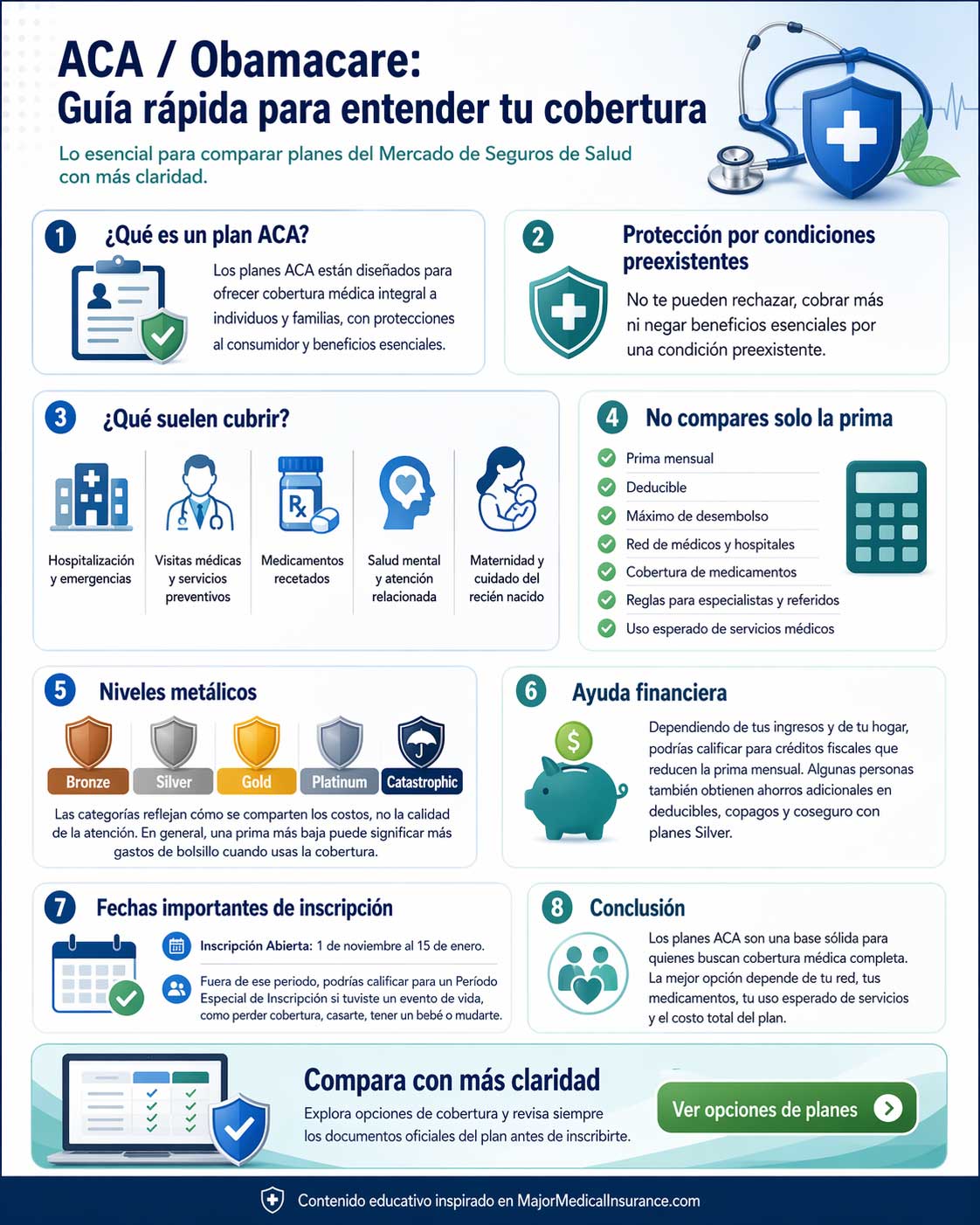
    Marketplace plans cannot reject applicants, charge more, or refuse to cover essential health benefits because of pre-existing conditions. For a more detailed breakdown, see pre-existing conditions and major medical insurance. [1]

    Essential Benefits

    Marketplace plans cover the ACA’s essential health benefit categories, which form the backbone of comprehensive coverage. [2]

    Enrollment Rules

    Open Enrollment remains the standard path for many shoppers, while Special Enrollment Periods may apply after qualifying life events. [5]

    ACA Obamacare infographic explaining coverage, pre-existing condition protections, essential benefits, metal tiers, financial help, and enrollment dates

    What ACA Plans Are Meant to Do

    ACA Marketplace coverage was built to improve access to health insurance and create stronger consumer protections in the individual market. That matters because major medical insurance is supposed to help with a broad range of medically necessary services, not just isolated events or narrow categories of care. [1] [2]

    In practice, ACA plans are important because they combine standardized protections with plan-level differences that still require careful comparison. Two plans may both be ACA-compliant, but deductibles, networks, formularies, referrals, and out-of-pocket limits can still vary in ways that change the plan’s actual value for a household. [3]

    What Marketplace Plans Cover

    All Marketplace plans must cover the ACA’s essential health benefit framework, but cost-sharing and network design still vary by plan. If you want a broader breakdown of those benefit areas, review what major medical insurance covers. [2]

    Category Why It Matters
    Hospital and emergency care Core major medical protection matters most when high-cost care is needed.
    Doctor visits and preventive services These affect routine access to care and long-term health management.
    Prescription drug coverage Formularies and pharmacy rules can strongly change a plan’s usefulness.
    Mental health and related services Broader benefit structure helps distinguish ACA plans from narrower coverage products.
    Maternity and newborn care Comprehensive benefits matter when life stage or family needs change.

    These examples reflect the ACA’s essential health benefit structure for Marketplace plans. [2]

    How to Compare ACA Plans More Responsibly

    A common mistake is focusing only on the monthly premium. In reality, ACA plan comparisons work better when you also evaluate the deductible, out-of-pocket maximum, provider network, prescription coverage, and how the plan handles specialists or hospital access. HealthCare.gov explains that plan categories are based on how you and the plan share costs, not on the quality of care itself. [3]

    That means a lower-premium plan can still become more expensive in practice if you expect regular prescriptions, specialist visits, ongoing treatment, or broader provider choice. A smarter comparison looks at total structure, not just the first number on the quote screen. If you want a deeper plan-by-plan comparison angle, see major medical insurance plans. [3]

    Checklist Before Choosing a Plan

    • Monthly premium
    • Deductible amount
    • Out-of-pocket maximum
    • Doctor and hospital network access
    • Prescription drug coverage
    • Referral and specialist rules
    • Expected healthcare usage
    • Official enrollment timing

    Metal Tiers Matter

    Bronze, Silver, Gold, Platinum, and Catastrophic categories are based on cost-sharing structure. In general, lower premiums often mean higher out-of-pocket costs when care is used. [3]

    Financial Help May Apply

    Depending on income and household details, some people qualify for premium tax credits that lower monthly premiums. Some also qualify for extra savings that reduce deductibles, copayments, and coinsurance, but those extra savings apply only with Silver plans. [4]

    Timing Still Controls Access

    Open Enrollment on HealthCare.gov runs from November 1 through January 15. Outside that window, many people need a qualifying life event to use a Special Enrollment Period. [5]

    Enrollment Timing Matters More Than Many People Think

    For many shoppers, Open Enrollment is the main path into ACA Marketplace coverage. HealthCare.gov says coverage can start January 1 if you enroll by December 15, and February 1 if you enroll between December 16 and January 15 and pay the first premium. [5]

    If you miss Open Enrollment, you may still qualify for a Special Enrollment Period after certain life events, such as losing coverage, getting married, having a baby, or moving. If enrollment timing is your main question, see major medical insurance enrollment. [5]

    Final Takeaway

    ACA plans remain one of the strongest starting points for people researching individual or family major medical insurance. They are built around standardized protections and broad benefits, but the right plan still depends on network fit, prescription needs, expected medical usage, and total cost structure. [1] [2] [3]

    A good ACA page should help visitors compare responsibly, not just repeat old talking points. That is why this version focuses on what still matters now: comprehensive coverage, pre-existing condition protections, essential health benefits, cost-sharing structure, financial help, and enrollment timing. If you are shopping on your own, major medical insurance for individuals is the best next page to read. [4] [5]

    References

    1. HealthCare.gov, Marketplace health plans cover pre-existing conditions. https://www.healthcare.gov/coverage/pre-existing-conditions/
    2. HealthCare.gov, What Marketplace health insurance plans cover. https://www.healthcare.gov/coverage/what-marketplace-plans-cover/
    3. HealthCare.gov, Health plan categories: Bronze, Silver, Gold & Platinum and 3 things to know before you pick a health insurance plan. https://www.healthcare.gov/choose-a-plan/plans-categories/ | https://www.healthcare.gov/choose-a-plan/comparing-plans/
    4. HealthCare.gov, How to Save Money on Monthly Health Insurance Premiums and Cost-sharing reductions. https://www.healthcare.gov/lower-costs/save-on-monthly-premiums/ | https://www.healthcare.gov/lower-costs/save-on-out-of-pocket-costs/
    5. HealthCare.gov, When can you get health insurance? and Special Enrollment Period. https://www.healthcare.gov/quick-guide/dates-and-deadlines/ | https://www.healthcare.gov/coverage-outside-open-enrollment/special-enrollment-period/

  • Medicare Advantage

    By MajorMedicalInsurance.com Editorial Team
    Published on April 18, 2026 · Updated on April 19, 2026

    Medicare Guide

    Medicare Advantage: What It Covers, How It Differs From Original Medicare, and What to Compare Before You Enroll

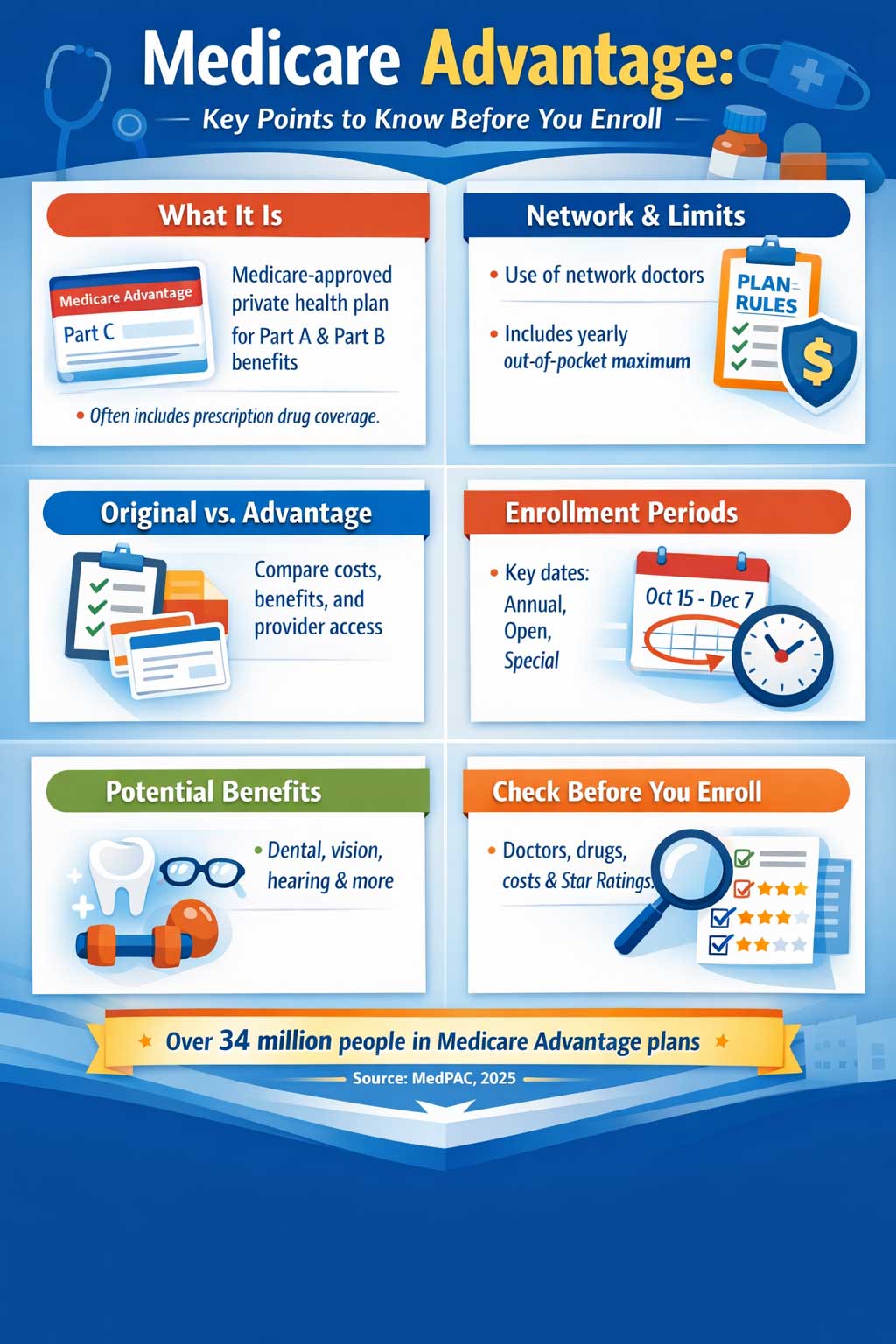
    Medicare Advantage, also called Medicare Part C, is a private-plan alternative to Original Medicare. These plans must cover Medicare Part A and Part B services, and many plans also include prescription drug coverage plus extra benefits such as dental, vision, hearing, or fitness-related services.[1][2]

    Private plan, Medicare rules

    A private insurer administers the plan, but Medicare sets core coverage requirements.[1]

    Often bundled

    Many Medicare Advantage plans include Part D drug coverage in one plan.[2]

    Network rules may apply

    Some plans require you to use network doctors or get plan approval for certain services.[1][2]

    Annual spending limit

    Unlike Original Medicare alone, Medicare Advantage plans include a yearly out-of-pocket cap for covered Part A and Part B services.[1][2]

    Infographic titled Medicare Advantage Key Points to Know Before You Enroll summarizing what Medicare Advantage is, network and cost limits, enrollment periods, extra benefits, and what to compare before choosing a plan.

    What Medicare Advantage really is

    Medicare Advantage is not a separate program outside Medicare. It is one of the main ways people can receive their Medicare benefits. Instead of using Original Medicare directly for most covered services, you receive those benefits through a Medicare-approved private health plan. In exchange, the plan may package your hospital coverage, medical coverage, and often prescription coverage into one product that is easier for some beneficiaries to manage.[1][2]

    That convenience comes with trade-offs. Depending on the plan, you may need to stay within a provider network, get referrals to see specialists, or obtain prior authorization for selected services, equipment, or medications. Because of those rules, the best plan is not simply the one with the lowest premium. The better choice is usually the plan that fits your doctors, your prescriptions, your expected use of care, and your tolerance for network restrictions. If you want a broader insurance foundation first, compare this with major medical health insurance.[1][2]

    Original Medicare vs. Medicare Advantage

    Category Original Medicare Medicare Advantage
    How you receive benefits Directly through Medicare Part A and Part B.[1] Through a Medicare-approved private plan.[1]
    Doctor and hospital choice Generally broader flexibility if the provider accepts Medicare.[1] May require use of a provider network for non-emergency care.[1][2]
    Prescription drug coverage Usually requires a separate Part D plan.[1] Many plans include Part D, though not all do.[2]
    Extra benefits Generally limited unless paired with other coverage. May include dental, vision, hearing, fitness, transportation, or other supplemental benefits.[2]
    Annual out-of-pocket limit No built-in yearly cap unless you have supplemental coverage. Includes a yearly limit on out-of-pocket costs for covered Part A and Part B services.[1][2]
    Plan rules Often simpler coverage rules for covered services. May involve referrals, prior authorization, formularies, and plan-specific rules.[1][2]

    Potential advantages

    • Can combine hospital, medical, and often drug coverage in one plan.[2]
    • May include extra benefits that Original Medicare does not routinely provide.[2]
    • Includes a yearly maximum on covered Part A and Part B out-of-pocket costs.[1][2]
    • Can be practical for beneficiaries comfortable using local provider networks.

    Potential drawbacks

    • Your preferred doctors or hospitals may not be in network.[1]
    • Copays, coinsurance, and drug costs vary significantly from plan to plan.[2]
    • Some plans require prior authorization for selected services or supplies.[1][2]
    • Benefits, provider participation, and costs can change from year to year.[3]

    Why the “$0 premium” pitch can be misleading

    A low plan premium does not mean your healthcare will be free. Many beneficiaries still pay the monthly Medicare Part B premium, and they may also face deductibles, copays, coinsurance, pharmacy costs, and different cost-sharing rules depending on whether care is in network or out of network. When comparing plans, the smarter metric is total likely annual cost, not just the premium advertised in a mailer or TV ad.[1][2]

    Who Medicare Advantage may fit best

    Medicare Advantage may be a good fit for beneficiaries who like the idea of one plan handling most of their coverage, who do not mind working inside a provider network, and who value extra benefits such as routine dental, vision, hearing, or wellness-related services. It can also appeal to people who want the financial protection of a yearly maximum out-of-pocket limit for covered Part A and Part B services.[1][2]

    On the other hand, people who travel often, want broader provider choice, or strongly prefer fewer plan-management rules may lean toward Original Medicare instead. The right answer depends less on ideology and more on your doctors, prescriptions, local plan offerings, and expected use of care over the next year.

    Enrollment periods to know

    Enrollment period When it happens What you can generally do
    Open Enrollment Period October 15 to December 7[3] Join, drop, or switch Medicare Advantage plans; move between Original Medicare and Medicare Advantage; changes generally take effect January 1.[3]
    Medicare Advantage Open Enrollment Period January 1 to March 31[3] If you are already in Medicare Advantage, you can make one change or return to Original Medicare.[3]
    Initial Enrollment Period Usually the 7-month window around first eligibility You can enroll in Medicare Advantage if you have both Part A and Part B.[2]
    Special Enrollment Periods Varies by situation Available in certain cases such as moving, losing qualifying coverage, or other eligible events.[3]

    What to compare before choosing a plan

    1. Check whether your primary doctor, specialists, hospitals, and preferred pharmacies are in network.[1][2]
    2. Look at your medications and verify the plan’s formulary, tiers, and pharmacy rules.[2]
    3. Review the plan’s annual maximum out-of-pocket limit, not just the monthly premium.[1][2]
    4. Read the evidence of coverage and note whether referrals or prior authorization could affect care you expect to use.[2]
    5. Compare quality through CMS Star Ratings and use Medicare’s official plan comparison tools.[4][1]
    6. Review the Annual Notice of Change each year if you are already enrolled, because costs and benefits may shift.[3]

    Why this matters more now

    Medicare Advantage is now a dominant part of the Medicare landscape. MedPAC reported that in 2025 the program included 5,492 plan options offered by 164 organizations, enrolled about 34.9 million beneficiaries, and represented about 55% of eligible Medicare beneficiaries. That scale makes careful comparison even more important, because broad growth does not mean every plan works equally well for every beneficiary.[5]

    CMS also publishes Medicare Advantage Star Ratings to help beneficiaries compare plan quality. Star Ratings are not the only factor to consider, but they can help you judge plan performance alongside benefits, provider access, and expected cost-sharing.[4]

    Bottom line

    Medicare Advantage can be a strong option for people who want bundled coverage, extra benefits, and a built-in annual spending limit for covered Part A and Part B services. It can be less appealing for beneficiaries who want the broadest provider choice or who dislike network restrictions and plan-management rules. The best decision is usually made by comparing specific local plans carefully each year rather than assuming all Medicare Advantage plans are essentially the same.[1][2]

    MM

    Majormedicalinsurance.com Editorial Team

    This article was prepared using official Medicare, CMS, and MedPAC materials to help readers understand how Medicare Advantage works, where it may fit, and what to compare before enrolling. It is intended for educational purposes and does not replace individualized plan guidance, official plan documents, or advice from a qualified professional.

    Reviewed for clarity, consumer usefulness, and alignment with current public Medicare guidance.

  • Understanding Hospital Indemnity Insurance

    By MajorMedicalInsurance.com Editorial Team
    Published on April 18, 2026 · Updated on April 19, 2026

    Supplemental Coverage Guide

    Hospital Indemnity

    Hospital indemnity insurance is generally a supplemental fixed-benefit product that may pay cash when a covered hospital event happens, such as an admission or a qualifying inpatient stay defined by the policy. It is not the same as major medical insurance, and federal guidance makes clear that fixed indemnity coverage is not a substitute for comprehensive coverage. [1]

    For visitors researching broader health protection, hospital indemnity coverage is best understood as an extra financial layer rather than a primary health plan. Depending on the policy structure, the cash benefit may help with out-of-pocket medical costs or non-medical expenses related to a hospital stay, but the plan’s real value depends on its benefit schedule, exclusions, and limits. If you want the broader context first, compare this with major medical health insurance. [1] [2]

    Fixed Cash Benefits

    NAIC describes hospital confinement indemnity coverage as insurance that pays a fixed amount for each day you are in a hospital. [2]

    Supplemental, Not Primary

    Federal guidance says hospital indemnity and other fixed indemnity insurance has traditionally been used as a form of income replacement and is not a substitute for comprehensive coverage. [1]

    Policy Terms Matter

    Covered events, payout amounts, exclusions, waiting periods, and renewal terms can vary by policy, so the benefit schedule needs careful review before purchase. [2]

    Woman recovering in a hospital bed with a supportive companion, representing hospital indemnity insurance and help with unexpected hospital expenses.

    What Hospital Indemnity Insurance Is

    Hospital indemnity insurance is typically structured as a limited supplemental policy. Instead of functioning like major medical coverage, it generally pays a fixed cash amount when a qualifying hospital-related event occurs under the policy terms. Federal guidance also explains that consumers can use the fixed cash benefit as they wish, including for out-of-pocket expenses not covered by comprehensive coverage or for non-medical expenses such as rent or mortgage. [1]

    This limited design is why hospital indemnity plans should be viewed as an add-on rather than a replacement for broader healthcare protection. A hospital event can create more than provider bills alone, but the policy only helps to the extent that its benefit definitions and payout amounts are actually meaningful for the policyholder’s situation. If you are comparing this against broader primary coverage, it also helps to review what major medical insurance covers. [1] [3]

    How It Differs From Major Medical Insurance

    Hospital indemnity insurance can complement broader health protection, but it should not be confused with comprehensive medical coverage. [1] [3]

    Feature Hospital Indemnity Insurance Major Medical Insurance
    Purpose Fixed cash support for covered hospital events Broad coverage for a wide range of healthcare services
    Payment Structure Usually pays a scheduled fixed amount when qualifying events occur Usually shares provider costs according to plan rules
    Scope Event-based supplemental protection Comprehensive healthcare protection
    Can It Replace Full Health Insurance? No Yes, this is the primary coverage type people usually rely on

    What These Plans May Help With

    Some consumers consider hospital indemnity plans because a hospital stay can create both medical and non-medical financial strain. Federal guidance notes that fixed cash benefits can be used for out-of-pocket costs not covered by comprehensive coverage or for non-medical expenses. [1]

    That said, a plan should not be judged by its marketing language alone. The practical question is whether the covered-event definitions, payout schedule, exclusions, and premium cost actually make sense compared with the policyholder’s likely financial exposure. To understand where this fits in a broader strategy, see supplemental coverage in the site. [2]

    Common Reasons People Consider It

    • To add a financial cushion after a hospital admission
    • To help with deductibles or coinsurance exposure
    • To support non-medical costs during recovery
    • To reduce strain on savings during an unexpected hospital stay
    • To supplement existing health coverage rather than replace it

    Covered Event Definitions

    A policy should clearly explain what counts as a hospital admission, inpatient confinement, ICU stay, or other qualifying event. [2]

    Payout Amounts

    A plan may sound helpful until its scheduled cash benefits are compared with realistic hospital-related expenses and your premium cost over time. [2]

    Primary Coverage Still Matters

    Because hospital indemnity is supplemental, it should usually be reviewed alongside your broader coverage, not instead of it. [1] [3]

    What to Review Before Choosing a Hospital Indemnity Plan

    A hospital indemnity policy should be reviewed as a limited supplemental product, not assumed to function like full health insurance. Strong review points include the admission benefit, daily confinement benefit, ICU-related benefits if offered, exclusions, waiting periods, premium cost, and whether the plan actually complements your broader coverage strategy. [1] [2]

    For a serious insurance site, the key is to explain the role of the product accurately: hospital indemnity insurance may help in some situations, but it should be evaluated as supplemental protection with defined limits, not as a broad medical safety net on its own. [1] [3]

    Final Thoughts

    Hospital indemnity insurance can make sense for some people who want an extra layer of financial support tied to covered hospital events. But the product should be understood as supplemental coverage, not as a replacement for major medical insurance. [1] [2]

    The most responsible way to present this topic is to explain what the plan does, what it does not do, and what policyholders need to verify before buying. That is what makes the page more useful and keeps it aligned with a serious major medical insurance site. If you want to compare broader plan value next, review major medical insurance benefits. [1] [2]

    References

    1. CMS, Short-Term, Limited-Duration Insurance and Independent, Noncoordinated Excepted Benefits Coverage. https://www.cms.gov/newsroom/fact-sheets/short-term-limited-duration-insurance-and-independent-noncoordinated-excepted-benefits-coverage-cms
    2. NAIC, Health Insurance and Glossary of Insurance Terms. https://content.naic.org/consumer/health-insurance.htm | https://content.naic.org/glossary-insurance-terms
    3. HealthCare.gov, Find out what Marketplace health insurance plans cover. https://www.healthcare.gov/coverage/what-marketplace-plans-cover/
    4. HealthCare.gov, Qualifying health coverage. https://www.healthcare.gov/glossary/qualifying-health-coverage/
    ET

    Editorial Review

    MajorMedicalInsurance.com Editorial Team

    Health Insurance Educational Content

    This page was prepared and reviewed for clarity, structure, and general educational usefulness by the MajorMedicalInsurance.com editorial team. Our content focuses on major medical coverage, ACA plans, Medicare-related topics, and supplemental health insurance categories to help readers compare options more responsibly.

  • What Does Major Medical Insurance Cover?

    By MajorMedicalInsurance.com Editorial Team
    Published on April 18, 2026 · Updated on April 19, 2026

    Coverage Guide

    In most consumer use, “major medical insurance” refers to comprehensive health coverage designed to protect against large medical expenses, not just limited cash benefits or short-gap policies. For ACA-compliant individual and Marketplace plans, that means coverage built around the 10 essential health benefits, including hospitalization, emergency care, prescription drugs, mental health services, preventive care, and more.[1][2]

    Core purpose

    Major medical coverage is built to help pay for high-cost medical care such as hospital stays, surgery, emergency treatment, and ongoing physician services.[1]

    What comprehensive plans include

    Marketplace and other ACA-compliant individual plans must cover the 10 essential health benefit categories.[1]

    What “covered” does not mean

    Covered services can still involve deductibles, copays, coinsurance, network rules, and out-of-pocket limits.[4][5]

    What to compare

    The smartest comparison is benefits plus cost-sharing plus network access, not premium alone.[4][5]

    What “major medical insurance” usually means today

    The term “major medical insurance” is commonly used to describe broad, comprehensive health coverage rather than a narrow supplemental product. In practical terms, people usually mean a plan that helps pay for expensive medical care, specialist treatment, hospitalization, emergency services, prescription drugs, and other medically necessary care. For nationwide consumer guidance, the clearest benchmark is ACA-compliant individual and Marketplace coverage, because those plans are required to meet federal benefit standards.[1][2]

    That distinction matters. A plan like short-term medical insurance can sometimes help during a brief gap, but it is generally not built to the same federal standards as full ACA-compliant major medical coverage. If you want a broader overview of how full coverage is structured, compare that with major medical health insurance and major medical insurance benefits.

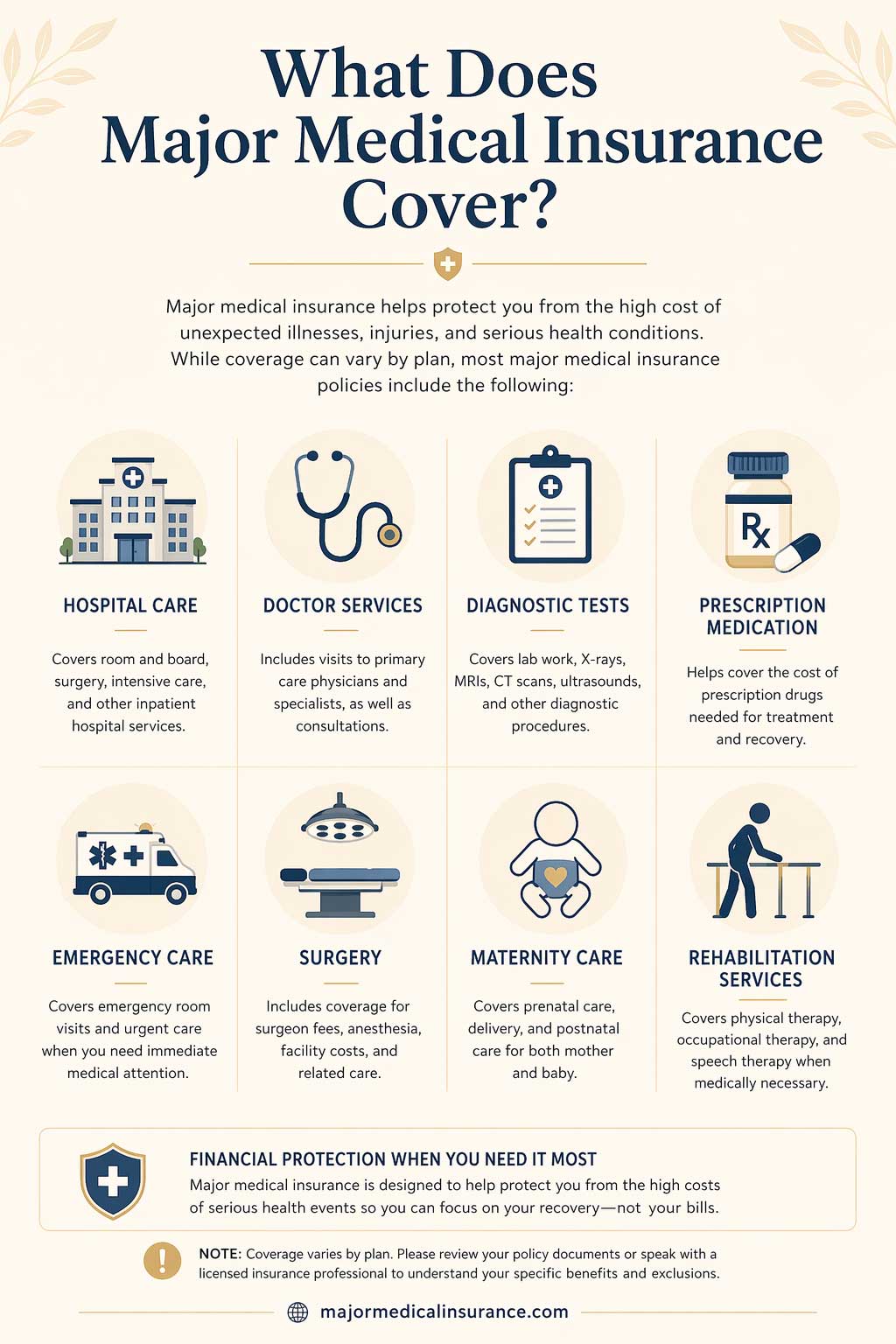
    Infographic titled What Does Major Medical Insurance Cover? showing common coverage areas of major medical insurance, including hospital care, doctor services, diagnostic tests, prescription medication, emergency care, surgery, maternity care, and rehabilitation services.

    What major medical insurance generally covers

    Under federal ACA rules, non-grandfathered individual and small-group coverage must include the 10 essential health benefit categories. These categories are the strongest real-world guide to what comprehensive major medical insurance is expected to cover across the United States, even though exact plan details can still vary by state, insurer, and network design.[1]

    Coverage area What it typically includes Why it matters
    Ambulatory patient services Outpatient care without a hospital admission, including office visits and many routine medical services.[1] Helps cover everyday medical care outside the hospital.
    Emergency services Emergency room treatment and other urgent emergency care.[1] Protects against the costs of sudden illness or injury.
    Hospitalization Inpatient hospital care, surgery, and overnight stays.[1] This is one of the biggest reasons people buy major medical coverage.
    Pregnancy, maternity, and newborn care Coverage for pregnancy and childbirth under Marketplace plans, with pregnancy protected from being treated as a pre-existing condition.[1][2] Important because maternity care is part of the essential health benefit framework.
    Mental health and substance use disorder services Behavioral health treatment, counseling, psychotherapy, and substance use disorder care.[1] Comprehensive plans are expected to include mental health coverage, not just physical health treatment.
    Prescription drugs Coverage for prescription medications, subject to each plan’s formulary and cost-sharing design.[1] Prescription costs are often a major part of total medical spending.
    Rehabilitative and habilitative services and devices Services and devices that help people recover or develop physical or mental functioning after injury, disability, or chronic illness.[1] Can be critical after accidents, surgeries, strokes, or developmental conditions.
    Laboratory services Lab testing and diagnostic support tied to medical care.[1] Lab work is central to diagnosis, monitoring, and treatment planning.
    Preventive and wellness services Many preventive services, including screenings and immunizations, are covered at no cost when delivered in-network under applicable rules.[3] Prevention can reduce the need for more expensive care later.
    Pediatric services, including oral and vision care Children’s oral and vision care are included in the essential health benefit framework for pediatric services.[1] This is one reason plan details for family coverage should be reviewed carefully.

    Prescription drug coverage

    Major medical insurance generally includes prescription drug coverage as part of the essential health benefits framework for ACA-compliant individual and small-group plans.[1] That said, coverage is not identical from one plan to another. A plan may cover prescription drugs, but your real cost can still depend on the formulary, the drug tier, whether prior authorization applies, and whether a generic or preferred brand alternative is required.

    This is why drug coverage should be checked carefully before enrollment instead of assumed. A plan with a lower premium can still become more expensive overall if your regular medications fall into higher-cost tiers or face stricter utilization rules. If you also want to compare the cost side of coverage, see major medical insurance cost.

    What to verify for prescription coverage

    • Whether your medications are on the plan’s formulary.
    • Which tier each prescription falls into.
    • Whether prior authorization, step therapy, or quantity limits apply.
    • How much you may owe through copays, coinsurance, or the deductible.[4]

    Mental health coverage

    Major medical insurance generally includes mental health and substance use disorder services as part of comprehensive coverage.[1] In practical terms, that can include outpatient therapy, behavioral health treatment, counseling, and other medically necessary mental health services, depending on the plan’s network, authorization rules, and cost-sharing design.

    Coverage does not mean every provider is automatically available at the same cost. Network rules still matter, especially for therapy, psychiatry, and ongoing treatment. That is one reason consumers should review the plan type, provider directory, and cost-sharing details before assuming mental health care will be equally accessible under every major medical plan.[5]

    What may be covered

    Therapy, behavioral health visits, psychiatric care, and substance use disorder treatment can fall within major medical coverage when they are part of the plan’s covered benefits.[1]

    What to check

    Review network participation, referral rules if applicable, prior authorization requirements, and what your deductible, copay, or coinsurance will be for ongoing care.[4][5]

    Maternity coverage

    Pregnancy, maternity, and newborn care are part of the essential health benefit structure for ACA-compliant Marketplace and individual major medical coverage.[1] Pregnancy also cannot be treated as a pre-existing condition in Marketplace coverage.[2] That makes maternity coverage one of the clearest real-world examples of how major medical insurance differs from weaker or narrower products.

    Even so, the exact way maternity care is handled can still vary by plan. Consumers should still verify which hospitals and physicians are in-network, what prenatal and delivery-related cost-sharing applies, and how newborn care is treated under the policy after birth. A plan may include maternity care broadly while still creating different out-of-pocket costs depending on the provider network and plan design.[4][5]

    Why maternity coverage matters

    Strong major medical coverage is built for major health events across the year, including pregnancy and childbirth, not just routine office visits or narrow one-time benefits. That broader protection is one of the main reasons comprehensive coverage carries more long-term value than limited products.

    What is usually included in stronger comprehensive plans

    • Primary care and specialist visits through the plan’s benefit structure.
    • Emergency care and hospital treatment.[1]
    • Prescription drug benefits.[1]
    • Mental health and substance use disorder treatment.[1]
    • Preventive screenings and many preventive services at no cost in-network under applicable rules.[3]

    What people should still verify in the plan details

    • Whether routine adult dental is included or sold separately.
    • Whether routine adult vision is included or sold separately.
    • How out-of-network care is handled under the plan design.[5]
    • What you will pay through deductibles, copays, and coinsurance.[4]

    Covered does not mean free

    One of the biggest misunderstandings around major medical insurance is thinking that “covered” means the insurer pays 100% of every bill. In reality, most comprehensive plans involve deductibles, copays, coinsurance, provider networks, and plan rules that affect what you pay when you actually use care.[4][5]

    Marketplace plans do, however, have an out-of-pocket maximum. For the 2026 plan year, that cap cannot exceed $10,600 for an individual and $21,200 for a family, although many plans set lower limits.[4] That ceiling is one of the biggest differences between strong major medical coverage and weaker, more limited products.

    What major medical insurance may not fully cover

    Even good comprehensive coverage has limits. Exact exclusions and restrictions depend on the plan, but consumers should always review the Summary of Benefits and Coverage, network rules, formulary, and cost-sharing structure before enrolling. It is especially important to check whether a plan uses an HMO, PPO, EPO, or POS design, because that changes how much provider choice and out-of-network coverage you may have.[5]

    Item What to check Why it matters
    Routine adult dental and vision Whether they are built into the medical plan or offered separately. These extras should always be verified instead of assumed.
    Out-of-network care Whether the plan covers it at all, and at what cost.[5] This can materially change your real access to doctors and hospitals.
    Drug coverage details Formulary tiers, prior authorization, and cost-sharing. A plan may cover prescriptions, but not every drug equally.
    Specialist access Whether referrals are required or provider options are restricted by network type.[5] This affects convenience, wait times, and continuity of care.

    How this differs from weaker or narrower coverage

    Comprehensive major medical coverage is designed to coordinate a broad range of care needs across the year. That is very different from products that pay only a fixed cash benefit, cover only a limited event, or are mainly intended as temporary stopgaps. If you are trying to understand the law behind comprehensive health coverage, see our overview of Obama Care / ACA.

    And if you are Medicare-eligible, keep in mind that Medicare Advantage is a separate type of coverage framework with different rules, enrollment periods, and benefits.

    What to compare before choosing a major medical plan

    1. Make sure the plan covers the broad benefit categories you are likely to use most.[1][2]
    2. Check the deductible, copays, coinsurance, and out-of-pocket maximum.[4]
    3. Look closely at the provider network and plan type before assuming your doctors are covered.[5]
    4. Confirm how prescriptions are handled, including formulary tiers and utilization rules.
    5. Review whether routine adult extras are included or sold separately instead of assuming they come with every plan.

    Bottom line

    Major medical insurance is meant to protect you from large medical expenses through broad, structured coverage rather than one-off cash benefits or short-gap protection. In the modern U.S. individual market, the clearest real-world benchmark is ACA-compliant comprehensive coverage, which includes the 10 essential health benefits and stronger consumer protections for pre-existing conditions and annual out-of-pocket limits.[1][2][4] The safest way to compare plans is to look beyond premium and review benefits, network access, prescription rules, and total potential out-of-pocket exposure.

    MM

    MajorMedicalInsurance.com Editorial Team

    This article was prepared using current HealthCare.gov materials to explain what comprehensive major medical coverage generally includes in the United States. It is intended for educational purposes and should be reviewed alongside official plan documents, provider directories, formularies, and licensed guidance before enrollment.

    Reviewed for clarity, consumer usefulness, and alignment with current public health coverage guidance.

  • Major Medical Insurance Eligibility

    By MajorMedicalInsurance.com Editorial Team
    Published on · Updated on

    Major medical insurance is one of the most important types of health coverage in the United States, but eligibility can mean different things depending on how you get coverage. Some people qualify through an employer, others through the Health Insurance Marketplace, and others through public programs such as Medicare or Medicaid. The right path depends on your age, household situation, income, work status, and whether you already have access to other coverage.

    Quick Answer

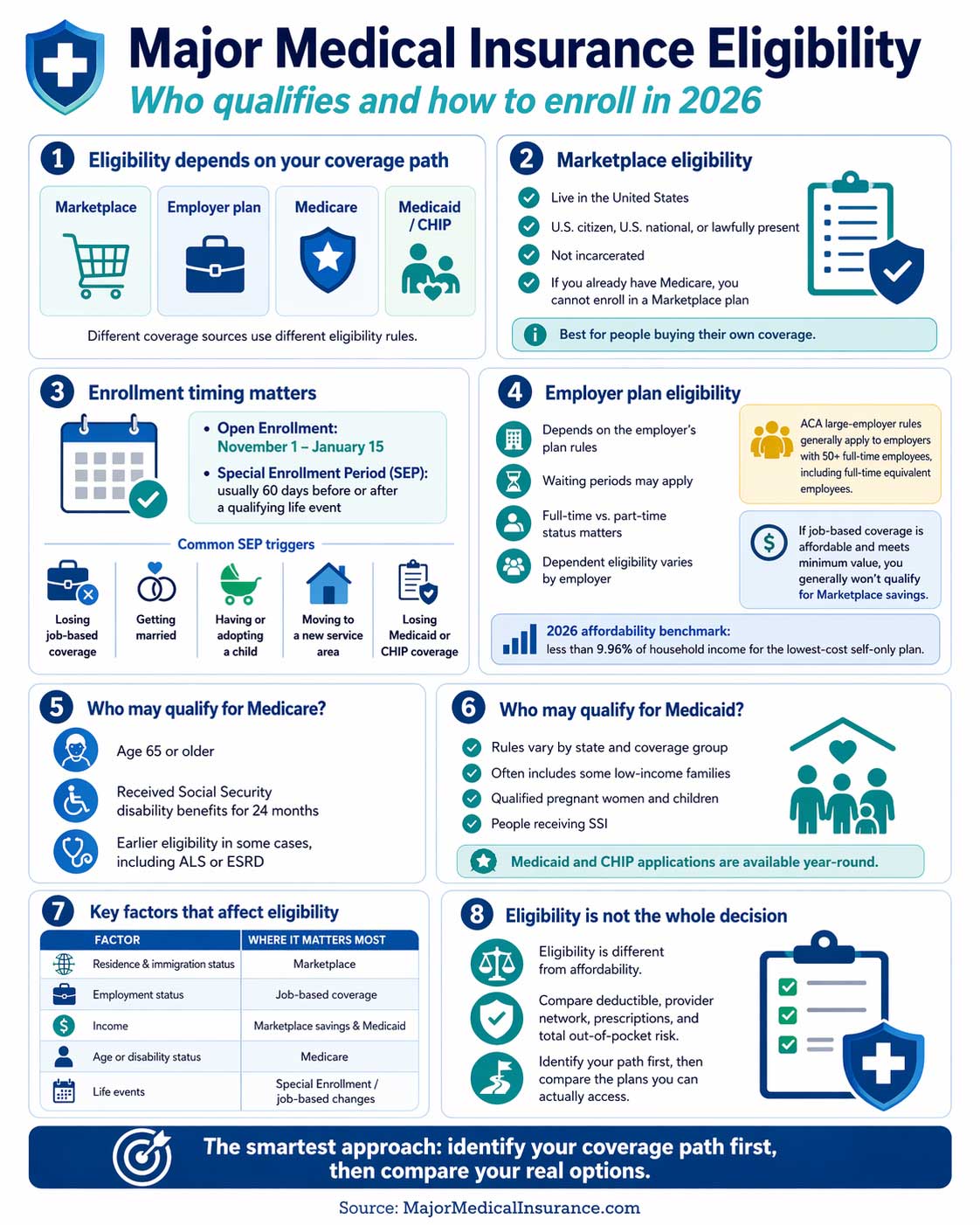
    Eligibility for major medical insurance depends on the source of the plan. Marketplace coverage generally requires that you live in the United States, be a U.S. citizen or national or be lawfully present, and not be incarcerated. Employer coverage depends on your employer’s plan rules. Medicare and Medicaid follow their own federal and state eligibility rules. The most important step is to identify which coverage path actually applies to you before comparing plans.

    Infographic explaining major medical insurance eligibility in 2026, including Marketplace, employer plans, Medicare, Medicaid, enrollment periods, and key factors that affect who qualifies.

    What Major Medical Insurance Means

    Major medical health insurance generally refers to comprehensive coverage designed to help pay for serious and routine medical needs, including hospitalization, physician services, emergency care, preventive services, prescription drugs, and other covered benefits. It is different from narrow or temporary products because it is designed to provide broader financial protection when care becomes expensive.

    Marketplace Eligibility

    If you are buying your own coverage, the Health Insurance Marketplace is often the first place to check. HealthCare.gov says that, in general, to enroll in Marketplace coverage you must live in the United States, be a U.S. citizen or national or be lawfully present, and not be incarcerated. It also states that if you already have Medicare, you cannot enroll in a Marketplace health plan.[1]

    That is why people shopping on their own often end up comparing this topic with Obamacare / ACA and pre-existing conditions and major medical insurance.

    When You Can Enroll

    Eligibility is not only about who qualifies. It is also about timing. On HealthCare.gov, Open Enrollment runs from November 1 through January 15. If you miss that window, you usually need a qualifying life event to use a Special Enrollment Period.[1]

    Common Special Enrollment triggers

    • Losing job-based coverage
    • Getting married
    • Having or adopting a child
    • Moving to a new service area
    • Losing Medicaid or CHIP coverage

    HealthCare.gov says SEP timing is usually 60 days before or after the qualifying event, although some Medicaid and CHIP loss situations can work differently.[1] For a deeper look at timing and sign-up windows, see major medical insurance enrollment.

    Employer-Sponsored Coverage

    Many Americans get major medical coverage through work, but the rules are not as simple as “all employers must offer insurance.” Employer eligibility depends on the employer’s plan rules, waiting periods, full-time or part-time classification, and whether dependents are eligible. Under the ACA employer shared responsibility rules, the large-employer requirements generally apply to applicable large employers with 50 or more full-time employees, including full-time equivalent employees.[2]

    If you have an offer of job-based coverage, that can also affect whether you qualify for Marketplace savings. HealthCare.gov says that in 2026 a job-based plan is considered affordable if your share of the premium for the lowest-cost self-only plan is less than 9.96% of household income and the plan meets minimum value standards. In that case, you generally will not qualify for Marketplace savings.[2]

    Medicare Eligibility

    Medicare is a separate federal coverage path. Medicare.gov says people generally become eligible at age 65, after receiving Social Security disability benefits for 24 months, or earlier in certain cases such as ALS or ESRD.[3] If you are near Medicare age or already dealing with disability-based eligibility, it often makes more sense to compare that route directly with Medicare Advantage instead of treating every option as part of the same market.

    Medicaid Eligibility

    Medicaid eligibility is different because it varies by state and by coverage group. Medicaid.gov explains that federal law requires states to cover certain groups, including some low-income families, qualified pregnant women and children, and people receiving SSI, while states may also choose to cover other groups under additional options.[4]

    HealthCare.gov also says you can apply for Medicaid and CHIP at any time during the year, which makes these programs different from the Marketplace Open Enrollment schedule.[4]

    What Usually Affects Eligibility

    Factor Why It Matters Where It Matters Most
    Residence and immigration status Marketplace rules require U.S. residence and eligible status Marketplace coverage
    Employment status Plan access often depends on full-time eligibility rules and employer policy Job-based coverage
    Income Can affect Marketplace savings and Medicaid eligibility Marketplace and Medicaid
    Age or disability status These can determine Medicare access Medicare
    Life events Can trigger Special Enrollment outside the annual window Marketplace and job-based changes

    What This Page Should Not Confuse With Eligibility

    Eligibility is not the same thing as affordability, plan quality, or network fit. A person may be eligible for a plan and still need to compare whether it makes sense based on deductible, provider network, prescription coverage, and total out-of-pocket risk.

    Bottom Line

    Major medical insurance eligibility depends first on where the coverage comes from. Marketplace coverage, employer plans, Medicare, and Medicaid all use different rules. The smartest approach is to identify your path first, then compare the plans you can actually access, instead of assuming one set of eligibility rules applies to every type of coverage.

    References

    1. HealthCare.gov, Are you eligible to use the Marketplace?, When can you get health insurance?, and Special Enrollment Period.
      https://www.healthcare.gov/quick-guide/eligibility/ |
      https://www.healthcare.gov/quick-guide/dates-and-deadlines/ |
      https://www.healthcare.gov/coverage-outside-open-enrollment/special-enrollment-period/
    2. IRS, Employer shared responsibility provisions; HealthCare.gov, If you have job-based insurance and Affordable coverage.
      https://www.irs.gov/affordable-care-act/employers/employer-shared-responsibility-provisions |
      https://www.healthcare.gov/have-job-based-coverage/ |
      https://www.healthcare.gov/glossary/affordable-coverage/
    3. Medicare.gov, Get started with Medicare, Which path is right for me?, and End-Stage Renal Disease (ESRD).
      https://www.medicare.gov/basics/get-started-with-medicare |
      https://www.medicare.gov/basics/get-started-with-medicare/other-paths |
      https://www.medicare.gov/basics/end-stage-renal-disease
    4. Medicaid.gov, Eligibility Policy; HealthCare.gov, Medicaid & CHIP coverage.
      https://www.medicaid.gov/medicaid/eligibility-policy |
      https://www.healthcare.gov/medicaid-chip/
  • Major Medical Insurance Enrollment

    By MajorMedicalInsurance.com Editorial Team
    Published on · Updated on

    If you need major medical coverage, the main time to enroll in a Marketplace plan is during the annual Open Enrollment Period. On HealthCare.gov, Open Enrollment runs from November 1 through January 15 each year. If you need help applying, you can use HealthCare.gov or call the Marketplace at 1-800-318-2596.[1]

    Quick Answer

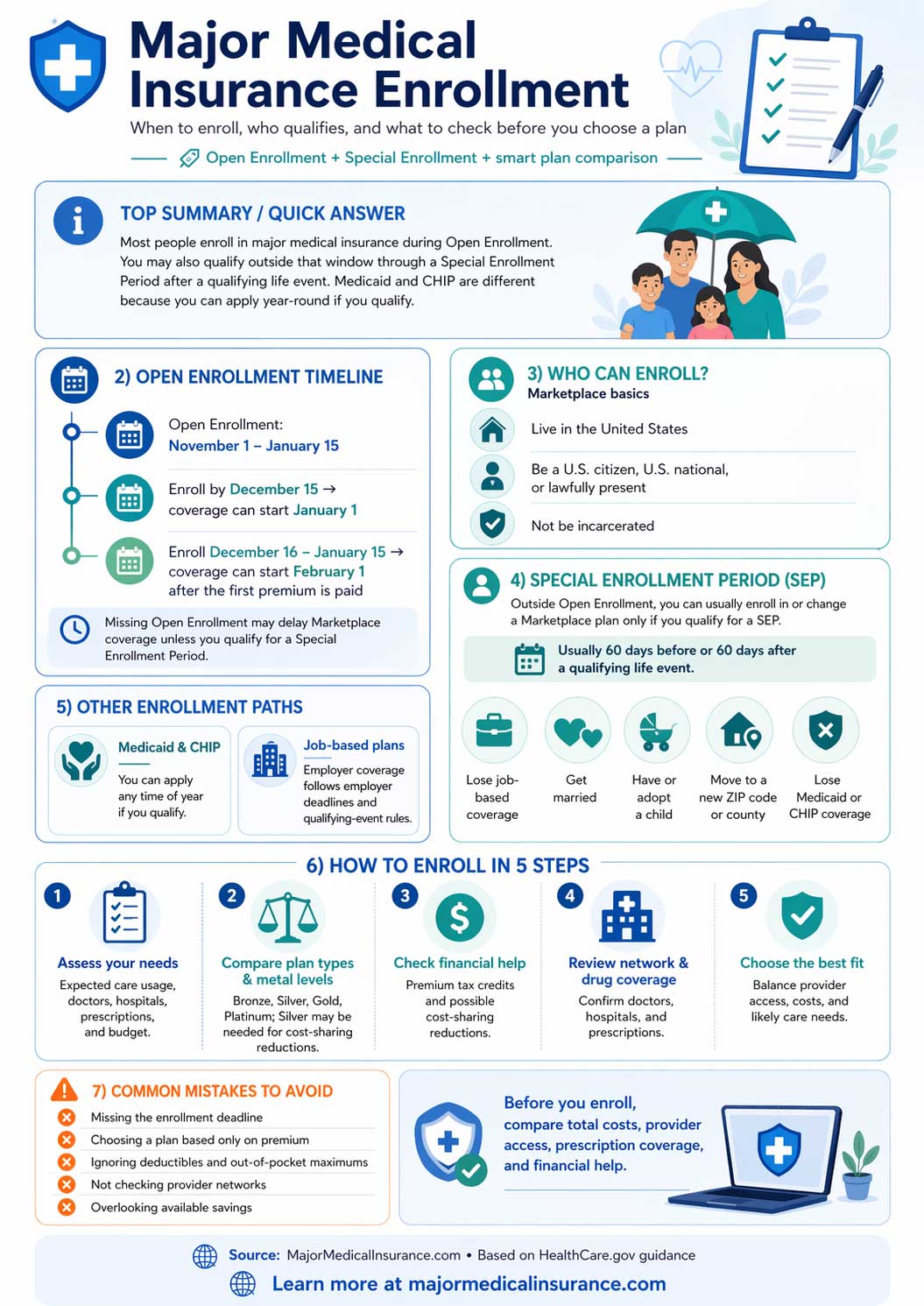
    Most people enroll in major medical insurance during Open Enrollment, but you may also qualify outside that window through a Special Enrollment Period after a qualifying life event. Medicaid and CHIP are different because you can apply for them any time of year if you qualify.[1][2]

    Understanding Major Medical Insurance

    Major medical insurance is comprehensive coverage designed to help pay for serious medical needs, hospital care, preventive services, prescription drugs, and other essential healthcare expenses. Enrollment matters because even a strong plan only works if you enroll at the right time and choose coverage that actually fits your health needs and budget.

    Who Can Enroll in Marketplace Coverage?

    HealthCare.gov says that, in general, to enroll in Marketplace coverage you must live in the United States, be a U.S. citizen or national or be lawfully present, and not be incarcerated.[1] If you are trying to sort out where you fit, it also helps to review major medical insurance eligibility before you compare plans.

    Open Enrollment Period

    The annual Open Enrollment Period is when most people can enroll in, renew, or change a Marketplace health plan. On HealthCare.gov, Open Enrollment starts November 1 and ends January 15. If you enroll by December 15, coverage can start January 1. If you enroll between December 16 and January 15, coverage can start February 1 after the first premium is paid.[1]

    Why timing matters

    Missing Open Enrollment can delay Marketplace coverage unless you qualify for a Special Enrollment Period. That is why enrollment timing is just as important as plan choice.

    Major medical insurance enrollment infographic showing open enrollment dates, special enrollment events, eligibility rules, and steps to choose a health plan

    Special Enrollment Period

    Outside Open Enrollment, you can usually enroll in or change a Marketplace plan only if you qualify for a Special Enrollment Period. HealthCare.gov says SEP timing usually gives you 60 days before or 60 days after the qualifying event, depending on the type of SEP.[2]

    Common qualifying life events include losing job-based coverage, getting married, having or adopting a child, moving to a new ZIP code or county, losing Medicaid or CHIP coverage, or certain other household and coverage changes.[2]

    Medicaid, CHIP, and Job-Based Enrollment

    Medicaid and the Children’s Health Insurance Program are different from Marketplace Open Enrollment. HealthCare.gov says you can apply for Medicaid and CHIP any time of year, and if you qualify, coverage can start without waiting for the yearly Open Enrollment window.[2]

    Job-based plans work on their own employer timelines. Marketplace deadlines do not automatically control employer plan enrollment, so employees should always check with their employer or benefits administrator for plan deadlines and qualifying-event rules.[1]

    How to Enroll in Major Medical Insurance

    Step 1: Assess Your Coverage Needs

    Before choosing a plan, look at your expected healthcare usage, preferred doctors and hospitals, prescription drug needs, and how much you can realistically handle in premiums, deductibles, and out-of-pocket costs.

    Step 2: Compare Plan Types and Categories

    When reviewing major medical insurance plans, compare both network structure and metal category. Bronze plans usually have lower premiums and higher out-of-pocket costs. Silver plans usually sit in the middle. Gold and Platinum generally have higher premiums and lower out-of-pocket costs. HealthCare.gov also explains that if you qualify for extra savings called cost-sharing reductions, you must choose a Silver plan to use them.[3]

    Step 3: Check Financial Help

    Many people qualify for premium tax credits that reduce monthly premium costs. Some also qualify for cost-sharing reductions that lower deductibles, copayments, and coinsurance. If you are comparing individual coverage, our Obamacare / ACA page can help you understand how these Marketplace savings fit into the bigger picture.[3]

    Step 4: Review Network and Drug Coverage

    Before enrolling, make sure your doctors, hospitals, and prescriptions are handled the way you expect. A lower-premium plan can still become expensive if your providers are out of network or your medications fall into costly tiers.[4]

    Step 5: Finalize the Best Fit

    If you are buying your own policy, compare your options carefully and choose the plan that matches your likely care needs, provider access, and budget. For more on shopping this market, see major medical insurance for individuals.

    Common Enrollment Mistakes to Avoid

    • Missing the enrollment deadline and creating a coverage gap
    • Choosing a plan based only on premium
    • Ignoring deductibles and out-of-pocket maximums
    • Failing to check whether your doctors and hospitals are in-network
    • Overlooking available premium tax credits or Silver-plan extra savings

    Bottom Line

    Major medical insurance enrollment is not just about signing up for any plan before the deadline. It is about enrolling at the right time, understanding whether you qualify for Open Enrollment or a Special Enrollment Period, checking whether Medicaid or CHIP might apply, and comparing plan categories, provider networks, and financial help carefully. A little attention at enrollment can make a big difference in both coverage quality and total cost.

    References

    1. HealthCare.gov, Tips about the Health Insurance Marketplace®, Are you eligible to use the Marketplace?, and When can you get health insurance?.
      https://www.healthcare.gov/quick-guide/one-page-guide-to-the-marketplace/ |
      https://www.healthcare.gov/quick-guide/eligibility/ |
      https://www.healthcare.gov/quick-guide/dates-and-deadlines/
    2. HealthCare.gov, Special Enrollment Period and Medicaid & CHIP coverage.
      https://www.healthcare.gov/coverage-outside-open-enrollment/special-enrollment-period/ |
      https://www.healthcare.gov/medicaid-chip/
    3. HealthCare.gov, How to Save Money on Monthly Health Insurance Premiums, Cost-sharing reductions, and Health plan categories: Bronze, Silver, Gold & Platinum.
      https://www.healthcare.gov/lower-costs/save-on-monthly-premiums/ |
      https://www.healthcare.gov/lower-costs/save-on-out-of-pocket-costs/ |
      https://www.healthcare.gov/choose-a-plan/plans-categories/
    4. HealthCare.gov, 3 things to know before you pick a health insurance plan.
      https://www.healthcare.gov/choose-a-plan/comparing-plans/