Author: admin

  • Major Medical Insurance For Cancer Survivors

    By MajorMedicalInsurance.com Editorial Team
    Published on · Updated on

    Cancer survivorship often means more than one doctor visit a year. It can involve follow-up oncology appointments, prescription drugs, imaging, lab work, preventive screenings, mental health support, and protection against a possible recurrence or a new diagnosis. That is why major medical insurance matters so much for cancer survivors: the goal is not just to have coverage, but to have coverage that still works when care becomes expensive and ongoing.

    Quick Answer

    For most cancer survivors, the most important insurance protections are coverage for pre-existing conditions, access to comprehensive medical benefits, strong prescription drug coverage, in-network access to the doctors and facilities you actually use, and a manageable out-of-pocket maximum. The best plan is usually not the one with the lowest premium. It is the one that gives you the best balance of provider access, drug coverage, and financial protection.

    Cancer survivor reviewing health insurance or medical coverage options with a healthcare professional in a bright consultation office

    Why Major Medical Coverage Matters After Cancer

    The Affordable Care Act changed the insurance landscape for cancer survivors. Marketplace plans must cover treatment for pre-existing conditions, and insurers cannot reject you, charge you more, or refuse to pay for essential health benefits because of a condition you had before coverage started. For a more detailed breakdown, see pre-existing conditions and major medical insurance.[1] That is one of the biggest reasons major medical coverage is different from temporary or limited-benefit products.

    Marketplace plans must also cover the 10 essential health benefit categories. These include hospitalization, outpatient care, emergency services, prescription drugs, laboratory services, mental health and substance use treatment, rehabilitative services, and preventive care.[2] For survivors, that broader structure matters because cancer-related costs are rarely limited to one type of service.

    What Survivors Often Need Why It Matters What to Check
    Oncology specialists and hospital access Cancer care is often tied to specific doctors, systems, or centers Provider directory and network rules
    Prescription drug coverage Oral oncology drugs and supportive medications can be expensive Formulary, tiers, prior rules, and specialty cost-sharing
    Imaging, labs, and follow-up visits Survivorship care often means ongoing monitoring Deductible, copays, and coinsurance
    Financial protection Major treatment costs can escalate quickly Annual out-of-pocket maximum

    For a broader foundation, you can also compare major medical health insurance and what major medical insurance covers.

    The Main Coverage Paths Cancer Survivors Usually Compare

    Marketplace or Other Individual Coverage

    If you are buying your own insurance, ACA-compliant Marketplace coverage is usually the most important place to start because of the pre-existing-condition protections and essential health benefits described above.[1][2] This is often the most relevant path for people between jobs, self-employed survivors, or those who do not have access to job-based coverage.

    Employer Coverage and COBRA

    If you already have good job-based coverage and then lose your job or work hours, COBRA may let you keep that same group health coverage temporarily. The U.S. Department of Labor says COBRA generally lasts 18 to 36 months depending on the qualifying event, but the plan may require you to pay the full premium plus up to a 2% administrative fee.[3]

    Why COBRA can still matter

    For a survivor who is already in active follow-up care, COBRA may help preserve continuity with the same doctors, facilities, and drug coverage. The tradeoff is cost, because employer contributions often end and the full premium shifts to you.[3]

    Medicare

    Medicare can be relevant if you are 65 or older or qualify through disability. Medicare covers many medically necessary cancer-related services, including chemotherapy and radiation treatment in the appropriate outpatient or inpatient settings.[4] If that is your situation, it often makes more sense to compare Medicare separately instead of trying to force every decision into the individual-market framework.

    What Cancer Survivors Should Check Before Choosing a Plan

    For cancer survivors, plan documents are not optional. They are often the difference between a plan that looks good on paper and one that actually works in practice. Before enrolling, it is worth checking:

    Use this checklist before you enroll

    • Are your oncologists, surgeons, hospitals, and imaging centers in-network?
    • Are your current drugs on the formulary, and on what tier?
    • What is the deductible?
    • What is the annual out-of-pocket maximum?
    • How does the plan handle specialist visits, imaging, infusion, and outpatient hospital care?
    • Do you want a lower-cost HMO or a broader-access PPO?

    If you are still comparing network styles, medical plans HMO vs PPO are a useful next read.

    Cost Protection Still Matters After Treatment

    Major medical coverage is not just about access. It is about cost exposure. For many survivors, the right question is not “Will this plan pay for something?” but “How much could I still owe in a heavy-care year?” That is why deductible, coinsurance, and especially the annual out-of-pocket maximum matter so much.

    HealthCare.gov says the out-of-pocket limit applies to covered in-network care. This is one of the most important protections in major medical coverage because it gives you a ceiling on what you may have to spend in a plan year for covered in-network services.[5]

    Bottom Line

    For cancer survivors, major medical insurance should be judged by what it does after the diagnosis, not just by the premium. The strongest plans usually combine pre-existing-condition protection, broad medical benefits, strong prescription coverage, survivorship-friendly provider access, and a manageable out-of-pocket ceiling.

    References

    1. HealthCare.gov, Marketplace health plans cover pre-existing conditions.
      https://www.healthcare.gov/coverage/pre-existing-conditions/
    2. HealthCare.gov, What Marketplace health insurance plans cover.
      https://www.healthcare.gov/coverage/what-marketplace-plans-cover/
    3. U.S. Department of Labor, COBRA Continuation Coverage.
      https://www.dol.gov/agencies/ebsa/laws-and-regulations/laws/cobra
    4. Medicare.gov, Medicare Coverage of Cancer Treatment Services.
      https://www.medicare.gov/publications/11931-medicare-coverage-of-cancer-treatment-services.pdf
    5. HealthCare.gov, Out-of-pocket maximum/limit.
      https://www.healthcare.gov/glossary/out-of-pocket-maximum-limit/
  • Medical Plans: HMO Vs PPO On The Health Insurance Exam

    By MajorMedicalInsurance.com Editorial Team
    Published on · Updated on

    Choosing between an HMO and a PPO is one of the most important steps in picking a health plan. Both can be part of comprehensive major medical health insurance, but they work differently when it comes to provider access, referrals, out-of-network care, and total cost.

    Quick Answer

    In general, an HMO is usually more restrictive but often lower-cost, while a PPO usually offers more freedom to choose providers but often costs more. The best choice depends on whether you value lower premiums and coordinated care or broader provider access and fewer referral rules.

    What an HMO and a PPO Actually Mean

    An HMO is a Health Maintenance Organization. HealthCare.gov says HMOs usually limit coverage to care from doctors who work for or contract with the HMO, and they generally do not cover out-of-network care except in an emergency. HMOs often provide integrated care and focus on prevention and wellness.[1]

    A PPO is a Preferred Provider Organization. HealthCare.gov says PPOs contract with a network of providers but usually let you use doctors, hospitals, and specialists outside the network too, usually at a higher cost. PPOs generally do not require referrals to see specialists.[1]

    This is why HMO vs PPO is not really about which one is “better” in the abstract. It is about which tradeoff fits your real life. If you are still comparing the larger structure of coverage, you may also want to review major medical insurance plans and major medical insurance PPOs.

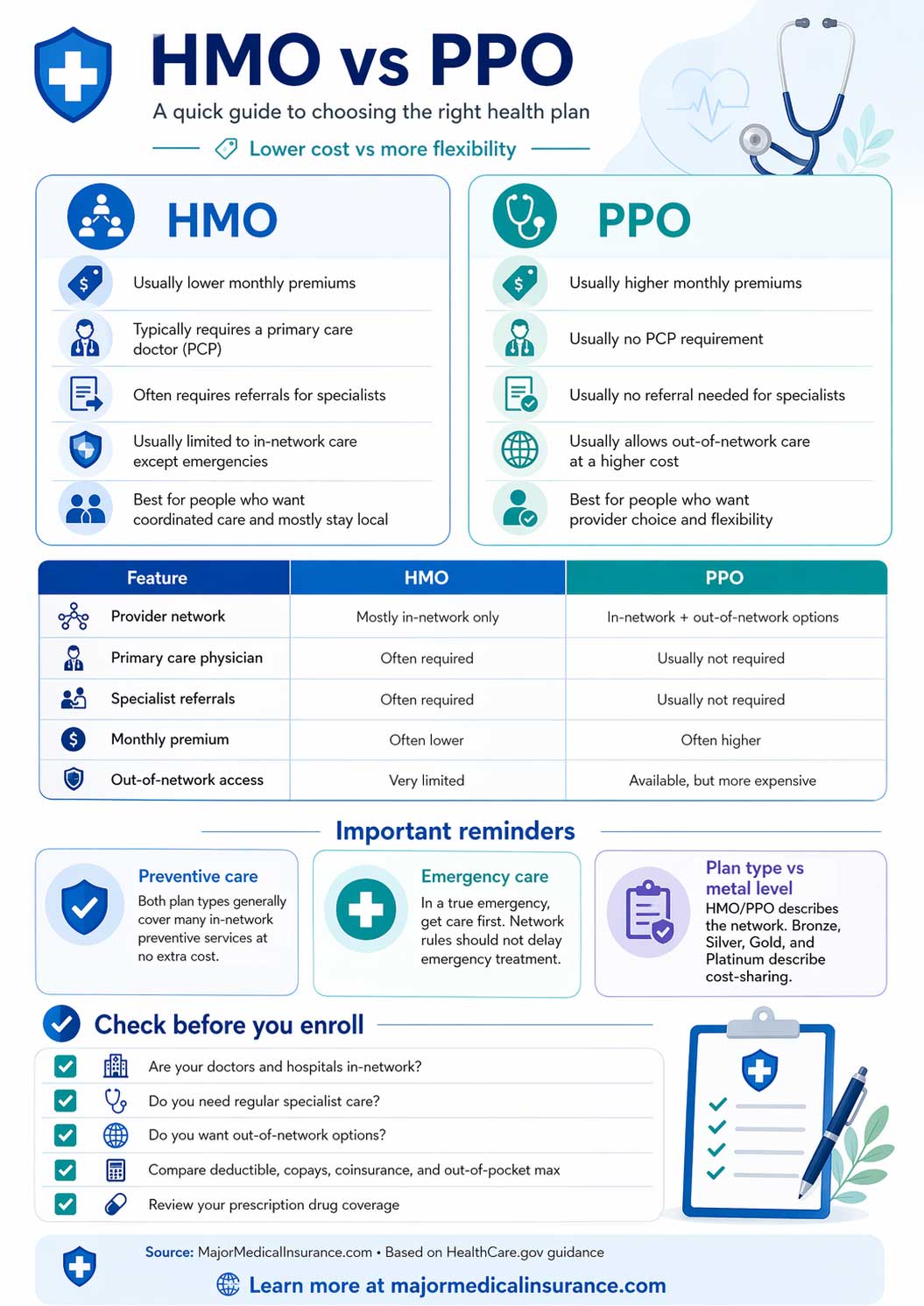
    HMO vs PPO infographic comparing provider networks, referrals, costs, out-of-network coverage, and key health plan differences

    HMO vs PPO at a Glance

    Feature HMO PPO
    Provider network Usually limited to in-network care except emergencies Uses a preferred network but usually allows out-of-network care at higher cost
    Primary care physician Often required Usually not required
    Specialist referrals Often required Usually not required
    Monthly premium Often lower Often higher
    Out-of-network access Very limited in non-emergency situations Usually available, but more expensive

    Why HMOs Often Cost Less

    HMOs often appeal to people who want a lower monthly premium and more coordinated care. Because the network is narrower and referrals are commonly part of the plan structure, HMOs can be easier for insurers to manage and often cost less than more flexible designs. That lower premium can be attractive for families and individuals who usually use local in-network care and do not mind working through a primary care doctor.

    An HMO may fit you better if:

    • You want lower monthly premiums
    • You are comfortable choosing a primary care doctor
    • You usually stay local for care
    • You do not expect to need many out-of-network specialists
    • You like a more coordinated, managed-care structure

    Why PPOs Often Cost More

    PPOs usually cost more because they give you more freedom. You can often see specialists without a referral, and you usually have some coverage outside the network, although it will generally cost more than staying in network. That flexibility can be valuable for people with complex care needs, those who travel often, or those who want access to a broader provider pool.

    A PPO may fit you better if:

    • You want broader provider choice
    • You do not want referrals for specialists
    • You have doctors or facilities outside one narrow network
    • You travel often or split time between locations
    • You are willing to pay more for flexibility

    How Preventive Care Fits In

    One thing HMO and PPO shoppers sometimes miss is that preventive care rules do not depend only on the network type. HealthCare.gov says preventive services are generally covered at no cost to you when provided by an in-network medical provider, and in many cases you do not pay copayments or coinsurance for certain preventive services even if you have not met your deductible. Coverage can vary by situation, so “free” should not be treated as universal for every service, but preventive care is still an important benefit in both HMO and PPO major medical plans.[2]

    If virtual care matters to you, it is also worth checking whether your plan includes useful telemedicine access, since that can affect convenience as much as network type does.

    Emergency Care Is Different

    Emergency care is one of the biggest areas where people misunderstand network rules. HealthCare.gov says insurers cannot require prior approval before you get emergency room services from a provider or hospital outside your plan’s network.[3] CMS also says the No Surprises Act bans surprise bills for most emergency services and bans out-of-network cost-sharing for most emergency and some non-emergency services, meaning you generally cannot be charged more than in-network cost-sharing for those protected situations.[3]

    Important emergency rule

    In a true emergency, go get care. Do not delay emergency treatment because you are trying to sort out whether the hospital is in-network first.

    HMO vs PPO Is Separate From Bronze, Silver, Gold, and Platinum

    Another common confusion is mixing up network type with plan category. HMO and PPO describe how the network works. Bronze, Silver, Gold, and Platinum describe how you and the plan split costs. HealthCare.gov treats these as separate parts of the decision, which is why someone can compare plan type and plan category at the same time.[4]

    That means you are not choosing between “HMO or Silver.” You might be choosing between something like a Silver HMO and a Gold PPO. That difference can matter a lot when comparing total cost and provider flexibility.

    How to Compare HMO and PPO Plans the Smart Way

    HealthCare.gov recommends comparing total costs, plan documents, provider networks, and covered prescription drugs when choosing a plan. That is especially important for HMO vs PPO decisions, because the wrong network setup can make a plan look cheaper than it really is for your situation.[5]

    Check these before enrolling

    • Whether your doctors and hospitals are in-network
    • Whether you are comfortable using a primary care doctor as a gatekeeper
    • Whether you need regular specialist care
    • Whether you want any out-of-network option
    • The deductible, copays, coinsurance, and out-of-pocket maximum
    • Your prescription drug formulary

    If you are comparing major medical options more broadly, major medical insurance benefits can help you connect the plan structure to real-world coverage value.

    Bottom Line

    An HMO often works best for people who want lower premiums, local in-network care, and a coordinated system built around a primary care doctor. A PPO often works best for people who want more provider freedom, fewer referral barriers, and some out-of-network access even if it costs more. The right choice depends less on which label sounds better and more on how you actually use healthcare.

    References

    1. HealthCare.gov, Health insurance plan & network types: HMOs, PPOs, and more.
      https://www.healthcare.gov/choose-a-plan/plan-types/
    2. HealthCare.gov, Preventive health services.
      https://www.healthcare.gov/coverage/preventive-care-benefits/
    3. HealthCare.gov, Getting emergency care; CMS, No Surprises: Understand your rights against surprise medical bills.
      https://www.healthcare.gov/using-marketplace-coverage/getting-emergency-care/ |
      https://www.cms.gov/newsroom/fact-sheets/no-surprises-understand-your-rights-against-surprise-medical-bills
    4. HealthCare.gov, Health plan categories: Bronze, Silver, Gold & Platinum.
      https://www.healthcare.gov/choose-a-plan/plans-categories/
    5. HealthCare.gov, 3 things to know before you pick a health insurance plan.
      https://www.healthcare.gov/choose-a-plan/comparing-plans/
  • Major Medical Insurance Requirements

    Major Medical Insurance Requirements

    By MajorMedicalInsurance.com Editorial Team

    Published on

    Updated on

    When people search for major medical insurance requirements, they are usually trying to answer two different questions at once. First, they want to know what a real comprehensive health plan is supposed to include. Second, they want to know what they personally need in order to enroll. Both matter, especially if you are comparing Marketplace coverage, employer coverage, and other health-related products that may look similar on the surface but work very differently in practice.

    If you are starting from the basics, review our guides to major medical health insurance and what major medical insurance covers. If your focus is ACA rules specifically, our Obama Care ACA page is the best companion piece to this article.

    Quick Answer

    A legitimate comprehensive major medical plan generally needs to provide broad health coverage, include the essential health benefits required of Marketplace plans, cover treatment for pre-existing conditions, and follow federal limits on cost-sharing. From the consumer side, you usually enroll during Open Enrollment or after a qualifying life event that unlocks a Special Enrollment Period.

    What “Major Medical Insurance Requirements” Usually Means

    In everyday use, this phrase often refers to the rules that separate comprehensive health insurance from narrower products. A qualified health plan sold through the Marketplace must provide essential health benefits, follow established cost-sharing limits, and meet other Affordable Care Act requirements.[4] That makes it very different from products that only pay fixed cash benefits or are designed mainly for temporary gaps in coverage.

    That distinction matters because many shoppers are not really asking for a technical legal definition. They are trying to avoid buying the wrong type of plan. A policy that sounds affordable may still fail to provide the kind of broad coverage most people expect from major medical insurance.

    The Core Coverage Requirements

    Marketplace major medical plans must cover ten categories of essential health benefits. These include hospitalization, emergency services, outpatient care, prescription drugs, maternity and newborn care, mental health and substance use treatment, laboratory services, rehabilitative services, preventive and wellness services, and pediatric services.[1]

    Hospital & Emergency Care

    Major medical coverage is designed to help with expensive care like emergency treatment, hospitalization, and surgery rather than only routine services.

    Doctor Visits & Outpatient Care

    Plans generally include physician visits, specialist care, outpatient procedures, diagnostic testing, and lab work.

    Prescription & Mental Health Benefits

    Prescription drugs and behavioral health treatment are not optional extras in Marketplace major medical coverage.

    Preventive Care

    Many preventive services are covered with no cost-sharing when you use an in-network provider.[3]

    This is one reason major medical coverage remains the benchmark for people who want dependable year-round protection. It is built to handle both everyday care and major medical events. If you want a deeper explanation of benefit categories, use this detailed coverage guide as your next step.

    Pre-Existing Condition Requirements

    One of the most important ACA protections is that Marketplace plans must cover treatment for pre-existing conditions. A compliant plan cannot reject you, charge you more, or refuse to pay for essential health benefits because of a condition you had before your coverage began.[2]

    Why this requirement matters

    • It protects people with ongoing medical needs from being screened out of real coverage.
    • It keeps major medical insurance usable for long-term healthcare planning, not just for healthy applicants.
    • It is one of the clearest lines between ACA-compliant major medical plans and weaker alternatives.

    Cost-Sharing and Financial Protection Requirements

    A qualified major medical plan is not just about what it covers. It also needs to follow rules on cost-sharing. That includes deductibles, copays, coinsurance, and annual out-of-pocket maximums. Marketplace plans must follow established federal limits, which is part of what makes them real comprehensive coverage instead of an undefined private arrangement.[9] [10] [11] [12]

    For the 2025 plan year, the Marketplace out-of-pocket limit cannot be more than $9,200 for an individual and $18,400 for a family. For the 2026 plan year, that limit rises to $10,600 for an individual and $21,200 for a family.[12] Those numbers matter because they define the upper edge of your in-network cost-sharing exposure under a compliant plan.

    Cost Feature What It Means Why It Matters
    Deductible The amount you usually pay before the plan starts paying for many covered services. A lower deductible often means a higher monthly premium.
    Copay A fixed dollar amount for certain covered services. Useful for budgeting predictable day-to-day care.
    Coinsurance Your percentage share of covered costs after the deductible in many cases. Affects how expensive specialist care, imaging, or hospital treatment can feel before you hit the cap.
    Out-of-Pocket Maximum The yearly limit on covered in-network cost-sharing under the plan rules. This is a major part of the financial protection major medical plans provide.

    Enrollment Requirements

    Most people do not need to prove a medical condition to buy major medical coverage. The bigger requirement is timing. For Marketplace coverage, you generally enroll during Open Enrollment or after a qualifying life event that gives you access to a Special Enrollment Period.[6]

    Common qualifying life events include losing other health coverage, moving, getting married, having a baby, or adopting a child. HealthCare.gov notes that Special Enrollment access is based on specific circumstances, and in some cases you may need to submit documents to confirm eligibility.

    Enrollment checklist

    • Check whether Open Enrollment is currently active.
    • If not, confirm whether you have a qualifying life event.
    • Compare available plans by network type, metal level, total cost, and drug coverage.
    • Review whether your preferred doctors, hospitals, and pharmacies are in-network.

    Network Requirements and Plan Types

    Another part of choosing the right plan is understanding how the network works. Major medical coverage can be sold in HMO, PPO, EPO, and POS structures.[5] Those plan types affect your provider flexibility, referral requirements, and how much you may pay for out-of-network care.

    If broad access matters to you, compare network size carefully and use our top provider guide to compare insurers before you enroll. The best-looking premium is not always the best value if the network does not fit how and where you receive care.

    What Does Not Automatically Meet Major Medical Requirements

    Some products can still help in the right situation, but they are not the same thing as comprehensive primary coverage. Temporary policies, fixed indemnity products, and other supplements may have a role, but they should be understood as separate from the core requirements of major medical insurance.[7] [8]

    Coverage Type What It Does How To Use It
    Short-Term Medical Designed mainly for temporary gaps in coverage and subject to different rules from Marketplace major medical plans. Treat as a short-gap tool, not a simple substitute for comprehensive coverage.
    Hospital Indemnity Usually pays fixed cash benefits for covered events rather than functioning like full health insurance. Best understood as a supplement layered on top of other coverage.
    Supplemental Coverage Can help with selected gaps or cash-flow support but does not replace a broad primary health plan. Use to complement major medical, not to redefine it.
    Medicare Advantage A private-plan option for people who already have Medicare. Relevant for Medicare-eligible shoppers, not a general replacement for everyone else.

    FAQ

    Does major medical insurance have to follow the ACA?

    Marketplace major medical plans follow Affordable Care Act requirements, including essential health benefits, pre-existing condition protections, and cost-sharing limits. That is a big part of what makes them real comprehensive coverage.

    Do I need to be healthy to qualify?

    No. Marketplace plans cannot reject you or charge you more because of a pre-existing condition.

    Can I enroll any time of year?

    Usually no. Most people enroll during Open Enrollment unless they qualify for a Special Enrollment Period triggered by a qualifying life event.

    Is short-term coverage the same thing as major medical?

    No. Short-term coverage follows different rules and should be evaluated separately rather than treated as an automatic substitute for comprehensive major medical insurance.

    Still comparing your options?

    Use this page to understand the requirements first, then compare coverage details, provider networks, and related products before enrolling. You can review what major medical covers, compare top providers, visit our About page, or contact us.

    Compare Providers
    Review Major Medical Basics

    References

    1. HealthCare.gov — What Marketplace Plans Cover
    2. HealthCare.gov — Coverage for Pre-Existing Conditions
    3. HealthCare.gov — Preventive Health Services
    4. HealthCare.gov — Qualified Health Plan
    5. HealthCare.gov — Health Insurance Plan & Network Types
    6. HealthCare.gov — Special Enrollment Period
    7. CMS — Short-Term Limited-Duration Insurance and Fixed Indemnity Coverage
    8. Medicare.gov — Medicare Advantage and Other Health Plans
    9. HealthCare.gov — Your Total Costs for Health Care
    10. HealthCare.gov — Deductible
    11. HealthCare.gov — Coinsurance
    12. HealthCare.gov — Out-of-Pocket Maximum/Limit

    About the Author

    MajorMedicalInsurance.com Editorial Team

    This article was reviewed and updated using current federal health coverage resources and was written for readers comparing comprehensive U.S. health insurance options. It is intended for general educational purposes and should not replace official plan documents, Marketplace materials, or licensed advice tailored to your state, eligibility, and medical needs.

  • Major Medical Insurance Cost

    By MajorMedicalInsurance.com Editorial Team
    Published on · Updated on

    Major medical insurance cost is not just one number. The real cost of coverage includes your monthly premium, deductible, copays, coinsurance, and the most you could spend in a bad medical year. That is why a plan with a lower premium is not always the cheaper plan overall.

    Quick Answer

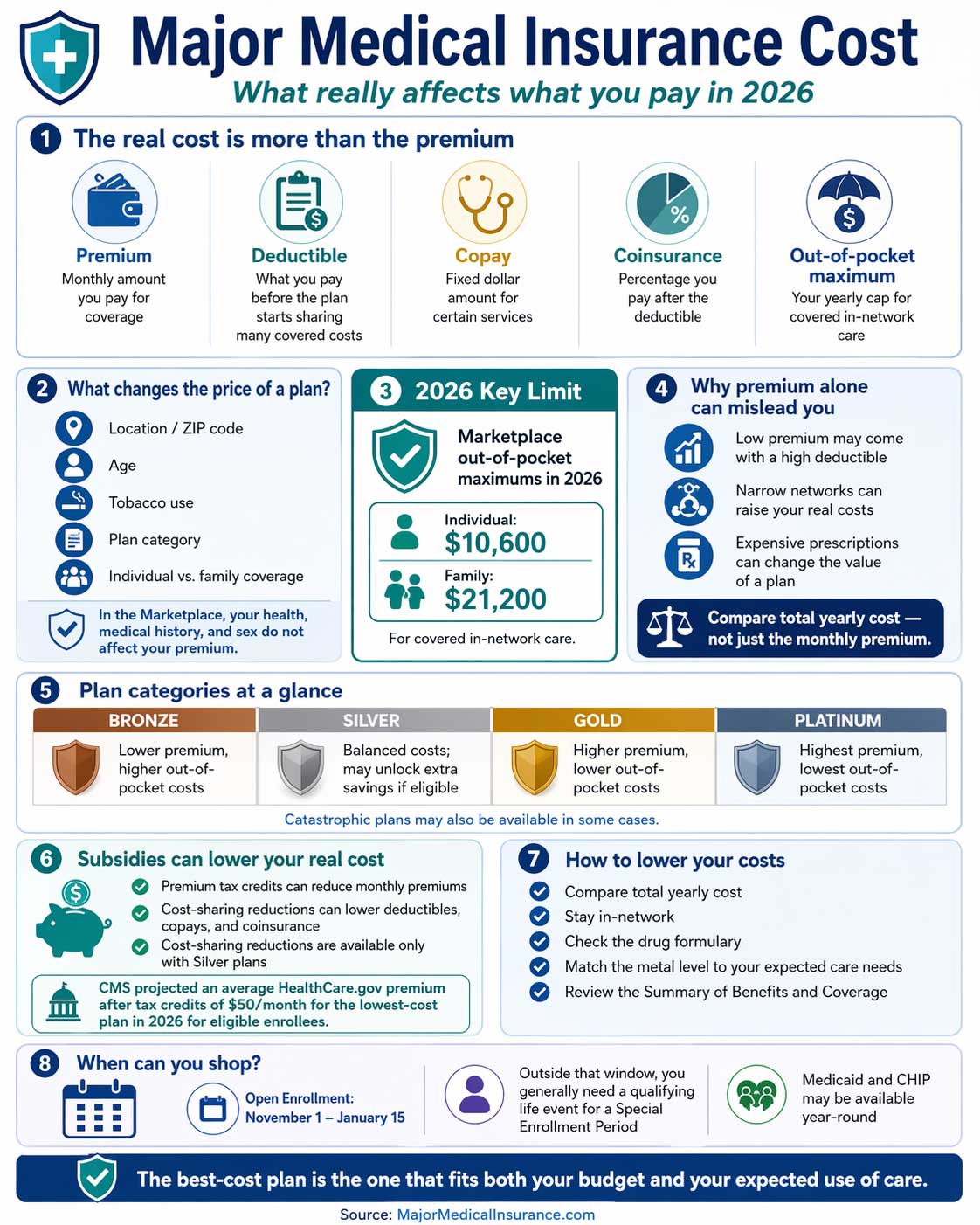
    The cost of major medical insurance depends on where you live, your age, whether you use tobacco, the plan category you choose, and how many people are covered. A smart comparison looks at total yearly cost, not just the monthly premium. For 2026, the out-of-pocket limit for a Marketplace plan cannot exceed $10,600 for an individual or $21,200 for a family for covered in-network care.[1][2]

    What Makes Up the Cost of Major Medical Insurance?

    Your total cost for health care is usually a mix of premium, deductible, copayments, coinsurance, and other out-of-pocket costs. That means a quote should never be judged on premium alone.[1] If you want a broader overview first, see major medical health insurance and what major medical insurance covers.

    Cost Part What It Means Why It Matters
    Premium The monthly amount you pay for coverage You pay it whether or not you use care
    Deductible What you pay before the plan starts sharing many covered costs Higher deductibles often come with lower premiums
    Copay A set amount for certain services Often applies to office visits, urgent care, or prescriptions
    Coinsurance A percentage you pay after the deductible Important for hospital, imaging, and specialist costs
    Out-of-pocket maximum The most you pay in a year for covered in-network care A key financial protection feature[1]

    What Changes the Price of a Plan?

    Marketplace premiums are not random. Five factors can affect a plan’s monthly premium: your location, age, tobacco use, plan category, and whether the plan covers dependents. Your health, medical history, and sex cannot affect your premium in the Marketplace.[2]

    The biggest pricing drivers

    • ZIP code and rating area
    • Age
    • Tobacco use
    • Whether you choose Bronze, Silver, Gold, Platinum, or Catastrophic
    • Whether you are buying coverage for yourself only or for a family

    That is one reason national “average premium” claims can be misleading. A price that sounds low in one area may be irrelevant somewhere else, and two people in different age brackets may see very different premiums even for the same plan structure.

    Why Premium Alone Can Mislead You

    Shoppers should look at total costs, not just the monthly premium. A plan with a low premium can still end up costing more if the deductible is high, the network is narrow, or your prescriptions fall into expensive tiers.[1][5]

    A simple way to think about cost

    A low premium is good only if the rest of the plan still fits your real life. If you use specialists, expensive prescriptions, frequent labs, or ongoing treatment, a higher-premium plan may still be the better value because it lowers what you pay when you actually need care.

    Infographic explaining major medical insurance cost in 2026, including premiums, deductibles, copays, coinsurance, out-of-pocket maximums, plan categories, subsidies, and cost-saving tips.

    How the Deductible Affects Your Real Cost

    Your deductible is the amount you generally pay for covered services before the plan starts sharing more of the cost. In practical terms, a higher deductible usually lowers the monthly premium, but it also means you may have to pay more out of pocket before the plan becomes more helpful.[1]

    That tradeoff matters most when you actually expect to use care. Someone who mainly wants protection for major events may accept a higher deductible to keep premiums lower. Someone with regular specialist visits, imaging, or ongoing treatment may prefer a lower deductible even if the premium is higher, because the plan starts sharing costs sooner.

    Why the deductible matters

    • A high deductible can make a low-premium plan feel more expensive when you need care
    • A lower deductible can reduce upfront medical spending during the year
    • The best choice depends on how often you expect to use covered services

    Copay vs. Coinsurance: What Is the Difference?

    Copays and coinsurance are both forms of cost-sharing, but they work differently. A copay is usually a fixed dollar amount for a service, while coinsurance is a percentage of the allowed cost after the deductible is met for services where coinsurance applies.[1]

    Cost Type How It Works Example
    Copay A fixed amount for certain services $30 for a primary care visit
    Coinsurance A percentage of the covered cost you pay 20% of an imaging or hospital bill after the deductible

    This difference can change your risk. Copays are easier to predict because the amount is set in advance. Coinsurance can be harder to estimate because the dollar amount depends on the cost of the service itself. That is one reason shoppers should review the Summary of Benefits and Coverage instead of assuming that all cost-sharing works the same way from plan to plan.[5]

    Simple rule

    Copay means a set amount. Coinsurance means a percentage. If you expect expensive care, coinsurance can have a bigger effect on your total yearly spending than many people realize.

    What the Out-of-Pocket Maximum Really Protects You From

    The out-of-pocket maximum is the most you pay in a plan year for covered in-network services before the plan pays 100% of covered costs for the rest of that year. This limit is one of the most important protections in a major medical policy because it places a ceiling on covered in-network medical spending.[1]

    That does not mean every medical expense automatically counts toward that limit. Premiums do not count, and out-of-network care or non-covered services may not count either. That is why two plans with similar premiums can still create very different worst-case financial exposure.

    Why this number matters so much

    The out-of-pocket maximum helps define the most you could owe for covered in-network care in a bad medical year. When you compare plans, this number can matter almost as much as the premium because it helps show your maximum financial risk.

    A smart comparison looks at all three together: deductible, coinsurance, and out-of-pocket maximum. If you want a broader look at plan structure after that, our guide to major medical insurance plans can help you compare how different plan setups affect real-world cost.

    How Plan Category Changes Cost

    Bronze, Silver, Gold, and Platinum categories show how you and the plan share costs. These categories do not measure quality. In general, Bronze plans have lower monthly premiums and higher out-of-pocket costs, while Gold and Platinum plans usually have higher premiums and lower cost-sharing when you use care.[3]

    Plan Category Typical Premium Pattern Typical Cost-Sharing Pattern
    Bronze Lower monthly premium Higher out-of-pocket costs when you get care
    Silver Middle-ground premium Balanced cost-sharing, plus possible extra savings if eligible
    Gold Higher monthly premium Lower out-of-pocket costs
    Platinum Usually the highest premium Usually the lowest out-of-pocket costs

    If available in your area, Catastrophic plans are separate from the standard metal levels. For 2026, all Bronze and Catastrophic Marketplace plans are eligible to be used with Health Savings Accounts.[3] If provider flexibility matters to you, compare cost with plan structure too. Our guide to major medical insurance plans can help with that side of the decision.

    How Subsidies and Savings Change the Real Cost

    The sticker price is not always the price you actually pay. Some people qualify for premium tax credits that lower their monthly premium, and some also qualify for cost-sharing reductions that lower deductibles, copayments, and coinsurance. Cost-sharing reductions are available only if you enroll in a Silver plan.[4]

    CMS also reported that the average HealthCare.gov premium after tax credits is projected to be $50 per month for the lowest-cost plan in 2026 for eligible enrollees. That does not mean everyone will pay $50. It does mean subsidy eligibility can completely change what a plan really costs.[4]

    Cost rule that matters most

    A plan should be compared after any subsidy or cost-sharing help you qualify for, not before. That is especially important for people buying their own coverage.

    How to Lower Major Medical Insurance Costs

    • Compare total yearly cost, not just premium
    • Use in-network providers whenever possible
    • Check your drug formulary before enrolling
    • Review whether a Bronze, Silver, Gold, Platinum, or Catastrophic plan matches your expected usage
    • Use the Summary of Benefits and Coverage and compare plans side by side

    If you are still narrowing your choices, it also helps to compare Obamacare / ACA.

    When You Can Shop and Why Timing Matters

    Open Enrollment on HealthCare.gov runs from November 1 to January 15. Outside that window, you generally need a qualifying life event for a Special Enrollment Period, although Medicaid and CHIP can be available year-round.[5]

    Timing matters for cost because missing the right enrollment window can limit your options or delay coverage. If you have a life change, it is worth checking whether you qualify for a Special Enrollment Period instead of assuming you have to wait.

    Bottom Line

    The cost of major medical insurance is the total financial picture, not the premium alone. A smart comparison includes monthly premium, deductible, coinsurance, out-of-pocket maximum, provider network, and any savings you qualify for. The best-cost plan is the one that fits both your budget and your real expected use of care.

    References

    1. HealthCare.gov, Out-of-pocket maximum/limit and Your total costs for health care: Premium, deductible, and out-of-pocket costs.
      https://www.healthcare.gov/glossary/out-of-pocket-maximum-limit/ |
      https://www.healthcare.gov/choose-a-plan/your-total-costs/
    2. HealthCare.gov, How insurance companies set health premiums.
      https://www.healthcare.gov/how-plans-set-your-premiums/
    3. HealthCare.gov, Health plan categories: Bronze, Silver, Gold & Platinum and More plans now work with Health Savings Accounts.
      https://www.healthcare.gov/choose-a-plan/plans-categories/ |
      https://www.healthcare.gov/hsa-options/
    4. HealthCare.gov, How to save money on monthly health insurance premiums and Cost-sharing reductions; CMS, Plan Year 2026 Marketplace Plans and Prices Fact Sheet.
      https://www.healthcare.gov/lower-costs/save-on-monthly-premiums/ |
      https://www.healthcare.gov/lower-costs/save-on-out-of-pocket-costs/ |
      https://www.cms.gov/newsroom/fact-sheets/plan-year-2026-marketplace-plans-prices-fact-sheet
    5. HealthCare.gov, 3 things to know before you pick a health insurance plan and When can you get health insurance?.
      https://www.healthcare.gov/choose-a-plan/comparing-plans/ |
      https://www.healthcare.gov/quick-guide/dates-and-deadlines/
  • Major Medical Insurance Benefits

    By MajorMedicalInsurance.com Editorial Team
    Published on · Updated on

    Major medical insurance is designed to give people broad health coverage and meaningful financial protection when medical needs become expensive. In practical terms, the biggest benefits are not just hospital coverage. The real value is that a strong plan can help cover preventive care, doctor visits, prescriptions, mental health treatment, emergency care, surgery, and other medically necessary services while limiting how much you pay out of pocket in a plan year.

    Quick Answer

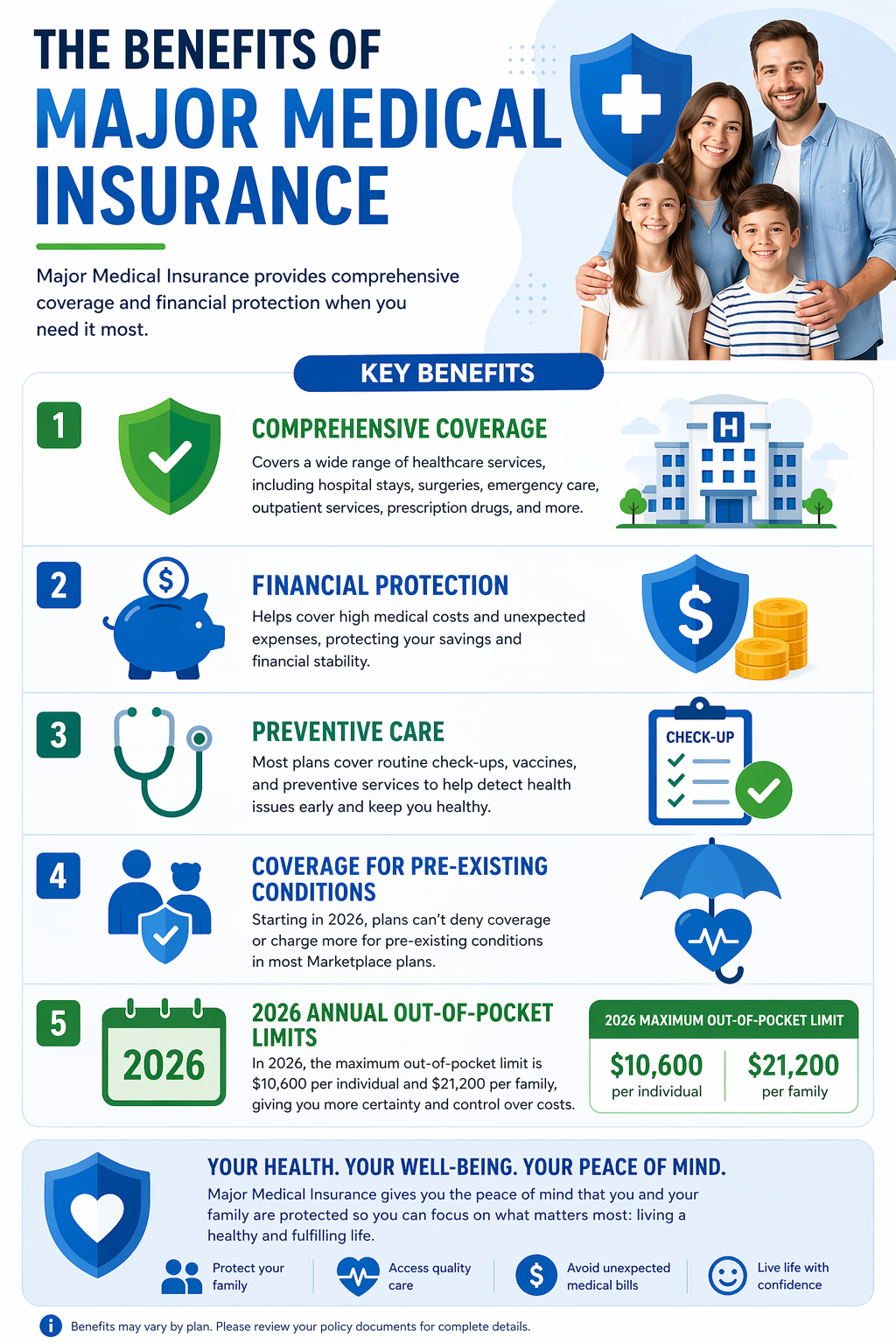
    The biggest benefits of major medical insurance are comprehensive coverage, protection against very high medical bills, coverage for pre-existing conditions, preventive care at no cost in-network, and access to essential health benefits like hospitalization, prescription drugs, mental health services, maternity care, and pediatric care. For 2026, Marketplace plans also have a maximum out-of-pocket limit of $10,600 for an individual and $21,200 for a family for covered in-network care.[1][2][3]

    What “Benefits” Really Means in Major Medical Insurance

    When people hear “benefits,” they often think only about what services a plan covers. But major medical insurance benefits are broader than that. A good plan offers two types of protection at the same time:

    • Medical protection: access to covered care when you need doctors, specialists, prescriptions, hospitalization, emergency treatment, or ongoing care.
    • Financial protection: limits on how much you may have to spend for covered in-network care in a plan year.

    That is why readers comparing major medical health insurance should not judge a plan by premium alone. The real benefit is the combination of covered services and financial safeguards.

    Key Benefits of Major Medical Insurance

    1. Broad Coverage for Essential Health Needs

    One of the biggest advantages of major medical insurance is that ACA-compliant Marketplace plans must cover the 10 essential health benefit categories. These include outpatient care, emergency services, hospitalization, pregnancy and newborn care, mental health and substance use treatment, prescription drugs, rehabilitative services, lab services, preventive and wellness services, and pediatric services.[2]

    This is what separates comprehensive coverage from narrow or temporary products. If you want a broader page on service scope, see what major medical insurance covers.

    2. Protection Against High Medical Bills

    Major medical insurance is built to protect against high-cost events such as surgery, serious illness, inpatient hospitalization, or emergency treatment. HealthCare.gov says that for the 2026 plan year, the out-of-pocket limit for a Marketplace plan cannot be more than $10,600 for an individual and $21,200 for a family for covered in-network care.[1]

    Benefit Why It Matters What to Remember
    Annual out-of-pocket cap Limits how much you spend on covered in-network care in a plan year Does not include premiums or every out-of-network charge
    Pre-existing condition protections Prevents denials or higher rates based on health history Coverage begins when the plan starts[4]
    Mental health and substance use benefits Extends comprehensive coverage beyond physical treatment alone Included within essential health benefits[4]

    3. Preventive Care at No Cost In-Network

    Another major benefit is preventive care. Most health plans must cover a set of preventive services at no cost to you, including Marketplace plans. In many cases, you do not pay a copayment or coinsurance for covered preventive services when provided by an in-network provider, even if you have not met your deductible yet.[3]

    Examples of preventive benefits

    • Routine screenings
    • Vaccinations and immunizations
    • Certain annual wellness visits
    • Some preventive care for adults, women, and children

    This is one reason comprehensive coverage is useful even for people who are relatively healthy. Preventive care is not just an extra. It is part of how major medical insurance supports earlier detection and better long-term cost control.

    4. Coverage for Pre-Existing Conditions

    For many consumers, one of the most important benefits is simple: pre-existing conditions are covered. All Marketplace plans must cover treatment for pre-existing medical conditions, and plans cannot reject you, charge you more, or refuse to pay for essential health benefits because of a condition you had before coverage started.[4]

    This is a core reason why major medical coverage is stronger than temporary or limited-benefit alternatives.

    5. Possible Extra Savings on Out-of-Pocket Costs

    Some major medical shoppers may get more than premium help. If you qualify for cost-sharing reductions, you can lower deductibles, copayments, coinsurance, and the out-of-pocket maximum, but those extra savings are available only if you choose a Silver plan.[5]

    Why this matters

    A plan with a higher premium is not always worse. If a Silver plan unlocks cost-sharing reductions, it may produce much better real-world value than a cheaper Bronze option for someone who expects to use care.

    Infographic showing the key benefits of major medical insurance, including comprehensive coverage, financial protection, preventive care, coverage for pre-existing conditions, and 2026 out-of-pocket limits.

    How Major Medical Insurance Benefits Compare With Other Coverage Types

    Many people compare major medical insurance with products that sound similar but work very differently. Major medical insurance is designed to combine broad benefits with financial protection. That is very different from a short-term plan meant mainly for temporary coverage gaps or a narrower cash-benefit product sold to cover only one type of event.

    That is why it helps to compare this page with short-term medical before assuming every health-related policy works the same way.

    How to Choose a Plan Based on Benefits, Not Hype

    The best benefit package is not always attached to the plan with the lowest premium or the strongest marketing language. Smart shoppers look at total costs, plan categories, provider network, and covered prescription drugs when comparing plans.[5]

    That means a strong comparison usually includes:

    • The deductible
    • The out-of-pocket maximum
    • Your doctor and hospital network
    • Your drug formulary
    • Whether PPO, HMO, EPO, or POS is a better fit
    • Whether services like telemedicine matter to you

    If you are still comparing structure and tradeoffs, major medical insurance plans is the best next page to read.

    Bottom Line

    The real benefits of major medical insurance go far beyond one hospital claim. Strong major medical coverage gives you access to broad essential health benefits, preventive care, pre-existing condition protections, mental health coverage, prescription drug benefits, and an annual ceiling on covered in-network costs. That combination is what makes it one of the most important forms of health coverage for people who want real protection against medical and financial risk.

    References

    1. HealthCare.gov, Out-of-pocket maximum/limit.
      https://www.healthcare.gov/glossary/out-of-pocket-maximum-limit/
    2. HealthCare.gov, What Marketplace health insurance plans cover.
      https://www.healthcare.gov/coverage/what-marketplace-plans-cover/
    3. HealthCare.gov, Preventive health services.
      https://www.healthcare.gov/coverage/preventive-care-benefits/
    4. HealthCare.gov, Marketplace health plans cover pre-existing conditions and Mental health & substance abuse coverage.
      https://www.healthcare.gov/coverage/pre-existing-conditions/ |
      https://www.healthcare.gov/coverage/mental-health-substance-abuse-coverage/
    5. HealthCare.gov, Cost-sharing reductions, Silver health plan, and 3 things to know before you pick a health insurance plan.
      https://www.healthcare.gov/lower-costs/save-on-out-of-pocket-costs/ |
      https://www.healthcare.gov/glossary/silver-health-plan/ |
      https://www.healthcare.gov/choose-a-plan/comparing-plans/
  • Top Major Medical Insurance Providers

    By MajorMedicalInsurance.com Editorial Team
    Published on · Updated on

    There is no single best major medical insurance provider for every shopper. The strongest option depends on your ZIP code, county, doctors, prescriptions, budget, and whether you prefer a broad provider network, an integrated care model, or a lower-premium Marketplace plan.[1] [2]

    That is why the smartest way to compare insurers is to start with plan structure, network type, and total out-of-pocket exposure before you focus on brand names. If you want the foundation first, review our guides to major medical health insurance, major medical insurance plans, and medical plans HMO vs. PPO.

    Quick Summary

    The major insurers many shoppers compare most often include Blue Cross Blue Shield companies, UnitedHealthcare, Kaiser Permanente, Cigna Healthcare, Ambetter Health, Molina Healthcare, and Oscar. Aetna remains a major health brand in other lines of coverage, but it says its Individual & Family Marketplace medical plans are no longer active as of January 1, 2026.[6] [5] [7] [8] [9] [10] [11] [12]

    What Makes a Provider “Top” for Your Situation

    A provider is only “top-tier” if its plans actually fit your medical and financial needs. When comparing insurers, focus on these five areas first:

    • Network fit: Make sure your doctors, hospitals, specialists, and nearby urgent care centers are in-network whenever possible.[1]
    • Plan design: Compare HMO, PPO, EPO, and POS structures instead of assuming one logo automatically means better coverage.[1]
    • Total cost: Monthly premium matters, but deductible, copays, coinsurance, and the annual out-of-pocket maximum matter just as much.[2]
    • Drug coverage: Check the formulary before enrolling if you take regular prescriptions.
    • Savings and timing: Premium tax credits, cost-sharing reductions, and Special Enrollment rules can completely change which plan is best for you.[3] [4]

    If cost is your main concern, also review major medical insurance cost, major medical insurance eligibility, and major medical insurance enrollment before requesting quotes.

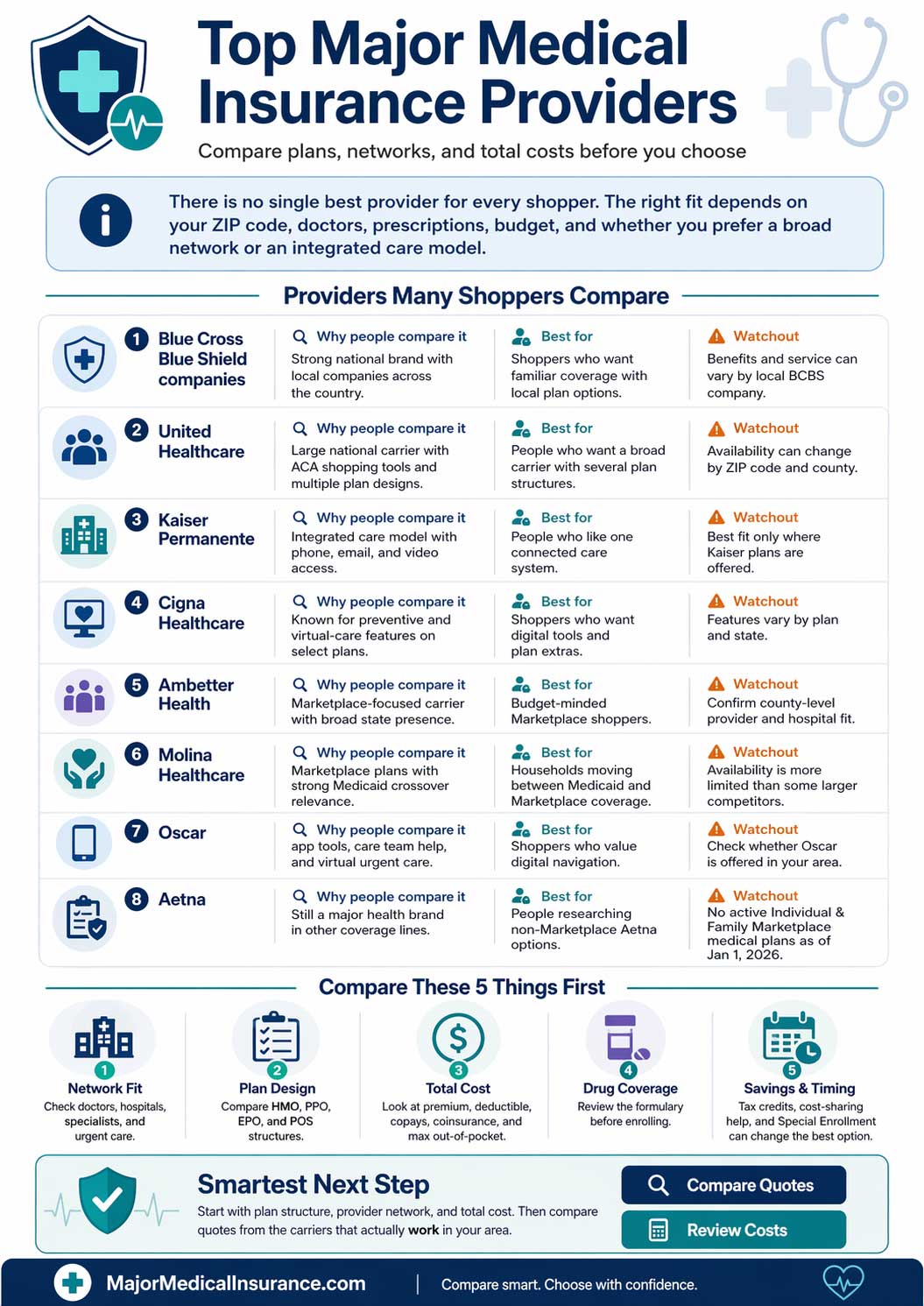
    Infographic comparing top major medical insurance providers, including Blue Cross Blue Shield, UnitedHealthcare, Kaiser Permanente, Cigna, Ambetter, Molina, Oscar, and Aetna, with key comparison points such as network fit, plan design, total cost, drug coverage, and enrollment timing.

    Major Medical Providers Many Shoppers Compare

    Provider Why Shoppers Look At It Often Best For Key Watchout
    Blue Cross Blue Shield companies Strong national brand with local companies across the country[6] Shoppers who want a familiar system with local plan options Benefits and service can vary by local BCBS company[6]
    UnitedHealthcare Current Individual & Family ACA plan shopping tools and enrollment guidance[5] People who want multiple plan designs and a large national carrier Availability can change by ZIP code and county[5]
    Kaiser Permanente Integrated care model with phone, email, and video access[7] People comfortable using one connected care system Best fit only where Kaiser individual and family plans are offered[7]
    Cigna Healthcare Individual/family plans with strong preventive and virtual-care features on select plans[8] Shoppers who want digital tools and plan extras where available Features vary by plan and state[8]
    Ambetter Health Marketplace-focused carrier with plans in 29 states[9] Budget-minded Marketplace shoppers who want broad state presence You still need to confirm county-level plan and provider fit[9]
    Molina Healthcare Marketplace plans in nine states and strong Medicaid/Marketplace crossover presence[10] Households moving between Medicaid and Marketplace coverage State availability is more limited than some larger competitors[10]
    Oscar Individual/family plans with an app, care team, and virtual urgent care tools[11] Tech-forward shoppers who value digital navigation Check whether Oscar is offered in your service area[11]
    Aetna Still a major health brand across employer, Medicare, Medicaid, dental, vision, student, and international coverage lines[12] People researching non-Marketplace Aetna options Not a current Individual & Family Marketplace medical option for new shoppers in 2026[12]

    Provider-by-Provider Breakdown

    Blue Cross Blue Shield Companies

    Blue Cross Blue Shield is one of the most recognizable names in U.S. health coverage, but it is important to understand that BCBS is a system of local companies rather than a single standardized insurer everywhere. The Blue Cross Blue Shield Association says BCBS companies offer a personalized local approach across the country, which helps explain why shoppers often start there when they want broad brand recognition and strong local market presence.[6]

    The biggest advantage is familiarity and reach. The biggest caution is that benefits, networks, and member experience can vary depending on the local BCBS company serving your state or region. If you are comparing Blue plans specifically, use our page on major medical insurance Blue Cross.

    UnitedHealthcare

    UnitedHealthcare remains one of the most important carriers to compare if you are shopping for current ACA coverage. Its official Individual & Family pages emphasize Marketplace plan shopping, enrollment guidance, plan-type comparisons, and the fact that availability depends on where you live.[5]

    That makes UnitedHealthcare a strong starting point for shoppers who want a large national carrier and a range of plan designs, but not every ZIP code or county will have UHC individual and family options. Before choosing it, verify provider participation, prescription coverage, and how the plan handles referrals and out-of-network care.

    Kaiser Permanente

    Kaiser Permanente stands out because it combines coverage with a connected care delivery model. Kaiser highlights phone, email, and video access, preventive care, and flexible individual and family plans.[7]

    This can work very well for people who like the idea of a coordinated care system rather than a looser independent network. The tradeoff is simple: Kaiser is strongest when you are in a service area where its system is available and you are comfortable using that model for most of your care.

    Cigna Healthcare

    Cigna’s current individual and family pages highlight preventive care, virtual care, customer support, and certain select-plan features such as low-cost generics or lower-cost routine care structures.[8] That makes Cigna attractive to shoppers who want a modern member experience and are comparing day-to-day usage features, not just catastrophic protection.

    The key detail is that these features are not identical across every plan. Always check the exact Summary of Benefits and Coverage, network, and formulary in your state before assuming a headline feature applies to the option you are considering.

    Ambetter Health

    Ambetter has become a major name for Marketplace shoppers because it says it offers coverage in 29 states and provides tools to shop by ZIP code, search providers, and manage coverage digitally.[9] For consumers who want ACA-compatible coverage with a wide state footprint, Ambetter often belongs on the shortlist.

    Still, statewide presence is not the same as county-level fit. You should compare the hospital system, specialist availability, prescription coverage, and network design in your exact area before choosing a lower-premium option just because the brand is widely available.

    Molina Healthcare

    Molina says it offers Marketplace plans in nine states and positions itself clearly around Marketplace and Medicaid-related coverage paths.[10] That makes Molina especially relevant for households whose income, program eligibility, or coverage source may shift over time.

    Its narrower footprint compared with some larger carriers does not automatically make it a worse choice. It simply means local validation matters more. Compare network access carefully and make sure the specific Molina plan available to you matches your expected medical usage.

    Oscar

    Oscar continues to market itself around digital navigation, highlighting its Oscar app, care team support, and virtual urgent care tools for individual and family shoppers.[11] That can be appealing if you want a plan that feels easier to manage through your phone and online account.

    Oscar can be worth strong consideration when it is available in your area and the provider network works for your doctors and hospitals. As always, tech features are helpful, but they should not outweigh network fit or drug coverage if you rely on ongoing care.

    Aetna

    Aetna is still a major health insurance brand, but this is exactly where outdated articles go wrong. Aetna’s own site says that, as of January 1, 2026, it no longer offers, renews, or has active individual and family medical plans through the Health Insurance Marketplace in any U.S. state.[12]

    That does not mean Aetna disappeared. It still points visitors to other coverage lines such as employer plans, Medicare, Medicaid, dental, vision, student, and international products.[12] But for a current Marketplace comparison article, Aetna should be treated as a legacy reference or a non-Marketplace option, not as a standard current ACA shopping choice. If you want a dedicated page on that brand context, see Aetna major medical insurance.

    How to Compare Providers Without Making an Expensive Mistake

    The safest comparison process is usually this: first compare network type, then metal level, then total cost, then prescriptions, and only after that compare brand reputation. HealthCare.gov makes clear that metal categories such as Bronze, Silver, Gold, and Platinum describe how costs are shared, not the quality of care itself.[2]

    That is important because the “best” provider can still be the wrong choice if the plan has the wrong deductible structure, the wrong drug list, or the wrong specialist network for your health needs. If you may qualify for premium tax credits or other Marketplace savings, update your income and household information first so you compare plans using realistic net costs instead of sticker-price premiums alone.[3]

    Ways to Save Without Choosing the Wrong Plan

    • Compare the plan’s full cost, not just the monthly premium.
    • Check whether you qualify for premium tax credits or other savings.[3]
    • Use in-network doctors, labs, and hospitals whenever possible.[1]
    • Review the drug formulary before enrolling.
    • Use preventive care benefits and annual plan review windows to avoid drifting into a poor-fit plan.[4]

    Compare the right way before you enroll

    Start with plan structure, provider network, and total cost. Then narrow your list to the carriers that actually work in your area.

    Compare Quotes
    Review Costs

    References

    1. HealthCare.gov — Health insurance plan and network types
    2. HealthCare.gov — Health plan categories
    3. HealthCare.gov — Saving money on health insurance premiums
    4. HealthCare.gov — Special Enrollment Period
    5. UnitedHealthcare — Individual and family health insurance plans
    6. Blue Cross Blue Shield — The Blue Cross and Blue Shield System
    7. Kaiser Permanente — Individual and family plans overview
    8. Cigna Healthcare — Individual and Family Plan Benefits
    9. Ambetter Health — Affordable health insurance plans
    10. Molina Healthcare — About Marketplace
    11. Oscar — Health insurance for individuals and families
    12. Aetna — Individuals and families

    About the Author

    Major Medical Insurance Editorial Team

    This article was reviewed and updated using current public carrier pages and federal health coverage resources. It is intended for general educational purposes and should not replace official plan documents, Summary of Benefits and Coverage forms, or licensed advice tailored to your state and eligibility.

  • Aetna Major Medical Insurance

    By MajorMedicalInsurance.com Editorial Team
    Published on · Updated on

    Aetna is still a major health insurance brand in the United States, but the right way to talk about Aetna major medical insurance in 2026 is different from how many older pages framed it. If you are shopping for major medical health insurance, the first thing to understand is whether you are looking at employer-based coverage, Medicare-related coverage, or ACA Marketplace coverage. That distinction matters because Aetna’s role is not the same in each market.

    Quick Answer

    Aetna can still be relevant for major medical coverage through employer-sponsored benefits and other non-Marketplace channels, but Aetna CVS Health no longer offers active individual and family medical plans through the Health Insurance Marketplace in any U.S. state as of January 1, 2026. That means if you are shopping for new ACA individual coverage today, you should not approach Aetna the same way older Marketplace-focused articles once did.[1]

    The Most Important 2026 Update

    If you are reading an older Aetna article, this is the part that needs to be updated first. Aetna’s official individual-and-family page states that, as of January 1, 2026, Aetna CVS Health no longer offers, renews, or has active individual and family medical plans through the Health Insurance Marketplace in any U.S. state. It also says former members can still sign in to their member account for up to five years after their plan ends.[1]

    What that means for shoppers

    If you need a new individual ACA Marketplace plan in 2026, Aetna is not a live Marketplace option for new enrollment. If you are comparing coverage on your own, it makes more sense to review current Marketplace choices and compare them by provider network, deductible, drug coverage, and total yearly cost.[4]

    What Aetna Major Medical Insurance Can Still Mean

    Aetna is still active in other health coverage channels. Aetna’s employer-coverage page says members can access health benefits through work, check benefits online, and use member tools tied to their employer plan.[2] That means Aetna can still matter if your employer offers an Aetna plan, if your spouse’s employer offers one, or if you are evaluating a job-based benefits package that includes Aetna medical coverage.

    Aetna also continues to promote PPO-style options through its employer-facing offerings. Its PPO page describes plan flexibility, and its provider tools highlight a large nationwide network plus pharmacy and clinic search features. Aetna’s virtual care page also says eligible members may have access to on-demand care and mental health support, depending on plan details.[3]

    Aetna Context Current 2026 Reality What You Should Do
    Employer-sponsored medical coverage Still active and relevant Review your employer’s specific Aetna plan documents and network
    Former Aetna individual/family Marketplace member Member access can remain available for several years after plan end Log in to retrieve plan information or records if needed[1]
    New individual ACA shopper Aetna is no longer an active Marketplace medical option Compare other available Marketplace carriers instead
    Medicare shopper Aetna still offers Medicare-related products and tools Review Medicare-specific pages separately

    What to Review in an Aetna Plan

    If you already have Aetna through work, the value is not in the brand name alone. The value is in the actual plan structure, cost-sharing rules, provider access, and digital tools. Before deciding, check whether the plan is PPO, HMO, POS, or another design, then review the deductible, copays, coinsurance, out-of-pocket maximum, provider directory, and prescription coverage details.[3]

    Use this checklist before you decide

    • Confirm whether the plan is PPO, HMO, POS, or another design
    • Review the deductible, copays, coinsurance, and out-of-pocket maximum
    • Search your doctors, hospitals, and pharmacies in the provider tools
    • Check whether virtual care is included in a meaningful way
    • Review your prescription coverage and formulary details

    How Aetna Compares With Other Major Medical Paths

    If you are shopping for new coverage on your own, Marketplace coverage is still available through carriers that meet Marketplace rules, including coverage for essential health benefits and pre-existing conditions.[4] Since Aetna no longer participates in the individual and family Marketplace medical space for new plans, the more useful comparison is between Aetna employer coverage and other carriers that are currently available where you live.

    If you are deciding whether Aetna is the right fit, the best next comparisons are usually major medical insurance plans, major medical insurance PPOs, and telemedicine.

    Who This Page Is Best For

    This page is most useful for people who are reviewing an Aetna plan offered through work, comparing employer options, or trying to understand whether older Aetna Marketplace content is still current. It is much less useful as a “where can I buy a new ACA Marketplace Aetna plan today?” page, because that is no longer how the brand is positioned in the individual and family Marketplace medical segment as of 2026.[1]

    Bottom Line

    Aetna still matters in U.S. health insurance, but the smart 2026 version of an Aetna major medical page needs to be honest about where the brand is active and where it is not. If you already have Aetna through work, the right focus is your network, plan type, drug coverage, virtual care options, and cost-sharing documents. If you are shopping for new individual ACA coverage, you should compare the carriers that are actually active in your area today.

    References

    1. Aetna, Individual & Family Health Insurance Plans & Coverage.
      https://www.aetna.com/individuals-families.html
    2. Aetna, Employer-Sponsored Health Insurance Plans for Employees.
      https://www.aetna.com/individuals-families/health-insurance-through-work.html
    3. Aetna, PPO Health Insurance Plans from Aetna, Find a Doctor, Dentist or Hospital, and Virtual care, wherever you are.
      https://www.aetna.com/health-insurance-plans/ppo.html |
      https://www.aetna.com/individuals-families/find-a-doctor.html |
      https://www.aetna.com/individuals-families/health-insurance-through-work/telemedicine.html
    4. HealthCare.gov, Tips about the Health Insurance Marketplace®, What Marketplace health insurance plans cover, and Marketplace health plans cover pre-existing conditions.
      https://www.healthcare.gov/quick-guide/one-page-guide-to-the-marketplace/ |
      https://www.healthcare.gov/coverage/what-marketplace-plans-cover/ |
      https://www.healthcare.gov/coverage/pre-existing-conditions/
  • Major Medical Insurance for the Self-Employed

    By MajorMedicalInsurance.com Editorial Team
    Published on · Updated on

    If you are self-employed, major medical insurance is usually the foundation of serious health coverage. It can help protect you from large medical bills while still covering many routine and preventive services, prescription drugs, specialist care, emergency treatment, and hospitalization. The challenge is not just finding a plan. It is finding one that matches unpredictable income, variable cash flow, and the real health needs of your household.

    Quick Answer

    For most self-employed people, the smartest starting point is the Health Insurance Marketplace. That is where you may qualify for premium tax credits and other savings based on your expected net self-employment income for the coverage year. A strong plan should be judged by total yearly cost, provider network, prescription drug coverage, deductible, and out-of-pocket maximum, not just the monthly premium.[1][4]

    Self-employed professional reviewing major medical insurance options

    Why Health Insurance Works Differently When You’re Self-Employed

    When you work for yourself, you usually do not have an employer arranging coverage, subsidizing premiums, or giving you a fixed benefits menu. That means you are often shopping as an individual or family on your own. HealthCare.gov says self-employed people can use the Marketplace and that Marketplace savings are based on the estimated net income for the year you are getting coverage, not last year’s income.[1]

    This matters because self-employed income can move up or down over the year. If you freelance, run a sole proprietorship, or operate a small business with uneven revenue, the plan that looks cheapest on the first screen may not be the best match once you consider your likely usage, deductible exposure, and whether you qualify for savings. That is why it also helps to compare this topic with major medical insurance for individuals and our overview of major medical health insurance.

    Common self-employed situations

    • Freelancers and independent contractors
    • Sole proprietors and consultants
    • Owners of very small businesses without group coverage
    • People between employer plans who now need to buy coverage on their own
    • Early retirees who are not yet eligible for Medicare

    When You Can Enroll

    Enrollment timing matters. HealthCare.gov says Open Enrollment starts on November 1 and ends on January 15. If you enroll by December 15, coverage can start January 1. If you enroll after that but by January 15, coverage can start February 1.[2]

    Outside Open Enrollment, you may still be able to enroll through a Special Enrollment Period after certain life events, such as losing coverage, moving, getting married, having a baby, or other qualifying changes. HealthCare.gov says many people usually have 60 days before or after the event to enroll. Medicaid and CHIP can be available year-round.[2]

    Important self-employed timing note

    If your income changes during the year, update your Marketplace application. Because savings are tied to your expected income for the year of coverage, inaccurate estimates can affect the subsidy you receive.[1]

    What a Self-Employed Major Medical Plan Usually Covers

    ACA-compliant Marketplace plans must cover the 10 essential health benefit categories. These include doctors’ services, inpatient and outpatient hospital care, prescription drug coverage, pregnancy and childbirth, mental health services, and more.[3] Marketplace plans must also cover pre-existing conditions, and treatment for those conditions begins when coverage starts.[3]

    Coverage Area What It Usually Includes Why It Matters for the Self-Employed
    Hospital and emergency care Inpatient and outpatient care, emergency treatment, medically necessary surgery Protects against the biggest financial shocks
    Doctors and specialists Primary care, specialist visits, diagnostics, follow-up care Important when you cannot rely on employer-plan access
    Prescription drugs Coverage based on the plan formulary and drug tiers Can drive your real annual cost up or down
    Preventive care Certain screenings, vaccines, and preventive services at no cost in-network Useful before you meet the deductible[3]
    Mental health and substance use care Covered as essential health benefits Important for comprehensive protection
    Telehealth and virtual care May be included depending on plan design Useful when travel time costs you work hours

    For a broader explanation, see what major medical insurance covers.

    Doctor discussing major medical insurance options with a self-employed patient

    Marketplace Savings Can Be a Big Deal

    For self-employed people, a quote without savings can be misleading. HealthCare.gov says you may qualify for premium tax credits that lower your monthly premium based on expected household income. Depending on income, you may also qualify for cost-sharing reductions that lower deductibles, copayments, and coinsurance, but those extra out-of-pocket savings apply only if you enroll in a Silver plan.[4]

    That means a self-employed shopper should not just compare Bronze versus Gold on sticker price alone. A Silver plan may deliver better real-world value if it unlocks extra cost-sharing help. This becomes especially important when cash flow is uneven and a single bad medical month could strain your business or household budget.

    Why estimated income matters

    Marketplace savings are based on your expected household income for the year you want coverage, not last year’s income. For self-employed people, that usually means estimating current-year net business income as accurately as possible.[1]

    Tax Advantages for the Self-Employed

    One of the biggest differences for self-employed shoppers is that health coverage can affect tax planning. The IRS says Form 7206 is used to determine any amount of the self-employed health insurance deduction you may be able to claim and report on Schedule 1 of Form 1040. The deduction may apply to health insurance premiums paid for yourself, your spouse, and your dependents, subject to IRS rules.[5]

    If you are self-employed and also claim the Premium Tax Credit, the IRS explains that the interaction between the self-employed health insurance deduction and the credit can be more complicated than it first appears. That is one reason the real after-tax cost of a plan may differ from the premium you see on a shopping screen.[5]

    Practical tax takeaway

    If you are self-employed, it is worth checking both Marketplace savings and the self-employed health insurance deduction before deciding what is truly affordable.

    How to Compare Plans When You Work for Yourself

    The best plan for a self-employed person is not always the cheapest premium. If you have chronic prescriptions, frequent specialist visits, or family members who use care often, a slightly higher premium may still be the better value if it lowers your deductible and out-of-pocket risk.

    What to Compare Why It Matters Self-Employed Angle
    Monthly premium Affects cash flow every month Important when business income fluctuates
    Deductible Determines how much you pay before the plan shares many costs A high deductible can hit hard in a slow business month
    Out-of-pocket maximum Caps annual spending for covered in-network care Critical for worst-case planning
    Provider network Determines whether your doctors and hospitals are covered in-network May affect travel time and business disruption
    Drug formulary Controls what your prescriptions cost Important for ongoing conditions
    Plan type PPO, HMO, EPO, or POS affects flexibility and cost Plan structure can change how easy it is to keep your preferred providers

    If you are still narrowing the basics, our broader Obamacare / ACA guide can help connect Marketplace rules, subsidies, and plan shopping.

    What About HSAs?

    HealthCare.gov says that for 2026, all Bronze and Catastrophic Marketplace plans are eligible for Health Savings Accounts, and plans in other categories may also be HSA-eligible depending on their deductibles and out-of-pocket maximums.[4] That can matter a lot for self-employed people who want to pair lower premiums with a tax-advantaged way to help cover deductibles and other qualified medical expenses.

    An HSA is not right for everyone. It tends to work best when you can tolerate a higher deductible, maintain some cash reserves, and want to save pre-tax money for future healthcare costs. If you want richer benefits up front, another plan design may be easier to live with even if the premium is higher.

    What Self-Employed Major Medical Insurance Is Not

    Serious coverage should not be confused with products that only fill one gap. A self-employed shopper may see short-term or supplemental products promoted alongside comprehensive plans, but those products serve different roles. They are not the same as a full ACA-compliant major medical plan.

    Bottom Line

    Major medical insurance for the self-employed should be evaluated as both a health decision and a business decision. The right plan helps protect your household from high medical costs, supports access to doctors and prescriptions you actually use, and works with the tax and subsidy rules that apply to self-employed income.

    Start with the Marketplace, estimate your income carefully, compare total yearly cost instead of only the premium, and read the plan documents before enrolling.

    References

    1. HealthCare.gov, Health coverage if you’re self-employed and Reporting self-employment income to the Marketplace.
      https://www.healthcare.gov/self-employed/ |
      https://www.healthcare.gov/self-employed/income/
    2. HealthCare.gov, When can you get health insurance?, Getting health coverage outside Open Enrollment, and Medicaid & CHIP coverage.
      https://www.healthcare.gov/quick-guide/dates-and-deadlines/ |
      https://www.healthcare.gov/coverage-outside-open-enrollment/special-enrollment-period/ |
      https://www.healthcare.gov/medicaid-chip/
    3. HealthCare.gov, What Marketplace health insurance plans cover, Marketplace health plans cover pre-existing conditions, and Preventive health services.
      https://www.healthcare.gov/coverage/what-marketplace-plans-cover/ |
      https://www.healthcare.gov/coverage/pre-existing-conditions/ |
      https://www.healthcare.gov/coverage/preventive-care-benefits/
    4. HealthCare.gov, Lower costs on Marketplace coverage, Health plan categories: Bronze, Silver, Gold & Platinum, and More plans now work with Health Savings Accounts.
      https://www.healthcare.gov/lower-costs/ |
      https://www.healthcare.gov/choose-a-plan/plans-categories/ |
      https://www.healthcare.gov/hsa-options/
    5. IRS, Instructions for Form 7206 (2025) and Publication 974, Premium Tax Credit (PTC).
      https://www.irs.gov/instructions/i7206 |
      https://www.irs.gov/publications/p974
  • Major Medical Insurance Quotes

    By MajorMedicalInsurance.com Editorial Team
    Published on · Updated on

    Major medical insurance quotes can look simple at first glance, but the lowest monthly premium is not always the best value. A real quote needs to be understood in context: your deductible, coinsurance, provider network, prescription drug coverage, and annual out-of-pocket limit can change the total cost of a plan far more than the premium alone.

    Quick Answer

    The best way to shop for major medical insurance quotes is to compare total yearly cost, not just the monthly premium. Marketplace tools let you preview plans and estimated prices based on your ZIP code, household, and income, but your exact price depends on the full application and any savings you qualify for.[1]

    What a Major Medical Insurance Quote Really Shows

    A major medical insurance quote is an estimate of what you may pay for comprehensive health coverage based on factors like your age, location, household information, tobacco use, and the type of plan you choose. When you preview plans, premium estimates reflect the basic information you enter, while exact prices are shown after you complete the full Marketplace application.[1]

    That is why a quote page should help people understand what changes a quote instead of pretending that one price applies everywhere. Readers who are still comparing the basics can also review major medical health insurance.

    What Changes Your Quote

    Marketplace premiums can vary based on age, where you live, tobacco use, how many people are covered, and plan category. At the same time, insurers cannot charge more because of your current health or medical history, and Marketplace plans must cover treatment for pre-existing conditions from the day coverage starts.[2]

    Quote Factor Why It Matters What to Watch
    ZIP code / area Plan availability and local pricing vary by area A quote in one county may not match another
    Age Older adults can generally be charged more than younger adults Age affects premium but not essential health benefits
    Household and income These factors can affect savings eligibility Tax credits can materially lower the premium
    Plan category Bronze, Silver, Gold, Platinum, and Catastrophic split costs differently Lower premiums often mean higher out-of-pocket costs
    Network type PPO, HMO, EPO, and POS plans work differently Provider flexibility can change total cost

    Why the Cheapest Quote Is Not Always the Best Quote

    Deductibles, copayments, and coinsurance can add a lot to your total yearly costs, sometimes more than a plan’s premium. That is why shoppers should compare a quote with expected use of doctors, specialists, prescriptions, imaging, and hospital care.[1][4]

    A smarter way to read a quote

    A low premium can still turn into a costly plan if the deductible is high, the network is too narrow, your prescriptions are on expensive tiers, or your preferred doctors are out of network. A slightly higher premium can be the better value if it lowers your real yearly exposure.

    How Marketplace Plan Categories Affect Quotes

    Marketplace plans are grouped into Bronze, Silver, Gold, and Platinum, and in some areas Catastrophic plans are also available. These categories do not measure quality. They mainly show how the plan and the member share costs for covered services.[3]

    Plan Category Typical Premium Pattern Typical Cost-Sharing Pattern
    Bronze Usually lower monthly premium Higher out-of-pocket costs when you get care
    Silver Middle-ground premium level Balanced cost-sharing, and the only level that unlocks cost-sharing reductions if eligible
    Gold Higher monthly premium Lower out-of-pocket costs when you use care
    Platinum Usually the highest premium Lowest out-of-pocket costs among metal levels
    Catastrophic Usually lower premium Higher out-of-pocket costs, with eligibility limits and at least 3 primary care visits before the deductible

    If you want a deeper breakdown of those tradeoffs, see our page on major medical insurance plans.

    How to Preview Real Quotes the Right Way

    You can preview plans and prices by entering your ZIP code and answering a few questions about estimated income and household members. Estimated premiums can reflect savings you may qualify for, while exact prices appear after the full application is completed.[1]

    What to do before requesting quotes

    • Estimate your household income as accurately as possible
    • List the people who need coverage
    • Check your prescriptions before comparing plans
    • Write down your preferred doctors and hospitals
    • Think about whether you expect low, medium, or high health care use this year

    What to Compare Alongside the Quote

    When you compare quotes, you should also review the summary of benefits, plan brochure, provider directory, and drug list for each plan. It is also worth checking whether plans cover your doctors, hospitals, and prescriptions in network.[4]

    Use this checklist before choosing a quote

    • Monthly premium
    • Deductible
    • Coinsurance and copays
    • Annual out-of-pocket maximum
    • Provider network
    • Prescription drug formulary
    • Plan type such as PPO, HMO, EPO, or POS

    If you are shopping on your own, our guide to major medical insurance for individuals can help you connect quote comparisons to real enrollment decisions.

    Current 2026 Numbers That Matter

    For 2026, the out-of-pocket limit for a Marketplace plan cannot exceed $10,600 for an individual and $21,200 for a family for covered in-network care. That limit does not include premiums, services the plan does not cover, out-of-network care, or charges above the allowed amount.[5]

    CMS also reported that the average HealthCare.gov premium after tax credits is projected to be $50 per month for the lowest-cost plan in 2026 for eligible enrollees. That is useful context for shoppers comparing subsidized Marketplace quotes rather than unsubsidized sticker prices.[5]

    When You Can Get Quotes and Enroll

    Open Enrollment on HealthCare.gov runs from November 1 through January 15. Outside Open Enrollment, a Special Enrollment Period may open after certain life events such as losing coverage, moving, getting married, or having a baby. People usually have 60 days before or after the event to enroll, while Medicaid and CHIP can be available year-round.[5]

    Bottom Line

    The best major medical insurance quote is not the one with the lowest advertised premium. It is the one that fits your expected health needs, protects you from high annual costs, keeps your doctors and prescriptions accessible, and works with any savings you qualify for. Quotes are a starting point, but plan documents and total yearly cost are what turn a quote into a smart decision.

    References

    1. HealthCare.gov, Preview health insurance plans & prices and Your total costs for health care: Premium, deductible, and out-of-pocket costs.
      https://www.healthcare.gov/apply-and-enroll/health-insurance-plans-estimator-overview/ |
      https://www.healthcare.gov/choose-a-plan/your-total-costs/
    2. HealthCare.gov, How insurance companies set health premiums and Marketplace health plans cover pre-existing conditions.
      https://www.healthcare.gov/how-plans-set-your-premiums/ |
      https://www.healthcare.gov/coverage/pre-existing-conditions/
    3. HealthCare.gov, Health plan categories: Bronze, Silver, Gold & Platinum, Catastrophic health plans, and Health insurance plan & network types: HMOs, PPOs, and more.
      https://www.healthcare.gov/choose-a-plan/plans-categories/ |
      https://www.healthcare.gov/choose-a-plan/catastrophic-health-plans/ |
      https://www.healthcare.gov/choose-a-plan/plan-types/
    4. HealthCare.gov, 3 things to know before you pick a health insurance plan and CMS, Summary of Benefits & Coverage & Uniform Glossary.
      https://www.healthcare.gov/choose-a-plan/comparing-plans/ |
      https://www.cms.gov/marketplace/health-plans-issuers/summary-benefits-coverage
    5. HealthCare.gov, Out-of-pocket maximum/limit, When can you get health insurance?, and Special Enrollment Period (SEP); CMS, Plan Year 2026 Marketplace Plans and Prices Fact Sheet.
      https://www.healthcare.gov/glossary/out-of-pocket-maximum-limit/ |
      https://www.healthcare.gov/quick-guide/dates-and-deadlines/ |
      https://www.healthcare.gov/glossary/special-enrollment-period/ |
      https://www.cms.gov/newsroom/fact-sheets/plan-year-2026-marketplace-plans-prices-fact-sheet
  • Major Medical Insurance for Individuals

    By MajorMedicalInsurance.com Editorial Team
    Published on · Updated on

    If you buy health coverage on your own, major medical insurance is usually the most important form of protection to compare first. Individual major medical coverage is designed to help pay for serious medical costs while also covering many everyday health needs, from preventive care and prescriptions to hospital stays, mental health treatment, and medically necessary specialist care.

    Quick Answer

    For most people shopping on their own, the best place to start is an ACA-compliant individual plan through the Marketplace. That is where you may qualify for premium tax credits and extra savings based on income. A good individual major medical plan should be judged by its provider network, deductible, prescription drug coverage, out-of-pocket maximum, and total yearly cost, not just the monthly premium.[1][4]

    Who Individual Major Medical Insurance Is For

    Individual major medical coverage is for people who need to buy their own major medical health insurance instead of getting it through a job or a public program. In practice, that often includes self-employed workers, freelancers, part-time workers, people between jobs, early retirees not yet on Medicare, and adults who are no longer covered as dependents under a parent’s plan.

    Marketplace coverage is generally for people who live in the United States, are U.S. citizens or nationals or are lawfully present, and are not incarcerated. If you do not have job-based coverage, Medicare, Medicaid, CHIP, or another qualifying source of coverage, the Marketplace is usually the first serious place to compare options.[1]

    Common situations where individual coverage matters

    • You are self-employed or have contract income
    • You lost job-based coverage
    • You turned 26 and aged out of a parent’s plan
    • You are between employer plans
    • You want ACA-compliant coverage with real annual financial protection

    Infographic about major medical insurance for individuals, showing key benefits, essential coverage, flexible plan options, and who this type of health insurance is best for.

    When Individuals Can Enroll

    Timing matters. Open Enrollment on HealthCare.gov runs from November 1 through January 15 each year. Enrolling by December 15 can start coverage on January 1, while enrolling by January 15 can start coverage on February 1.[1]

    Outside Open Enrollment, you usually need a qualifying life event to access a Special Enrollment Period. Examples can include losing job-based coverage, moving to a new area, certain family-status changes, or other qualifying events. Medicaid and CHIP can be available year-round.[1]

    What Individual Major Medical Insurance Usually Covers

    ACA-compliant Marketplace plans must cover the 10 essential health benefit categories. These include outpatient care, hospitalization, emergency services, prescription drugs, pregnancy and childbirth, mental health and substance use disorder services, lab services, rehabilitative services, pediatric services, and preventive services.[2]

    Marketplace plans must also cover treatment for pre-existing medical conditions. Once you are enrolled, a plan cannot reject you, charge you more, or refuse to pay for essential health benefits because of a condition you had before coverage started.[2]

    Coverage Area What an Individual Major Medical Plan May Include Why It Matters
    Hospital and emergency care Coverage for inpatient and outpatient hospital services, emergency care, and follow-up treatment Helps protect against large medical bills
    Doctors and specialists Primary care, specialist visits, diagnostic testing, and medically necessary treatment Core day-to-day usability of the plan
    Prescription drugs Coverage subject to the plan formulary and tier rules A major driver of total annual cost
    Preventive care Many in-network preventive services at no cost to you Useful before you meet the deductible[2]
    Behavioral health Mental health and substance use disorder services An essential part of serious health coverage[2]
    Virtual care Some plans may include telehealth or follow-up virtual visits Can reduce time and friction for routine care

    For a broader explanation, you can also review what major medical insurance covers and compare it with our guide to major medical insurance plans.

    How Individual Major Medical Plans Work

    Individual major medical plans usually combine a monthly premium with cost-sharing features such as a deductible, copays, coinsurance, and an out-of-pocket maximum. The best way to understand these parts is to think in terms of your total yearly exposure, not just the premium.

    Cost Feature What It Means What to Watch For
    Premium Your monthly payment to keep coverage active Lower premiums often mean more cost-sharing later
    Deductible What you pay before the plan starts paying for many covered services High deductibles can be hard to absorb unexpectedly
    Copay A fixed amount for certain services, like a doctor visit Check primary care, specialist, urgent care, and drug tiers
    Coinsurance A percentage you pay after the deductible This matters a lot for surgery, imaging, and hospital care
    Out-of-pocket maximum The most you pay in a plan year for covered services For 2026, Marketplace plans cannot exceed $10,600 for an individual or $21,200 for a family[3]

    The ACA also stops insurance companies from placing yearly or lifetime dollar limits on essential health benefits in these plans. That is a major reason comprehensive coverage is different from limited-benefit or temporary products.[3]

    Marketplace Savings Matter for Individuals

    For many individual shoppers, the best plan on paper is not the best plan after subsidies. Depending on your expected household income, you may qualify for a premium tax credit that lowers your monthly premium and possibly extra savings that lower deductibles, copayments, and coinsurance.[1][4]

    Those extra out-of-pocket savings work differently from the premium tax credit. If you qualify for cost-sharing reductions, you must enroll in a Silver plan to receive them. You can still use the premium tax credit in other metal levels, but you do not get those extra cost-sharing reductions unless you choose Silver.[4]

    Useful 2026 note

    For 2026, Bronze and Catastrophic Marketplace plans now work with Health Savings Accounts. That may matter for healthier shoppers who want a lower premium and want to set aside pre-tax money for qualified medical expenses.[4]

    How to Choose the Best Individual Plan

    The best individual plan is usually the one that balances premium, deductible, provider access, and drug coverage for your real health needs. It is not necessarily the cheapest premium and it is not necessarily the richest-looking benefits list.

    Use this checklist before you enroll

    • Check whether your doctors and hospitals are in-network
    • Review the prescription drug formulary before you buy
    • Compare the deductible with the out-of-pocket maximum
    • Estimate your total yearly cost, not just the monthly premium
    • Read the plan’s Summary of Benefits and Coverage
    • Compare whether a PPO, HMO, EPO, or POS setup fits you best

    Plans must provide a Summary of Benefits and Coverage that summarizes key features, cost-sharing rules, covered benefits, and important limitations or exceptions. People should receive it when shopping, enrolling, at each new plan year, and within seven business days of requesting a copy.[4]

    If you are still narrowing the basics, our broader Obamacare / ACA guide can help connect Marketplace rules, subsidies, and plan shopping.

    What Individual Major Medical Insurance Is Not

    People shopping on their own often see multiple coverage types presented side by side, even though they do not serve the same purpose. A serious individual major medical plan should not be confused with narrow or temporary products that fill only one gap. Those policies can have a place in some situations, but they are not the same thing as full ACA-compliant major medical coverage.

    Bottom Line

    Major medical insurance for individuals is the foundation of serious health coverage when you are buying on your own. The best plan for you depends on when you can enroll, whether you qualify for Marketplace savings, how much cost-sharing you can realistically handle, and whether your preferred doctors, hospitals, and prescriptions fit the plan.

    Start with the Marketplace if you may qualify for savings, compare total yearly cost instead of just the premium, and read the Summary of Benefits and Coverage before you enroll.

    References

    1. HealthCare.gov, A quick guide to the Health Insurance Marketplace®, When can you get health insurance?, and Getting health coverage outside Open Enrollment.
      https://www.healthcare.gov/quick-guide/one-page-guide-to-the-marketplace/ |
      https://www.healthcare.gov/quick-guide/dates-and-deadlines/ |
      https://www.healthcare.gov/coverage-outside-open-enrollment/special-enrollment-period/
    2. HealthCare.gov, What Marketplace health insurance plans cover, Marketplace health plans cover pre-existing conditions, Preventive health services, and Mental health & substance abuse coverage.
      https://www.healthcare.gov/coverage/what-marketplace-plans-cover/ |
      https://www.healthcare.gov/coverage/pre-existing-conditions/ |
      https://www.healthcare.gov/coverage/preventive-care-benefits/ |
      https://www.healthcare.gov/coverage/mental-health-substance-abuse-coverage/
    3. HealthCare.gov, Out-of-pocket maximum/limit and Ending lifetime & yearly limits.
      https://www.healthcare.gov/glossary/out-of-pocket-maximum-limit/ |
      https://www.healthcare.gov/health-care-law-protections/lifetime-and-yearly-limits/
    4. HealthCare.gov, Cost-sharing reductions, Health plan categories: Bronze, Silver, Gold & Platinum, and New in 2026: More plans now work with Health Savings Accounts; CMS, Summary of Benefits & Coverage & Uniform Glossary.
      https://www.healthcare.gov/lower-costs/save-on-out-of-pocket-costs/ |
      https://www.healthcare.gov/choose-a-plan/plans-categories/ |
      https://www.healthcare.gov/hsa-options/ |
      https://www.cms.gov/marketplace/health-plans-issuers/summary-benefits-coverage