By MajorMedicalInsurance.com Editorial Team
Published on April 18, 2026 · Updated on April 19, 2026
Temporary Health Coverage Guide
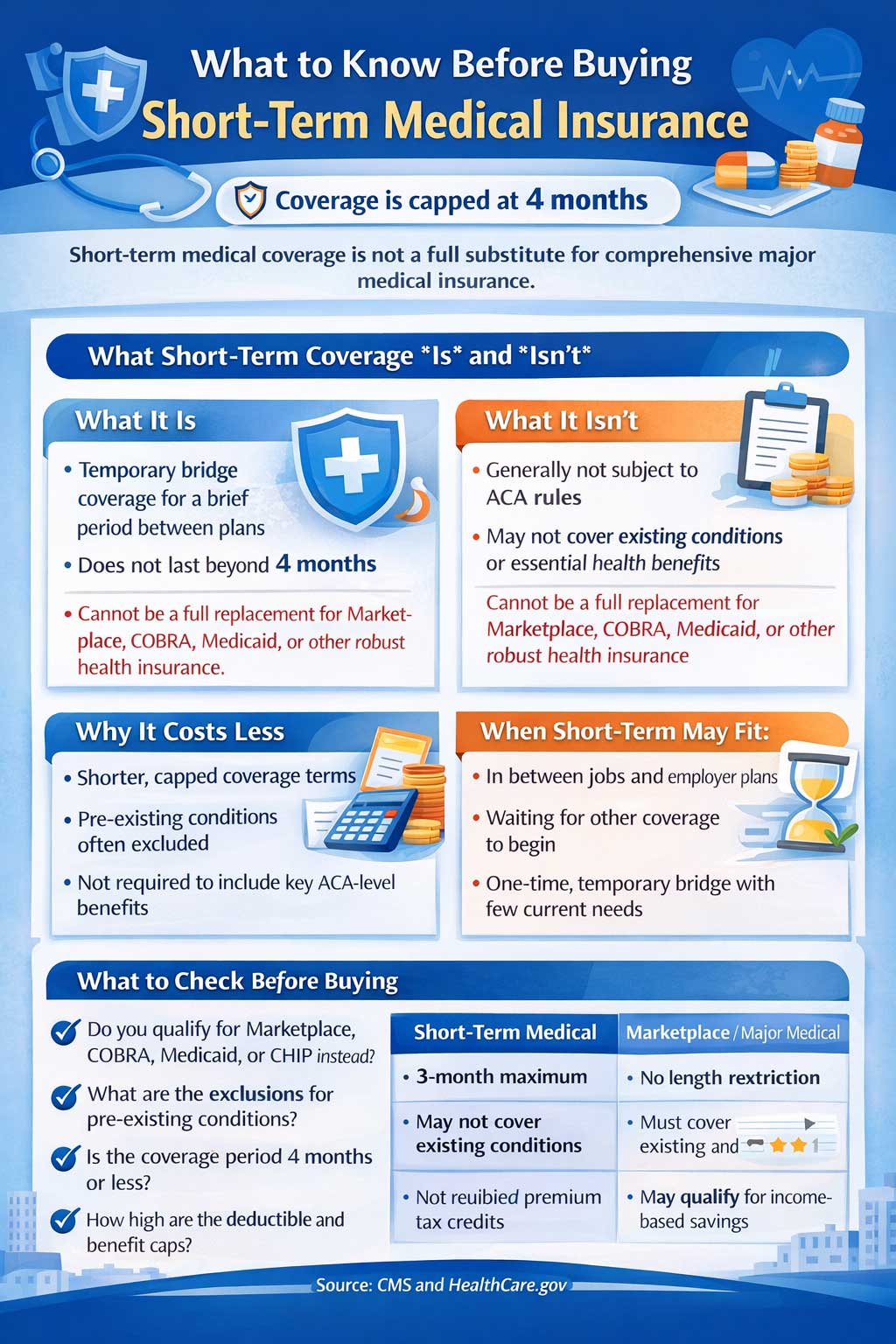
Short-term medical insurance, often called short-term limited-duration insurance, is designed to help fill a temporary gap in coverage rather than replace comprehensive health insurance for the long run.[1] Federal rules now limit these plans to an initial term of no more than 3 months and a total maximum coverage period of 4 months, including renewals or extensions.[2]
What it is
A temporary policy meant to bridge short coverage gaps, not serve as a full substitute for ACA-compliant major medical coverage.[1]
What it is not
It is generally not built under the same federal consumer protections that apply to comprehensive Marketplace coverage.[1][3]
Why people consider it
It may appeal to people between jobs or waiting for another source of coverage to begin.[1]
What to do first
Before buying one, check whether you qualify for Marketplace coverage, a Special Enrollment Period, COBRA, Medicaid, CHIP, or another employer-based option.[5]
What short-term medical insurance really means
Short-term medical coverage can look attractive because the monthly premium is often lower than a comprehensive major medical plan. The trade-off is that the policy is not built to the same standard as Marketplace coverage. That means you should not assume it covers pre-existing conditions, all essential health benefits, or the same level of cost protection that ACA-compliant plans provide.[1][3]
In other words, short-term medical insurance can be useful in narrow situations, but it works best when you treat it as temporary, limited coverage and read the exclusions closely. People who need broader protection for ongoing care, prescription costs, maternity needs, or chronic conditions usually need to compare it against stronger options such as major medical insurance plans or other comprehensive coverage first.
Initial term no more than 3 months; total maximum 4 months including renewals or extensions.[2]
Not subject to the short-term duration cap.
Pre-existing conditions
Not protected by the ACA rules that require Marketplace plans to cover pre-existing conditions.[1][3]
Marketplace plans must cover pre-existing conditions.[3]
Essential health benefits
Not required to cover the ACA’s essential health benefits.[1]
Marketplace plans cover the 10 essential health benefits.[3]
Out-of-pocket protection
Varies by policy and may not provide the same overall cost protections as ACA-compliant plans.
For 2026, the Marketplace out-of-pocket limit cannot exceed $10,600 for an individual or $21,200 for a family.[4]
When short-term medical may make sense
You are between health plans and need a very short bridge.[1]
You are waiting for new employer coverage to begin and need temporary protection.
You want some limited financial protection for a narrow time period while you finalize long-term coverage.
When it is usually the wrong fit
You have an ongoing condition and need dependable coverage for pre-existing care.[1][3]
You need comprehensive benefits such as maternity, mental health treatment, prescription coverage, or broader preventive care protections.[3]
You want stronger overall consumer protection and predictable long-term coverage.
You may qualify for Marketplace coverage, COBRA, Medicaid, CHIP, or another comprehensive alternative instead.[5]
What people often misunderstand
Lower premiums do not automatically mean better value. Short-term medical plans can cost less because they are not built to the same comprehensive standard as Marketplace plans. A cheaper monthly payment can still leave you more exposed if the policy excludes a condition, limits a benefit category, or provides less protection than an ACA-compliant plan.[1][3]
The most useful comparison is not premium alone. It is premium plus exclusions, deductible, coinsurance, network rules, prescription handling, and what happens if you need expensive care during the time you are insured.
What to check before buying a short-term policy
Check whether you qualify for a Special Enrollment Period before you shop for short-term coverage.[5]
Read the policy’s exclusions carefully, especially around pre-existing conditions and high-cost services.[1]
Verify the exact coverage period so you do not confuse a short bridge with a long-term solution.[2]
Review the deductible, coinsurance, benefit caps, and whether the provider network is limited.
Do not assume prescription drugs, maternity care, mental health care, or preventive care will work the same way they do under an ACA-compliant plan.[3]
Compare the policy against a real comprehensive alternative before deciding.
Smarter alternatives to compare first
Before choosing short-term medical insurance, many shoppers should compare it with Marketplace coverage, COBRA, Medicaid, CHIP, or a spouse’s or employer’s coverage if available.[5] On this site, it also makes sense to compare temporary coverage against stronger long-term options such as major medical insurance for individuals and ACA coverage.
The goal is not to assume short-term coverage is always wrong. It is to compare it honestly against the broader protection you may still be able to access.
Bottom line
Short-term medical insurance can play a limited role when you are truly in transition and need a brief bridge. It is far less suitable as a long-term replacement for comprehensive health insurance. The most responsible approach is to treat it as a temporary, carefully reviewed option only after you have checked for Marketplace eligibility, Special Enrollment rights, COBRA, Medicaid, CHIP, and other comprehensive alternatives.[1][5]
This article was prepared using current CMS, Federal Register, and HealthCare.gov materials to help readers understand how short-term medical insurance works, where it may fit, and where it falls short compared with comprehensive coverage. It is intended for educational purposes and should be used alongside official plan documents and licensed guidance when comparing health coverage.
Reviewed for clarity, consumer usefulness, and alignment with current public health coverage guidance.
By MajorMedicalInsurance.com Editorial Team
Published on · Updated on
“Major medical insurance” is a consumer term often used for comprehensive health coverage that helps protect against large medical bills. In practice, people usually compare these plans by where the coverage comes from, such as the Marketplace, an employer, COBRA, Medicare, or Medicaid, and by how the plan is structured, such as HMO, PPO, EPO, or POS.
Quick Answer
A serious way to compare major medical plans is to separate plan category from plan design. Marketplace plans are grouped into Bronze, Silver, Gold, Platinum, and sometimes Catastrophic, while HMO, PPO, EPO, and POS describe how provider networks and referrals work. Those are not the same thing, and mixing them up is one of the biggest reasons shoppers get confused.
Start With the Right Framework
Many older insurance articles treat every health plan label as if it means the same kind of choice. That leads to confusion. A better framework is to divide major medical coverage into three separate questions:
Question
What It Tells You
Examples
Where does the coverage come from?
Whether the plan is Marketplace, job-based, COBRA, Medicare, or Medicaid
How provider networks, referrals, and out-of-network care work
HMO, PPO, EPO, POS
How are costs split?
How premiums and out-of-pocket costs are balanced
Bronze, Silver, Gold, Platinum, Catastrophic
This structure is much more useful than lumping every plan label together. It lets readers compare coverage in a way that matches how official Marketplace and program materials actually describe plan options.
What Counts as Serious Major Medical Coverage
For most consumers, major medical coverage means health insurance that provides meaningful protection against high medical costs and broad ongoing benefits. In practical terms, that usually means Marketplace plans, job-based coverage, Medicare, or Medicaid, depending on your situation.
Marketplace qualified health plans must cover the essential health benefits. All Marketplace plans cover the 10 essential health benefit categories, including hospitalization, emergency services, prescription drugs, maternity care, mental health services, lab services, rehabilitative care, pediatric services, outpatient care, and preventive services. Readers who want a broader overview can also review what major medical insurance covers.
What serious coverage should do
Help cover expensive care such as hospitalization and surgery
Include broad medical benefits rather than one narrow cash benefit
Limit annual out-of-pocket spending for covered in-network care
Include preventive services, generally at no cost when received in-network
Marketplace plans must also cover treatment for pre-existing conditions. They cannot reject you, charge you more, or refuse to pay for essential health benefits because of your health history.
Marketplace Plans: Bronze, Silver, Gold, Platinum, and Catastrophic
Marketplace plan categories are about cost-sharing, not quality of care. Bronze plans generally have lower monthly premiums and higher out-of-pocket costs when you use care. Platinum plans generally have higher monthly premiums and lower out-of-pocket costs when you use care. Silver and Gold sit in the middle. Catastrophic plans are available only in certain cases, such as for many people under 30 or people who qualify for a hardship or affordability exemption.
Marketplace Category
Typical Tradeoff
Who May Prefer It
Bronze
Lower premium, higher out-of-pocket costs when care is used
Someone expecting low routine use who wants lower monthly cost
Silver
Balanced premium and cost-sharing
A common comparison point for many shoppers
Gold
Higher premium, lower out-of-pocket costs than Bronze or Silver
People expecting more regular care
Platinum
Highest premium, lowest out-of-pocket costs among metal levels
People who value lower cost at point of care
Catastrophic
Lower premium, very high deductible, same essential health benefits, plus at least 3 primary care visits before deductible
People who meet Catastrophic eligibility rules
Network Types: HMO, PPO, EPO, and POS
Network type answers a different question: how much flexibility do you have when choosing doctors and hospitals, and do referrals matter? If network freedom is your main concern, compare this with medical plans HMO vs PPO.
A practical comparison
HMO: Usually limits coverage to doctors and facilities in the network except for emergencies, and often requires coordination through a primary care doctor.
PPO: Generally offers more flexibility to use out-of-network providers, but you usually pay more when you do.
EPO: Usually does not cover out-of-network care except in an emergency, but often does not require referrals the way some HMOs do.
POS: Blends features of HMO and PPO arrangements and may require referrals for specialists while still offering some out-of-network coverage at higher cost.
Job-Based Coverage and COBRA
Employer-sponsored insurance remains one of the most common ways Americans get comprehensive major medical coverage. In many job-based plans, the employer pays part of the monthly premium. If the offer is considered affordable and meets minimum value, the employee generally will not qualify for Marketplace premium tax credits instead.
COBRA is not a separate health plan design like HMO or PPO. It is a temporary continuation right that can let workers and family members keep group health benefits for limited periods after certain qualifying events, such as job loss or reduced hours. In many cases, COBRA lasts 18 to 36 months, and the person keeping coverage may have to pay the entire premium plus up to a 2% administrative fee.
Important COBRA reality check
COBRA can preserve continuity of care, but it is often expensive because the employer may no longer be paying its share. It is best understood as a temporary bridge, not automatically the cheapest option.
Medicaid and Medicare Are Not the Same Thing
Eligibility rules are not the same across major medical options. Medicaid is jointly funded by states and the federal government and provides coverage to eligible low-income adults, children, pregnant women, older adults, and people with disabilities. Eligibility rules and covered services can vary by state within federal requirements.
Medicare is a federal program with two main ways to get coverage: Original Medicare or Medicare Advantage. Original Medicare includes Part A and Part B, while Medicare Advantage is an alternative offered by private plans approved by Medicare. People in Original Medicare may also choose drug coverage and may buy Medigap to help with out-of-pocket costs, but Medigap is different from Medicare Advantage and you do not use both for the same purpose.
What to Compare Before Choosing a Plan
The most reliable way to compare major medical plans is not to shop by buzzwords. Shop by documents and cost structure. Plans must provide a Summary of Benefits and Coverage that outlines key benefits, cost-sharing rules, and important coverage limitations or exceptions.
Use this checklist when comparing plans
Monthly premium
Deductible
Copays and coinsurance
Annual out-of-pocket maximum
Provider network and hospital access
Prescription drug formulary
Referral and prior authorization rules
Whether preventive care is covered at no cost in-network
For covered in-network care, the out-of-pocket maximum is one of the most important protections in major medical coverage. Once you reach that plan limit for covered services in a plan year, the plan pays 100% of covered services for the rest of the year under the plan’s rules. Depending on the plan, related services such as telehealth may also be available for routine follow-up or non-emergency care.
How to Compare Major Medical Insurance Plans
Comparing major medical insurance plans is easier when you stop looking at one number in isolation. A low premium may look attractive at first, but it does not automatically mean the plan is the better value. A serious comparison should look at total yearly risk, provider access, prescription coverage, referral rules, and the plan’s cost-sharing structure.[5]
A practical way to compare plans is to review the Summary of Benefits and Coverage for each option side by side. That document helps you compare deductibles, copays, coinsurance, annual out-of-pocket maximums, and important coverage limits or exceptions. If you also need help understanding the cost side, see major medical insurance cost and medical plans HMO vs PPO.[5]
The best way to compare plans
Compare plans by total cost, network access, drug coverage, and real-world use, not just by the monthly premium or a marketing label like PPO or Gold.
What to Compare
Why It Matters
What to Check
Monthly premium
This is your fixed monthly cost
Whether the premium fits your monthly budget
Deductible and cost-sharing
These affect what you pay when you actually use care
Deductible, copays, coinsurance, and service-level costs
Out-of-pocket maximum
Shows your maximum covered in-network risk for the year
The annual cap for covered in-network services
Provider network
Affects doctor, hospital, and specialist access
Whether your doctors and preferred hospitals are in-network
Prescription drug coverage
Drug costs can change the real value of a plan
Formulary tiers, prior authorization, and refill rules
Referrals and prior authorization
These rules affect convenience and access to care
Whether specialist referrals or advance approvals are required
Compare Plans Based on Your Expected Use of Care
The right plan for one person may be the wrong plan for another. Someone who mainly wants protection against major emergencies may focus more on premium and worst-case annual exposure. Someone with regular prescriptions, specialist visits, therapy, maternity care, or ongoing treatment may care more about predictable cost-sharing and a stronger provider network.[2][5]
Ask these practical questions
Do I expect only basic preventive care, or regular medical use?
Are my current doctors and hospitals in the network?
Do I take prescriptions that could become expensive under the wrong formulary?
Would I rather pay more per month or take more risk when I need care?
Will I need flexibility to see specialists without extra administrative steps?
Do Not Compare Plan Labels in the Wrong Way
Many shoppers accidentally compare things that do not answer the same question. Bronze, Silver, Gold, and Platinum describe how costs are shared. HMO, PPO, EPO, and POS describe how provider networks and referrals work. Marketplace, employer coverage, COBRA, Medicare, and Medicaid describe where coverage comes from. A good comparison keeps those three layers separate instead of mixing them together.[1]
That is why a PPO is not automatically “better” than an HMO, and a Gold plan is not automatically “better” than a Bronze plan for every shopper. The better plan is the one that matches your budget, your provider needs, and your expected use of care.
Smart comparison rule
First compare where the coverage comes from. Then compare the network type. Then compare premium, deductible, copays, coinsurance, prescription rules, and annual out-of-pocket protection.
Consumers should also understand the difference between comprehensive coverage and supplemental or fixed-indemnity products. Hospital indemnity and other fixed indemnity insurance are not a substitute for comprehensive coverage. They are generally designed to pay a fixed cash benefit and may help with non-medical expenses or out-of-pocket costs, but they do not replace the broad protection of a major medical plan.
It is also important not to confuse comprehensive major medical coverage with short-term medical plans, which may not offer the same protections, benefit structure, or long-term stability as ACA-compliant coverage.
Bottom Line
A better major medical insurance guide does not treat HMO, PPO, Bronze, COBRA, Medicare, and Medicaid as if they were all the same type of choice. They are different layers of the decision. First identify where the coverage comes from. Then compare how the network works. Then compare the premium, deductible, coinsurance, provider access, and annual out-of-pocket protection. For readers who want to continue researching, it also helps to compare top major medical insurance providers before making a decision.