

By MajorMedicalInsurance.com Editorial Team
Published on · Updated on
A major medical PPO can be a strong option for people who want broad provider choice without giving up the financial protection of comprehensive health coverage. PPO stands for Preferred Provider Organization. In plain language, it usually means you pay less when you stay in-network, but you can still get some out-of-network care at a higher cost without needing a referral in many cases.
Quick Answer
A major medical PPO is a type of comprehensive health plan that generally offers more provider flexibility than an HMO. You typically pay less when you use in-network doctors and hospitals, but you may still have out-of-network coverage at a higher cost. The smartest way to compare PPO plans is to look beyond the premium and review the deductible, coinsurance, out-of-pocket maximum, provider network, drug list, and Summary of Benefits and Coverage.[1][3]
What a Major Medical PPO Actually Means
A PPO is a network type, not a promise that every service will be cheap or that every doctor will be covered the same way. HealthCare.gov defines a PPO as a type of health plan where you pay less if you use providers in the plan’s network, but you can also use doctors, hospitals, and other providers outside the network for an additional cost.[1]
That distinction matters because people often confuse a PPO with a whole category of insurance. In reality, a PPO can exist inside different kinds of major medical insurance plans. What makes the plan “major medical” is the broad financial protection and comprehensive benefit structure, while “PPO” describes how the provider network works. If you want the broader context first, compare this with major medical health insurance.
The core PPO tradeoff
- More freedom to choose doctors and specialists
- No referral required in many PPO designs
- Higher costs if you go outside the network
- More flexibility, but also more need to read the cost-sharing rules closely
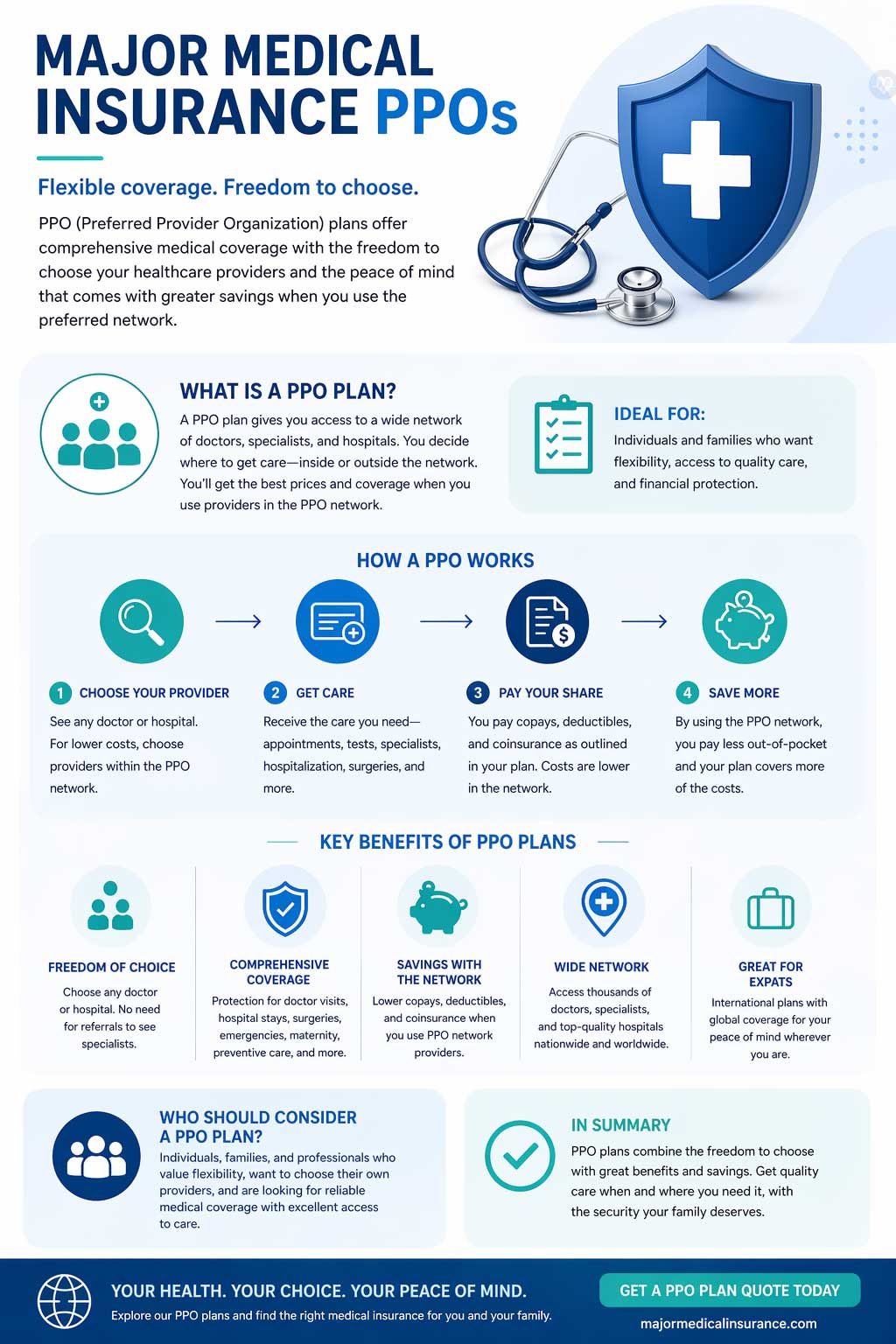
What a Comprehensive PPO Usually Covers
If you are comparing ACA-compliant individual or family coverage, Marketplace plans must cover the 10 essential health benefit categories, including outpatient care, hospitalization, emergency services, prescription drugs, mental health care, lab services, preventive services, maternity care, rehabilitative services, and pediatric services.[2]
That is part of what makes this kind of coverage different from limited-benefit products or cash-benefit policies. For a broader breakdown, see what major medical insurance covers.
PPO vs. HMO, EPO, and POS
If you want more flexibility, a PPO often deserves a closer look. But it is not automatically the best choice for every budget. The real question is how much you value provider freedom compared with tighter network rules and lower monthly premiums. If that comparison is your main issue, read medical plans HMO vs PPO alongside this page.
What a PPO Does Not Guarantee
A better PPO page should say clearly that a PPO does not automatically mean every out-of-network claim will be affordable, every hospital in your city is in-network, or every prescription will be covered the way you expect. It also does not eliminate prior authorization rules or other utilization controls just because the plan is more flexible than an HMO.
- Every out-of-network claim will be paid generously
- Every hospital in your area is in-network
- No prior authorization rules apply
- Your premium will be low
- Your prescriptions will be covered the way you expect
- Your out-of-network costs will count the same as in-network costs
That is why the most useful comparison documents are the provider directory, prescription drug list, and the Summary of Benefits and Coverage. Federal rules require plans to provide an easy-to-read SBC so consumers can make more direct comparisons between plan options.[1][3]
Why Out-of-Network Costs Matter So Much
The main reason people choose PPOs is flexibility. But that flexibility can get expensive quickly if you do not understand how the plan handles out-of-network deductibles, coinsurance, and uncovered charges. It is important to check the plan brochure, provider directory, and cost-sharing summary instead of assuming that a PPO will automatically protect you from every billing issue.[3]
The No Surprises Act added federal protections against certain surprise medical bills. Consumers now have protections for emergency care, certain non-emergency care from out-of-network providers at in-network facilities, and out-of-network air ambulance services. Those protections matter for PPO members too, because a PPO is not the same thing as blanket protection from all out-of-network charges.[4]
A smarter way to read a PPO
Think of a PPO as a plan that gives you more lanes, not a plan that makes every lane cheap. The network rules still matter, especially for surgery, imaging, specialty drugs, and hospital-based care.
In-Network vs. Out-of-Network Costs
One of the biggest financial differences in a PPO is the gap between in-network and out-of-network care. In-network providers have agreed to the plan’s negotiated rates, which usually means lower costs for members. Out-of-network providers have not agreed to those same rates, so the member may face higher deductibles, higher coinsurance, and in some cases charges that go beyond what the plan recognizes for reimbursement.[1][3]
This is why a PPO should never be judged only by the fact that it offers some out-of-network flexibility. The important question is not just whether out-of-network care is technically available, but how expensive it becomes when you actually use it. For a broader cost breakdown, see major medical insurance cost.
Simple way to think about it
In-network care is where PPO coverage usually works best. Out-of-network care may still be available, but it is often the more expensive lane, sometimes by a wide margin.
Why the Difference Can Be Larger Than People Expect
Many shoppers assume that a PPO makes out-of-network care reasonably affordable by default. That is not necessarily true. A PPO may still apply a separate out-of-network deductible, a higher coinsurance percentage, and stricter reimbursement rules. Even when the plan pays something, your share can still be much higher than it would be for the same service in-network.[3]
That is especially important for hospital-based care, imaging, surgery, specialty treatment, and expensive follow-up services. A PPO gives you more access options, but it does not erase the cost gap between contracted providers and non-contracted providers.
Before using out-of-network care, check:
- Whether the plan has a separate out-of-network deductible
- Whether out-of-network coinsurance is much higher than in-network coinsurance
- Whether the service even counts toward the same out-of-pocket protection
- Whether a nearby in-network provider could lower your total cost significantly
How the No Surprises Act Fits In
Federal surprise billing protections help in certain situations, especially for emergency services and some non-emergency care at in-network facilities. But those protections do not mean every out-of-network PPO claim will be treated like in-network care. They are important safeguards, not a substitute for reading the actual network and cost-sharing rules in your plan documents.[4]
If provider flexibility is your top priority, a PPO may still be the right choice. But if your main goal is controlling predictable yearly spending, the better question is not just whether the plan allows out-of-network care. It is whether the added flexibility is worth the added financial risk.
How to Compare Major Medical PPO Costs
Random monthly premium examples age badly and often mislead readers. Real premiums vary by location, age, tobacco use, plan category, and whether dependents are covered. Your actual total cost is not just the premium. It also includes your deductible, copays, coinsurance, and other out-of-pocket costs.[3]
Should You Consider a High-Deductible PPO?
Some PPOs are designed as high-deductible health plans. That can work for people who want lower monthly premiums and are comfortable carrying more upfront risk, especially if they want an HSA-eligible design. For 2026, the IRS says an HSA-qualified HDHP generally must have a minimum deductible of $1,700 for self-only coverage or $3,400 for family coverage, with annual out-of-pocket limits generally not above $8,500 for self-only coverage or $17,000 for family coverage, other than bronze and catastrophic plans.[5]
That does not mean a high-deductible PPO is automatically better. It is usually a stronger fit for people who use less routine care, can absorb a large deductible if something goes wrong, and want the tax advantages of HSA contributions.
What to Check Before You Enroll
Before enrolling, compare more than the logo on the card.
- Whether your preferred doctors and hospitals are in-network
- Whether your prescriptions are on the formulary
- How the plan handles out-of-network deductibles and coinsurance
- What the in-network out-of-pocket maximum is
- Whether telehealth or remote follow-up options are included in a useful way
- Whether referrals or prior authorizations apply to the services you use most
Bottom Line
A major medical PPO can be a smart choice when you want access to more doctors and specialists without relying on referrals for every step. The tradeoff is that flexibility often comes with higher premiums, more complicated out-of-network cost-sharing, and a bigger need to read the details carefully. The best PPO is not the one with the broadest marketing claim. It is the one whose network, deductible, formulary, and out-of-pocket protection fit your real health needs.
References
-
HealthCare.gov, Health insurance plan & network types: HMOs, PPOs, and more and 3 things to know before you pick a health insurance plan.
https://www.healthcare.gov/choose-a-plan/plan-types/ |
https://www.healthcare.gov/choose-a-plan/comparing-plans/
↩ -
HealthCare.gov, What Marketplace health insurance plans cover and Preventive health services.
https://www.healthcare.gov/coverage/what-marketplace-plans-cover/ |
https://www.healthcare.gov/coverage/preventive-care-benefits/
↩ -
HealthCare.gov, Your total costs for health care: Premium, deductible, and out-of-pocket costs, Out-of-pocket maximum/limit, and CMS, Summary of Benefits & Coverage & Uniform Glossary.
https://www.healthcare.gov/choose-a-plan/your-total-costs/ |
https://www.healthcare.gov/glossary/out-of-pocket-maximum-limit/ |
https://www.cms.gov/marketplace/health-plans-issuers/summary-benefits-coverage
↩ -
CMS, Ending Surprise Medical Bills.
https://www.cms.gov/nosurprises/ending-surprise-medical-bills
↩ -
IRS, Internal Revenue Bulletin: 2026-02.
https://www.irs.gov/irb/2026-02_IRB
↩