

By MajorMedicalInsurance.com Editorial Team
Published on April 18, 2026 · Updated on April 19, 2026
Coverage Guide
In most consumer use, “major medical insurance” refers to comprehensive health coverage designed to protect against large medical expenses, not just limited cash benefits or short-gap policies. For ACA-compliant individual and Marketplace plans, that means coverage built around the 10 essential health benefits, including hospitalization, emergency care, prescription drugs, mental health services, preventive care, and more.[1][2]
Core purpose
Major medical coverage is built to help pay for high-cost medical care such as hospital stays, surgery, emergency treatment, and ongoing physician services.[1]
What comprehensive plans include
Marketplace and other ACA-compliant individual plans must cover the 10 essential health benefit categories.[1]
What “major medical insurance” usually means today
The term “major medical insurance” is commonly used to describe broad, comprehensive health coverage rather than a narrow supplemental product. In practical terms, people usually mean a plan that helps pay for expensive medical care, specialist treatment, hospitalization, emergency services, prescription drugs, and other medically necessary care. For nationwide consumer guidance, the clearest benchmark is ACA-compliant individual and Marketplace coverage, because those plans are required to meet federal benefit standards.[1][2]
That distinction matters. A plan like short-term medical insurance can sometimes help during a brief gap, but it is generally not built to the same federal standards as full ACA-compliant major medical coverage. If you want a broader overview of how full coverage is structured, compare that with major medical health insurance and major medical insurance benefits.
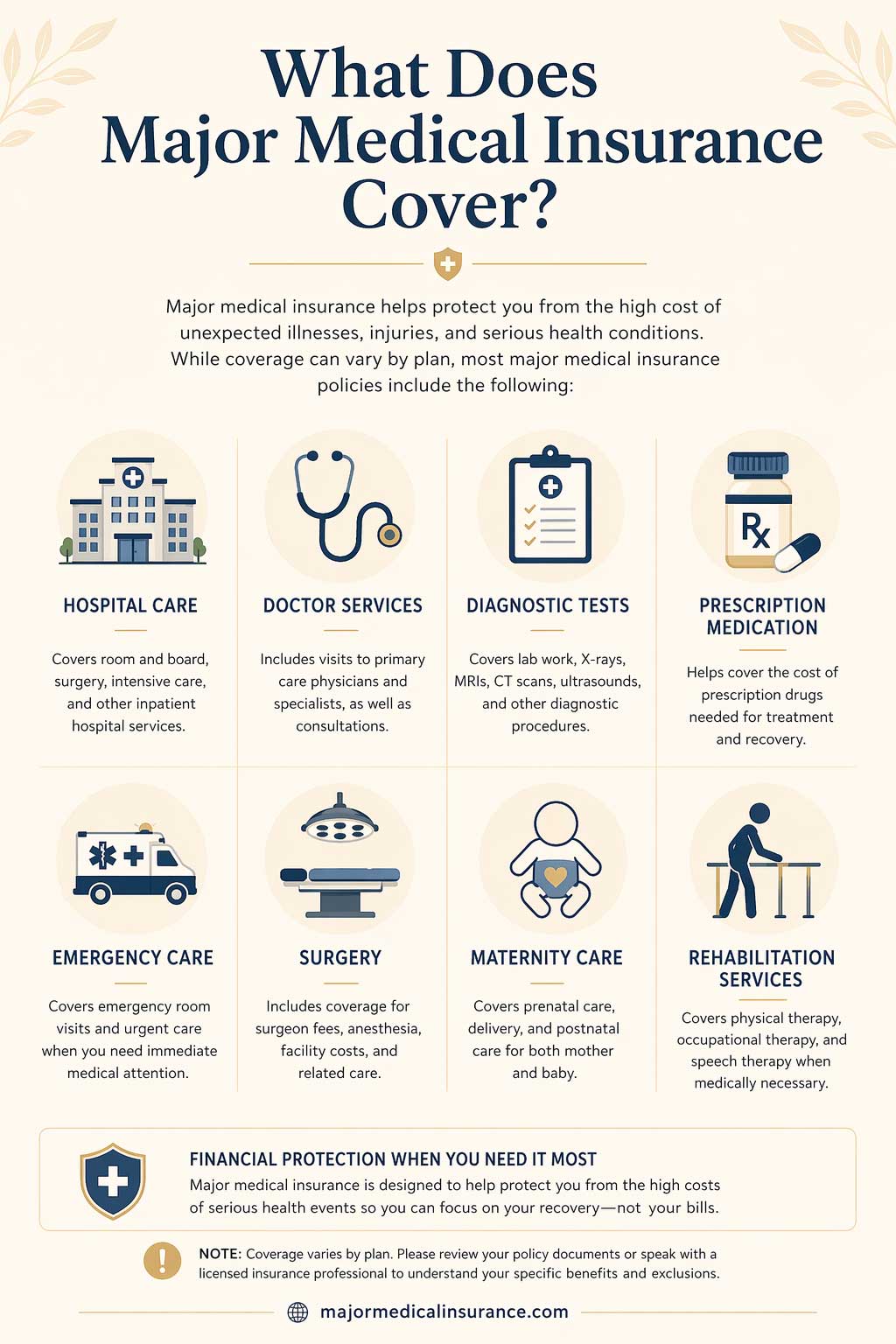
What major medical insurance generally covers
Under federal ACA rules, non-grandfathered individual and small-group coverage must include the 10 essential health benefit categories. These categories are the strongest real-world guide to what comprehensive major medical insurance is expected to cover across the United States, even though exact plan details can still vary by state, insurer, and network design.[1]
Prescription drug coverage
Major medical insurance generally includes prescription drug coverage as part of the essential health benefits framework for ACA-compliant individual and small-group plans.[1] That said, coverage is not identical from one plan to another. A plan may cover prescription drugs, but your real cost can still depend on the formulary, the drug tier, whether prior authorization applies, and whether a generic or preferred brand alternative is required.
This is why drug coverage should be checked carefully before enrollment instead of assumed. A plan with a lower premium can still become more expensive overall if your regular medications fall into higher-cost tiers or face stricter utilization rules. If you also want to compare the cost side of coverage, see major medical insurance cost.
What to verify for prescription coverage
- Whether your medications are on the plan’s formulary.
- Which tier each prescription falls into.
- Whether prior authorization, step therapy, or quantity limits apply.
- How much you may owe through copays, coinsurance, or the deductible.[4]
Mental health coverage
Major medical insurance generally includes mental health and substance use disorder services as part of comprehensive coverage.[1] In practical terms, that can include outpatient therapy, behavioral health treatment, counseling, and other medically necessary mental health services, depending on the plan’s network, authorization rules, and cost-sharing design.
Coverage does not mean every provider is automatically available at the same cost. Network rules still matter, especially for therapy, psychiatry, and ongoing treatment. That is one reason consumers should review the plan type, provider directory, and cost-sharing details before assuming mental health care will be equally accessible under every major medical plan.[5]
What may be covered
Therapy, behavioral health visits, psychiatric care, and substance use disorder treatment can fall within major medical coverage when they are part of the plan’s covered benefits.[1]
Maternity coverage
Pregnancy, maternity, and newborn care are part of the essential health benefit structure for ACA-compliant Marketplace and individual major medical coverage.[1] Pregnancy also cannot be treated as a pre-existing condition in Marketplace coverage.[2] That makes maternity coverage one of the clearest real-world examples of how major medical insurance differs from weaker or narrower products.
Even so, the exact way maternity care is handled can still vary by plan. Consumers should still verify which hospitals and physicians are in-network, what prenatal and delivery-related cost-sharing applies, and how newborn care is treated under the policy after birth. A plan may include maternity care broadly while still creating different out-of-pocket costs depending on the provider network and plan design.[4][5]
Why maternity coverage matters
Strong major medical coverage is built for major health events across the year, including pregnancy and childbirth, not just routine office visits or narrow one-time benefits. That broader protection is one of the main reasons comprehensive coverage carries more long-term value than limited products.
What is usually included in stronger comprehensive plans
- Primary care and specialist visits through the plan’s benefit structure.
- Emergency care and hospital treatment.[1]
- Prescription drug benefits.[1]
- Mental health and substance use disorder treatment.[1]
- Preventive screenings and many preventive services at no cost in-network under applicable rules.[3]
What people should still verify in the plan details
Covered does not mean free
One of the biggest misunderstandings around major medical insurance is thinking that “covered” means the insurer pays 100% of every bill. In reality, most comprehensive plans involve deductibles, copays, coinsurance, provider networks, and plan rules that affect what you pay when you actually use care.[4][5]
Marketplace plans do, however, have an out-of-pocket maximum. For the 2026 plan year, that cap cannot exceed $10,600 for an individual and $21,200 for a family, although many plans set lower limits.[4] That ceiling is one of the biggest differences between strong major medical coverage and weaker, more limited products.
What major medical insurance may not fully cover
Even good comprehensive coverage has limits. Exact exclusions and restrictions depend on the plan, but consumers should always review the Summary of Benefits and Coverage, network rules, formulary, and cost-sharing structure before enrolling. It is especially important to check whether a plan uses an HMO, PPO, EPO, or POS design, because that changes how much provider choice and out-of-network coverage you may have.[5]
How this differs from weaker or narrower coverage
Comprehensive major medical coverage is designed to coordinate a broad range of care needs across the year. That is very different from products that pay only a fixed cash benefit, cover only a limited event, or are mainly intended as temporary stopgaps. If you are trying to understand the law behind comprehensive health coverage, see our overview of Obama Care / ACA.
And if you are Medicare-eligible, keep in mind that Medicare Advantage is a separate type of coverage framework with different rules, enrollment periods, and benefits.
What to compare before choosing a major medical plan
- Make sure the plan covers the broad benefit categories you are likely to use most.[1][2]
- Check the deductible, copays, coinsurance, and out-of-pocket maximum.[4]
- Look closely at the provider network and plan type before assuming your doctors are covered.[5]
- Confirm how prescriptions are handled, including formulary tiers and utilization rules.
- Review whether routine adult extras are included or sold separately instead of assuming they come with every plan.
Bottom line
Major medical insurance is meant to protect you from large medical expenses through broad, structured coverage rather than one-off cash benefits or short-gap protection. In the modern U.S. individual market, the clearest real-world benchmark is ACA-compliant comprehensive coverage, which includes the 10 essential health benefits and stronger consumer protections for pre-existing conditions and annual out-of-pocket limits.[1][2][4] The safest way to compare plans is to look beyond premium and review benefits, network access, prescription rules, and total potential out-of-pocket exposure.
References
- HealthCare.gov — What Marketplace Health Insurance Plans Cover ↩
- HealthCare.gov — Marketplace Health Plans Cover Pre-Existing Conditions ↩
- HealthCare.gov — Preventive Health Services ↩
- HealthCare.gov — Out-of-Pocket Maximum / Limit ↩
- HealthCare.gov — Health Insurance Plan & Network Types: HMOs, PPOs, and More ↩
MajorMedicalInsurance.com Editorial Team
This article was prepared using current HealthCare.gov materials to explain what comprehensive major medical coverage generally includes in the United States. It is intended for educational purposes and should be reviewed alongside official plan documents, provider directories, formularies, and licensed guidance before enrollment.
Reviewed for clarity, consumer usefulness, and alignment with current public health coverage guidance.