
Category: Supplemental Coverage

  • Supplemental Coverage

    By MajorMedicalInsurance.com Editorial Team
    Published on April 18, 2026 · Updated on April 19, 2026

    Supplemental Health Guide

    Supplemental coverage is extra insurance meant to add a layer of protection on top of your primary health coverage or, in some cases, to help with specific costs or benefit gaps. Depending on the product, it may pay fixed cash benefits, help with Original Medicare cost-sharing, or add benefits such as dental or vision. It is usually narrower than comprehensive medical insurance and should not be treated as a full replacement for primary coverage.[1][2]

    What it is

    Extra coverage designed to help with specific gaps, extra services, or out-of-pocket costs rather than replace broad medical insurance.[1][2]

    What it is not

    Many supplemental products are not comprehensive coverage and may not include the federal protections people expect from major medical insurance.[1][5]

    Where it can help

    It may help with hospital cash benefits, Medicare cost-sharing, or extra services like dental and vision, depending on the policy.[1][2][3]

    What to compare

    The most important questions are what the policy actually pays, what it excludes, and whether you already have adequate primary coverage.[4]
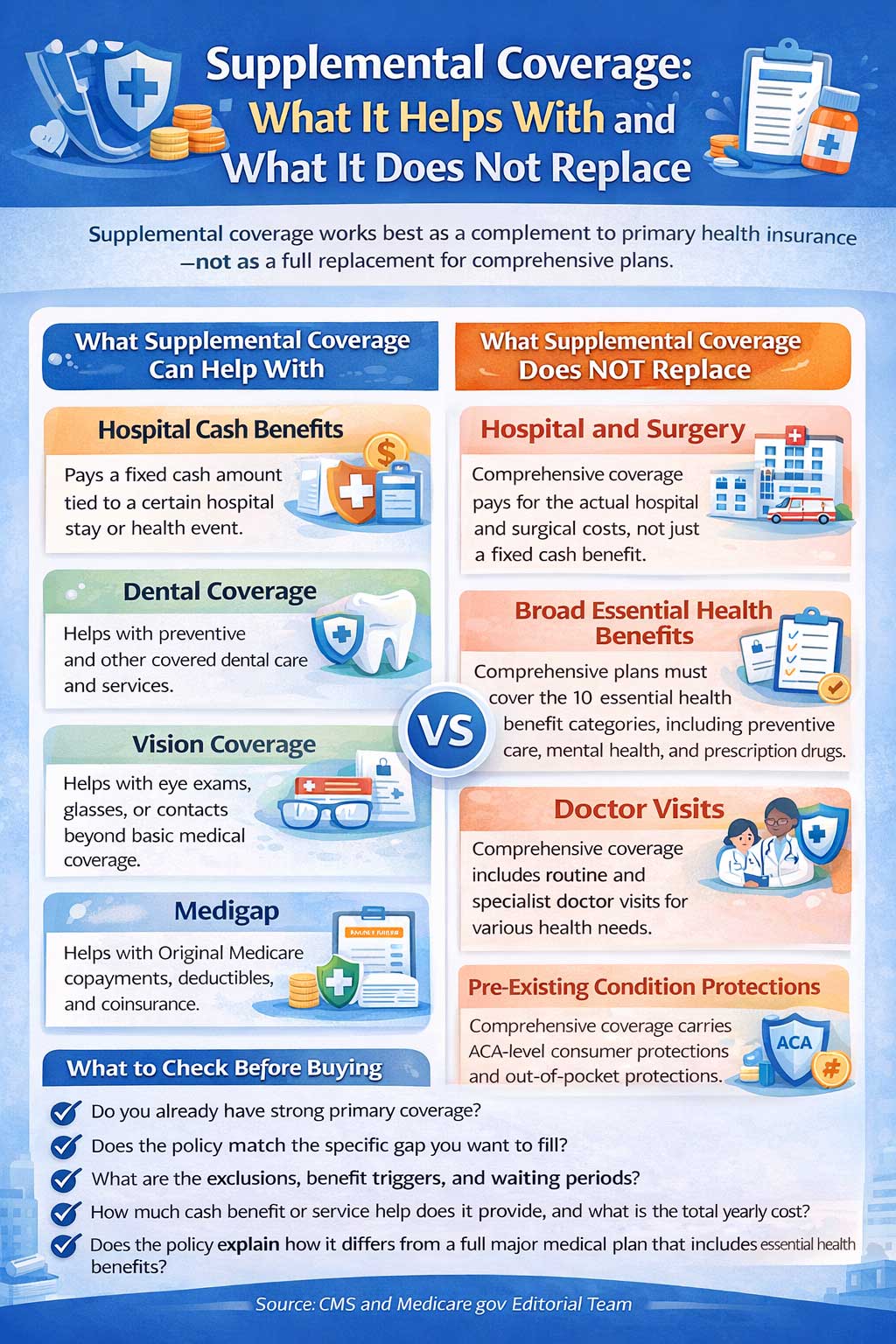
    Infographic titled Supplemental Coverage: What It Helps With and What It Does Not Replace showing hospital cash benefits, dental, vision, and Medigap while explaining that supplemental coverage does not replace comprehensive medical insurance.

    What supplemental coverage really means

    In practical consumer terms, supplemental coverage means an extra policy layered over your main coverage strategy. It can help in different ways depending on the product. Some policies pay a fixed cash amount when a health-related event happens. Others are designed to cover a narrower category of services, such as dental or vision. Medicare beneficiaries may also use supplemental coverage in the form of Medigap to help pay deductibles, copayments, and coinsurance in Original Medicare.[1][2][3]

    That does not mean all supplemental products work the same way. Some are true medical complements, while others are limited-benefit or excepted-benefit products. Because of that, a supplemental policy should generally be evaluated as support coverage, not as your only coverage plan. If you still need a stronger primary coverage foundation, start by reviewing broader options such as ACA-compliant coverage instead of trying to build your health protection around a narrow supplement.

    Common types of supplemental coverage

    Type of supplemental coverage What it may help with Key limitation to understand
    Hospital indemnity / fixed indemnity coverage May pay a fixed cash amount tied to hospitalization or another covered health event.[1] It is not a substitute for comprehensive coverage and can sit outside some protections people expect from major medical plans.[1][5]
    Dental coverage May help with preventive visits, basic services, and sometimes more advanced dental care depending on the policy.[3] Separate dental plans can have their own premiums and waiting periods may apply for some services.[3]
    Vision coverage May help with eye exams, lenses, and glasses, especially when adult vision is not included in the main plan.[3] The Marketplace does not offer stand-alone vision plans, and only some Marketplace plans include adult vision coverage.[3]
    Medicare Supplement Insurance (Medigap) Helps pay Original Medicare out-of-pocket costs like copayments, coinsurance, and deductibles.[2] You must have Original Medicare to buy it, and it does not work like Medicare Advantage.[2]

    When supplemental coverage can add value

    • You already have primary medical coverage, but want help with certain out-of-pocket exposure or service gaps.[1]
    • Your main plan does not include adult dental or adult vision, and you want targeted extra coverage for those services.[3]
    • You are in Original Medicare and want extra protection from deductibles, copayments, and coinsurance through Medigap.[2]
    • You want fixed cash benefits that could help with non-medical costs during a covered health event.[1]

    When supplemental coverage is often misunderstood

    • When people assume it covers the same broad services as major medical insurance.[1][4]
    • When shoppers buy a cash-benefit policy thinking it will function like comprehensive hospital and doctor coverage.
    • When buyers focus only on premium and ignore exclusions, benefit triggers, waiting periods, and total likely cost.[4]
    • When a person needs real primary health coverage but buys only a narrow supplement or limited-benefit product instead.[1]

    Major Medical vs. Supplemental Insurance

    Major medical insurance and supplemental insurance do not serve the same purpose. Major medical coverage is designed to act as your main health insurance layer for hospitalization, physician services, preventive care, prescription drugs, and other core medical benefits. Supplemental insurance is usually narrower. It is generally meant to add support for a specific gap, service, or out-of-pocket exposure rather than replace comprehensive medical coverage.[1][4]

    That difference matters because many consumers assume a supplemental product will function like full medical insurance when it often will not. A hospital indemnity policy may pay fixed cash benefits. A dental or vision plan may help with a narrow category of care. A Medigap plan may help with Original Medicare cost-sharing. But those products are not built to replace the broader protection of major medical insurance.[1][2][3]

    In simple terms, major medical insurance is usually the foundation, while supplemental insurance is usually the add-on. If a person still needs real primary coverage, the safer starting point is usually a comprehensive plan rather than trying to build protection around a narrow supplement alone. If you want to compare limited protection with broader coverage, it also helps to review short-term medical coverage and hospital indemnity insurance.

    Question Supplemental coverage Primary medical coverage
    Main role Adds targeted benefits or extra financial support. Provides the main structure for medical coverage.
    Scope Usually narrower and tied to a service, event, or cost gap.[1] Usually broader and built around medically necessary care categories.[4]
    Typical use Helps with gaps, cash benefits, dental, vision, or Medicare cost-sharing. Covers routine and major medical care under the plan design.
    Should it stand alone? Usually no, unless you fully understand its limited role and scope.[1] Yes, this is generally the main health insurance layer.

    Important protections and limitations to understand

    Another issue people miss is that not every supplemental policy carries the same billing protections as comprehensive health insurance. CMS explains that No Surprises Act balance-billing protections generally do not apply to hospital indemnity policies or to items and services covered by stand-alone dental or vision plans.[5]

    That does not make supplemental coverage useless. It just means you need to match the product to the job. A fixed-indemnity policy can sometimes help as a cash-support layer. A dental policy can help with routine oral care. A Medigap plan can make Original Medicare more predictable. But none of those products should be evaluated as if they all solve the same problem.

    How to evaluate a supplemental policy before you buy

    1. Start by identifying the gap you are trying to solve: hospital cash exposure, dental, vision, Medicare cost-sharing, or something else.
    2. Check whether you already have primary health coverage that meets your main medical needs.[4]
    3. Read the benefit trigger carefully. Some supplemental plans pay only when a specific event occurs, not whenever you receive care.[1]
    4. Review exclusions, waiting periods, separate premiums, and whether adult benefits are limited or optional.[3]
    5. Compare total yearly cost, not just premium. Deductibles, copayments, and out-of-pocket costs can materially change value on the primary-plan side too.[4]
    6. If you are Medicare-eligible, make sure you understand whether Medigap or Medicare Advantage is the better fit for your situation, because they do not function the same way.[2]

    Bottom line

    Supplemental coverage can be useful when it is matched to a real gap: hospital cash exposure, dental care, vision care, or Medicare cost-sharing. But it usually works best as extra support layered on top of primary medical coverage, not as a replacement for it. The right way to buy it is to define the gap first, review the policy terms carefully, and compare it against the broader protection you may still need.[1][2][4][5]

    MM

    MajorMedicalInsurance.com Editorial Team

    This article was prepared using current CMS, HealthCare.gov, and Medicare materials to explain how supplemental coverage works in the United States, where it may add value, and where it should not be mistaken for full primary medical coverage. It is intended for educational purposes and should be reviewed alongside official plan documents and licensed guidance before enrollment.

    Reviewed for clarity, consumer usefulness, and alignment with current public health coverage guidance.

  • Understanding Hospital Indemnity Insurance

    By MajorMedicalInsurance.com Editorial Team
    Published on April 18, 2026 · Updated on April 19, 2026

    Supplemental Coverage Guide

    Hospital Indemnity

    Hospital indemnity insurance is generally a supplemental fixed-benefit product that may pay cash when a covered hospital event happens, such as an admission or a qualifying inpatient stay defined by the policy. It is not the same as major medical insurance, and federal guidance makes clear that fixed indemnity coverage is not a substitute for comprehensive coverage. [1]

    For visitors researching broader health protection, hospital indemnity coverage is best understood as an extra financial layer rather than a primary health plan. Depending on the policy structure, the cash benefit may help with out-of-pocket medical costs or non-medical expenses related to a hospital stay, but the plan’s real value depends on its benefit schedule, exclusions, and limits. If you want the broader context first, compare this with major medical health insurance. [1] [2]

    Fixed Cash Benefits

    NAIC describes hospital confinement indemnity coverage as insurance that pays a fixed amount for each day you are in a hospital. [2]

    Supplemental, Not Primary

    Federal guidance says hospital indemnity and other fixed indemnity insurance has traditionally been used as a form of income replacement and is not a substitute for comprehensive coverage. [1]

    Policy Terms Matter

    Covered events, payout amounts, exclusions, waiting periods, and renewal terms can vary by policy, so the benefit schedule needs careful review before purchase. [2]

    Woman recovering in a hospital bed with a supportive companion, representing hospital indemnity insurance and help with unexpected hospital expenses.

    What Hospital Indemnity Insurance Is

    Hospital indemnity insurance is typically structured as a limited supplemental policy. Instead of functioning like major medical coverage, it generally pays a fixed cash amount when a qualifying hospital-related event occurs under the policy terms. Federal guidance also explains that consumers can use the fixed cash benefit as they wish, including for out-of-pocket expenses not covered by comprehensive coverage or for non-medical expenses such as rent or mortgage. [1]

    This limited design is why hospital indemnity plans should be viewed as an add-on rather than a replacement for broader healthcare protection. A hospital event can create more than provider bills alone, but the policy only helps to the extent that its benefit definitions and payout amounts are actually meaningful for the policyholder’s situation. If you are comparing this against broader primary coverage, it also helps to review what major medical insurance covers. [1] [3]

    How It Differs From Major Medical Insurance

    Hospital indemnity insurance can complement broader health protection, but it should not be confused with comprehensive medical coverage. [1] [3]

    Feature Hospital Indemnity Insurance Major Medical Insurance
    Purpose Fixed cash support for covered hospital events Broad coverage for a wide range of healthcare services
    Payment Structure Usually pays a scheduled fixed amount when qualifying events occur Usually shares provider costs according to plan rules
    Scope Event-based supplemental protection Comprehensive healthcare protection
    Can It Replace Full Health Insurance? No Yes, this is the primary coverage type people usually rely on

    What These Plans May Help With

    Some consumers consider hospital indemnity plans because a hospital stay can create both medical and non-medical financial strain. Federal guidance notes that fixed cash benefits can be used for out-of-pocket costs not covered by comprehensive coverage or for non-medical expenses. [1]

    That said, a plan should not be judged by its marketing language alone. The practical question is whether the covered-event definitions, payout schedule, exclusions, and premium cost actually make sense compared with the policyholder’s likely financial exposure. To understand where this fits in a broader strategy, see supplemental coverage in the site. [2]

    Common Reasons People Consider It

    • To add a financial cushion after a hospital admission
    • To help with deductibles or coinsurance exposure
    • To support non-medical costs during recovery
    • To reduce strain on savings during an unexpected hospital stay
    • To supplement existing health coverage rather than replace it

    Covered Event Definitions

    A policy should clearly explain what counts as a hospital admission, inpatient confinement, ICU stay, or other qualifying event. [2]

    Payout Amounts

    A plan may sound helpful until its scheduled cash benefits are compared with realistic hospital-related expenses and your premium cost over time. [2]

    Primary Coverage Still Matters

    Because hospital indemnity is supplemental, it should usually be reviewed alongside your broader coverage, not instead of it. [1] [3]

    What to Review Before Choosing a Hospital Indemnity Plan

    A hospital indemnity policy should be reviewed as a limited supplemental product, not assumed to function like full health insurance. Strong review points include the admission benefit, daily confinement benefit, ICU-related benefits if offered, exclusions, waiting periods, premium cost, and whether the plan actually complements your broader coverage strategy. [1] [2]

    For a serious insurance site, the key is to explain the role of the product accurately: hospital indemnity insurance may help in some situations, but it should be evaluated as supplemental protection with defined limits, not as a broad medical safety net on its own. [1] [3]

    Final Thoughts

    Hospital indemnity insurance can make sense for some people who want an extra layer of financial support tied to covered hospital events. But the product should be understood as supplemental coverage, not as a replacement for major medical insurance. [1] [2]

    The most responsible way to present this topic is to explain what the plan does, what it does not do, and what policyholders need to verify before buying. That is what makes the page more useful and keeps it aligned with a serious major medical insurance site. If you want to compare broader plan value next, review major medical insurance benefits. [1] [2]

    References

    1. CMS, Short-Term, Limited-Duration Insurance and Independent, Noncoordinated Excepted Benefits Coverage. https://www.cms.gov/newsroom/fact-sheets/short-term-limited-duration-insurance-and-independent-noncoordinated-excepted-benefits-coverage-cms
    2. NAIC, Health Insurance and Glossary of Insurance Terms. https://content.naic.org/consumer/health-insurance.htm | https://content.naic.org/glossary-insurance-terms
    3. HealthCare.gov, Find out what Marketplace health insurance plans cover. https://www.healthcare.gov/coverage/what-marketplace-plans-cover/
    4. HealthCare.gov, Qualifying health coverage. https://www.healthcare.gov/glossary/qualifying-health-coverage/
    ET

    Editorial Review

    MajorMedicalInsurance.com Editorial Team

    Health Insurance Educational Content

    This page was prepared and reviewed for clarity, structure, and general educational usefulness by the MajorMedicalInsurance.com editorial team. Our content focuses on major medical coverage, ACA plans, Medicare-related topics, and supplemental health insurance categories to help readers compare options more responsibly.

  • Telemedicine

    By MajorMedicalInsurance.com Editorial Team
    Published on · Updated on

    Telemedicine can make care more convenient, but good coverage depends on the details of your health plan. Many people assume every virtual visit is covered the same way, always costs less, or replaces in-person care. In reality, telemedicine is best understood as a care delivery method inside a broader insurance plan, not as a guarantee of free or unlimited virtual care.

    Quick Answer

    Telehealth, often called telemedicine in consumer content, can include video visits, phone-based care, secure messaging, and in some cases remote patient monitoring. Many private health plans cover at least some telehealth services, but the covered service, provider type, network rules, and cost-sharing can vary. In a major medical plan, telemedicine is usually one way covered care is delivered, not a separate promise that every virtual visit is free or handled the same way.

    What Telemedicine Usually Includes

    Telemedicine is no longer limited to a basic video call. Depending on the provider and your plan, it may include live video visits, phone-based care, secure patient portal messaging, and remote patient monitoring tools that let patients share health information such as blood pressure or glucose readings with their care team.

    Common situations where telemedicine may help

    • Mental health or substance use counseling
    • Medication reviews and refill follow-ups
    • Reviewing lab or imaging results
    • Minor illnesses like headaches, colds, stomach issues, or some infections
    • Skin concerns that can be seen on camera
    • Post-surgery follow-up
    • Physical or occupational therapy visits
    • Remote monitoring for ongoing health conditions
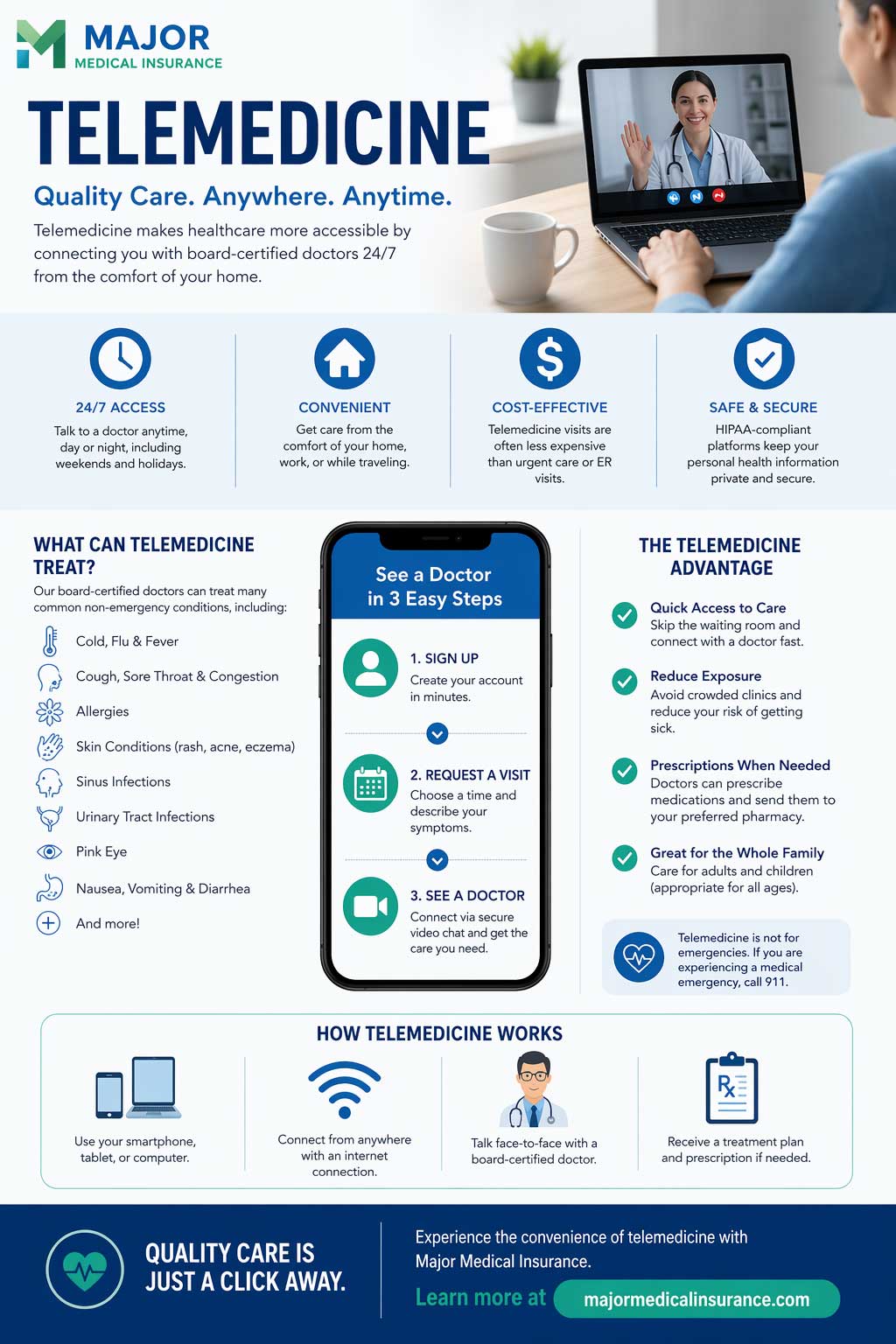
    Infographic for Major Medical Insurance about telemedicine, showing 24/7 access to doctors, convenient at-home care, lower-cost visits, secure virtual appointments, common conditions treated, and a 3-step process to connect with a doctor online.

    How Major Medical Insurance Fits In

    For a site focused on major medical coverage, the key point is this: telemedicine is usually part of the plan’s broader medical benefits. It may show up under outpatient care, behavioral health, preventive services, or chronic care management. Marketplace plans must cover broad essential health benefit categories, but telemedicine is still governed by the specific plan’s coverage rules, network, and cost-sharing.

    If you want the broader coverage context first, compare this page with major medical health insurance and what major medical insurance covers.

    Coverage Type What to Expect Important Caveat
    Employer or individual private plan Many insurers cover at least some telehealth services Coverage, copays, network rules, and reimbursement vary by insurer and state
    Marketplace major medical plan Telemedicine may be part of outpatient, behavioral health, preventive, or chronic care benefits Specific covered virtual services still vary by plan documents and state rules
    Medicare Broad telehealth flexibilities remain in place through December 31, 2027 Rules differ by service type, and some policies change after 2027
    Medicaid Telehealth is widely used, but states have broad flexibility State rules differ on eligible services, providers, technology, and payment

    Do Telemedicine Visits Always Cost Less?

    Not necessarily. Telemedicine can save time, travel, childcare costs, and missed work, which is one reason many people find it valuable. But it is not accurate to promise that every telemedicine visit is cheaper than in-person care. Depending on the plan, copays, coinsurance, deductibles, and network rules may still apply.

    A better way to explain value

    Telemedicine may reduce friction more consistently than it reduces total medical spending. For many people, the biggest benefit is easier access, faster follow-up, and less disruption to daily life.

    When an In-Person Visit Is Still Better

    Telemedicine is useful, but it is not a full replacement for hands-on care. Some conditions still need an in-person examination, testing, imaging, or procedures. That is especially true when symptoms are severe, the diagnosis is uncertain, or a physical exam is central to safe treatment. A hybrid model, virtual when appropriate and in-person when necessary, is usually the most realistic way to think about telemedicine inside a major medical plan.

    Do not rely on telemedicine alone for emergencies

    Emergency symptoms such as chest pain, severe shortness of breath, stroke symptoms, major trauma, or other urgent warning signs need emergency care, not a routine virtual visit.

    What Patients Should Check Before Booking a Virtual Visit

    Before scheduling, patients should confirm the visit is covered the way they expect.

    Question Why It Matters
    Is the provider in-network? Out-of-network telehealth may cost more or be denied
    Is video required, or is audio-only allowed? Some programs and services have different rules for phone-only care
    What will I pay? Copay, coinsurance, or deductible rules may still apply
    Does the plan require a specific telehealth vendor or portal? Some insurers steer members to preferred virtual care platforms
    Can prescriptions, referrals, labs, or imaging be handled after the visit? A virtual visit may still lead to in-person follow-up

    Privacy and Data Security Matter

    Telemedicine should not be presented as casual messaging with no safeguards. Similar to in-person care, telehealth appointments, messages, and related health and billing information are protected by HIPAA when covered providers and health plans are involved, and providers are expected to use platforms that support secure communications and data storage.

    Patients also play a role in protecting their privacy. A private location, headphones, secure devices, strong passwords, and avoiding public networks can all help reduce unnecessary exposure of health information.

    Practical privacy tip

    A telemedicine visit is often most effective when the patient is in a quiet, private place with good lighting, a stable connection, and any relevant medication list, blood pressure log, or recent test results ready to share.

    Telemedicine and Medicare

    If your telemedicine questions are tied to Medicare coverage, it also helps to compare this page with Medicare Advantage, since Medicare telehealth rules and plan administration can differ from the private individual-market experience.

    Bottom Line

    Telemedicine deserves a place in modern major medical coverage, but it should be explained honestly. It can improve convenience and access, help with follow-up care, medication management, behavioral health, and some routine medical needs. At the same time, coverage rules, cost-sharing, audio-only availability, network access, and follow-up requirements differ by insurer, state, and public program. A strong insurance page should help readers understand those differences instead of assuming all virtual care works the same way.

    References

    1. U.S. Department of Health and Human Services, Why use telehealth? and What can be treated through telehealth?
      https://telehealth.hhs.gov/patients/why-use-telehealth |
      https://telehealth.hhs.gov/patients/what-can-be-treated-through-telehealth
    2. U.S. Department of Health and Human Services, Private insurance coverage for telehealth.
      https://telehealth.hhs.gov/providers/billing-and-reimbursement/private-insurance-coverage-for-telehealth
    3. HealthCare.gov, What Marketplace health insurance plans cover.
      https://www.healthcare.gov/coverage/what-marketplace-plans-cover/
    4. Centers for Medicare & Medicaid Services, Telehealth FAQ (updated February 26, 2026); Medicaid.gov, Telehealth.
      https://www.cms.gov/files/document/telehealth-faq-updated-02-26-2026.pdf |
      https://www.medicaid.gov/medicaid/benefits/telehealth
    5. U.S. Department of Health and Human Services, Privacy laws and policy guidance and Telehealth Privacy and Security Tips for Patients.
      https://telehealth.hhs.gov/providers/best-practice-guides/privacy-and-security-telehealth/privacy-laws-and-policy-guidance |
      https://www.hhs.gov/hipaa/for-professionals/privacy/guidance/telehealth-privacy-security/index.html