

By MajorMedicalInsurance.com Editorial Team
Published on · Updated on
Major medical insurance is designed to give people broad health coverage and meaningful financial protection when medical needs become expensive. In practical terms, the biggest benefits are not just hospital coverage. The real value is that a strong plan can help cover preventive care, doctor visits, prescriptions, mental health treatment, emergency care, surgery, and other medically necessary services while limiting how much you pay out of pocket in a plan year.
Quick Answer
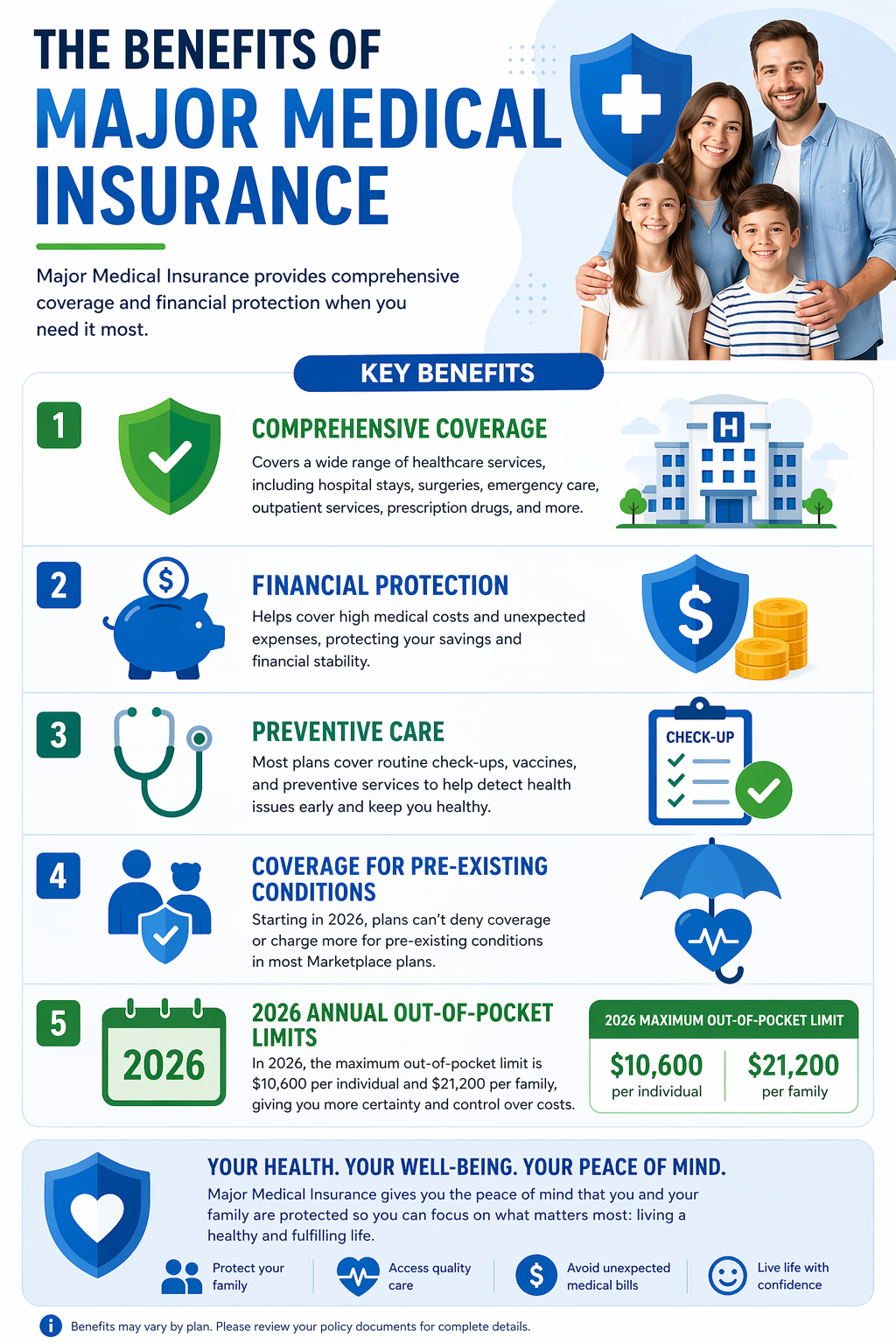
The biggest benefits of major medical insurance are comprehensive coverage, protection against very high medical bills, coverage for pre-existing conditions, preventive care at no cost in-network, and access to essential health benefits like hospitalization, prescription drugs, mental health services, maternity care, and pediatric care. For 2026, Marketplace plans also have a maximum out-of-pocket limit of $10,600 for an individual and $21,200 for a family for covered in-network care.[1][2][3]
What “Benefits” Really Means in Major Medical Insurance
When people hear “benefits,” they often think only about what services a plan covers. But major medical insurance benefits are broader than that. A good plan offers two types of protection at the same time:
- Medical protection: access to covered care when you need doctors, specialists, prescriptions, hospitalization, emergency treatment, or ongoing care.
- Financial protection: limits on how much you may have to spend for covered in-network care in a plan year.
That is why readers comparing major medical health insurance should not judge a plan by premium alone. The real benefit is the combination of covered services and financial safeguards.
Key Benefits of Major Medical Insurance
1. Broad Coverage for Essential Health Needs
One of the biggest advantages of major medical insurance is that ACA-compliant Marketplace plans must cover the 10 essential health benefit categories. These include outpatient care, emergency services, hospitalization, pregnancy and newborn care, mental health and substance use treatment, prescription drugs, rehabilitative services, lab services, preventive and wellness services, and pediatric services.[2]
This is what separates comprehensive coverage from narrow or temporary products. If you want a broader page on service scope, see what major medical insurance covers.
2. Protection Against High Medical Bills
Major medical insurance is built to protect against high-cost events such as surgery, serious illness, inpatient hospitalization, or emergency treatment. HealthCare.gov says that for the 2026 plan year, the out-of-pocket limit for a Marketplace plan cannot be more than $10,600 for an individual and $21,200 for a family for covered in-network care.[1]
3. Preventive Care at No Cost In-Network
Another major benefit is preventive care. Most health plans must cover a set of preventive services at no cost to you, including Marketplace plans. In many cases, you do not pay a copayment or coinsurance for covered preventive services when provided by an in-network provider, even if you have not met your deductible yet.[3]
Examples of preventive benefits
- Routine screenings
- Vaccinations and immunizations
- Certain annual wellness visits
- Some preventive care for adults, women, and children
This is one reason comprehensive coverage is useful even for people who are relatively healthy. Preventive care is not just an extra. It is part of how major medical insurance supports earlier detection and better long-term cost control.
4. Coverage for Pre-Existing Conditions
For many consumers, one of the most important benefits is simple: pre-existing conditions are covered. All Marketplace plans must cover treatment for pre-existing medical conditions, and plans cannot reject you, charge you more, or refuse to pay for essential health benefits because of a condition you had before coverage started.[4]
This is a core reason why major medical coverage is stronger than temporary or limited-benefit alternatives.
5. Possible Extra Savings on Out-of-Pocket Costs
Some major medical shoppers may get more than premium help. If you qualify for cost-sharing reductions, you can lower deductibles, copayments, coinsurance, and the out-of-pocket maximum, but those extra savings are available only if you choose a Silver plan.[5]
Why this matters
A plan with a higher premium is not always worse. If a Silver plan unlocks cost-sharing reductions, it may produce much better real-world value than a cheaper Bronze option for someone who expects to use care.
How Major Medical Insurance Benefits Compare With Other Coverage Types
Many people compare major medical insurance with products that sound similar but work very differently. Major medical insurance is designed to combine broad benefits with financial protection. That is very different from a short-term plan meant mainly for temporary coverage gaps or a narrower cash-benefit product sold to cover only one type of event.
That is why it helps to compare this page with short-term medical before assuming every health-related policy works the same way.
How to Choose a Plan Based on Benefits, Not Hype
The best benefit package is not always attached to the plan with the lowest premium or the strongest marketing language. Smart shoppers look at total costs, plan categories, provider network, and covered prescription drugs when comparing plans.[5]
That means a strong comparison usually includes:
- The deductible
- The out-of-pocket maximum
- Your doctor and hospital network
- Your drug formulary
- Whether PPO, HMO, EPO, or POS is a better fit
- Whether services like telemedicine matter to you
If you are still comparing structure and tradeoffs, major medical insurance plans is the best next page to read.
Bottom Line
The real benefits of major medical insurance go far beyond one hospital claim. Strong major medical coverage gives you access to broad essential health benefits, preventive care, pre-existing condition protections, mental health coverage, prescription drug benefits, and an annual ceiling on covered in-network costs. That combination is what makes it one of the most important forms of health coverage for people who want real protection against medical and financial risk.
References
-
HealthCare.gov, Out-of-pocket maximum/limit.
https://www.healthcare.gov/glossary/out-of-pocket-maximum-limit/
↩ -
HealthCare.gov, What Marketplace health insurance plans cover.
https://www.healthcare.gov/coverage/what-marketplace-plans-cover/
↩ -
HealthCare.gov, Preventive health services.
https://www.healthcare.gov/coverage/preventive-care-benefits/
↩ -
HealthCare.gov, Marketplace health plans cover pre-existing conditions and Mental health & substance abuse coverage.
https://www.healthcare.gov/coverage/pre-existing-conditions/ |
https://www.healthcare.gov/coverage/mental-health-substance-abuse-coverage/
↩ -
HealthCare.gov, Cost-sharing reductions, Silver health plan, and 3 things to know before you pick a health insurance plan.
https://www.healthcare.gov/lower-costs/save-on-out-of-pocket-costs/ |
https://www.healthcare.gov/glossary/silver-health-plan/ |
https://www.healthcare.gov/choose-a-plan/comparing-plans/
↩