

By MajorMedicalInsurance.com Editorial Team
Published on April 18, 2026 · Updated on April 19, 2026
Medicare Guide
Medicare Advantage: What It Covers, How It Differs From Original Medicare, and What to Compare Before You Enroll
Medicare Advantage, also called Medicare Part C, is a private-plan alternative to Original Medicare. These plans must cover Medicare Part A and Part B services, and many plans also include prescription drug coverage plus extra benefits such as dental, vision, hearing, or fitness-related services.[1][2]
Private plan, Medicare rules
A private insurer administers the plan, but Medicare sets core coverage requirements.[1]
Often bundled
Many Medicare Advantage plans include Part D drug coverage in one plan.[2]
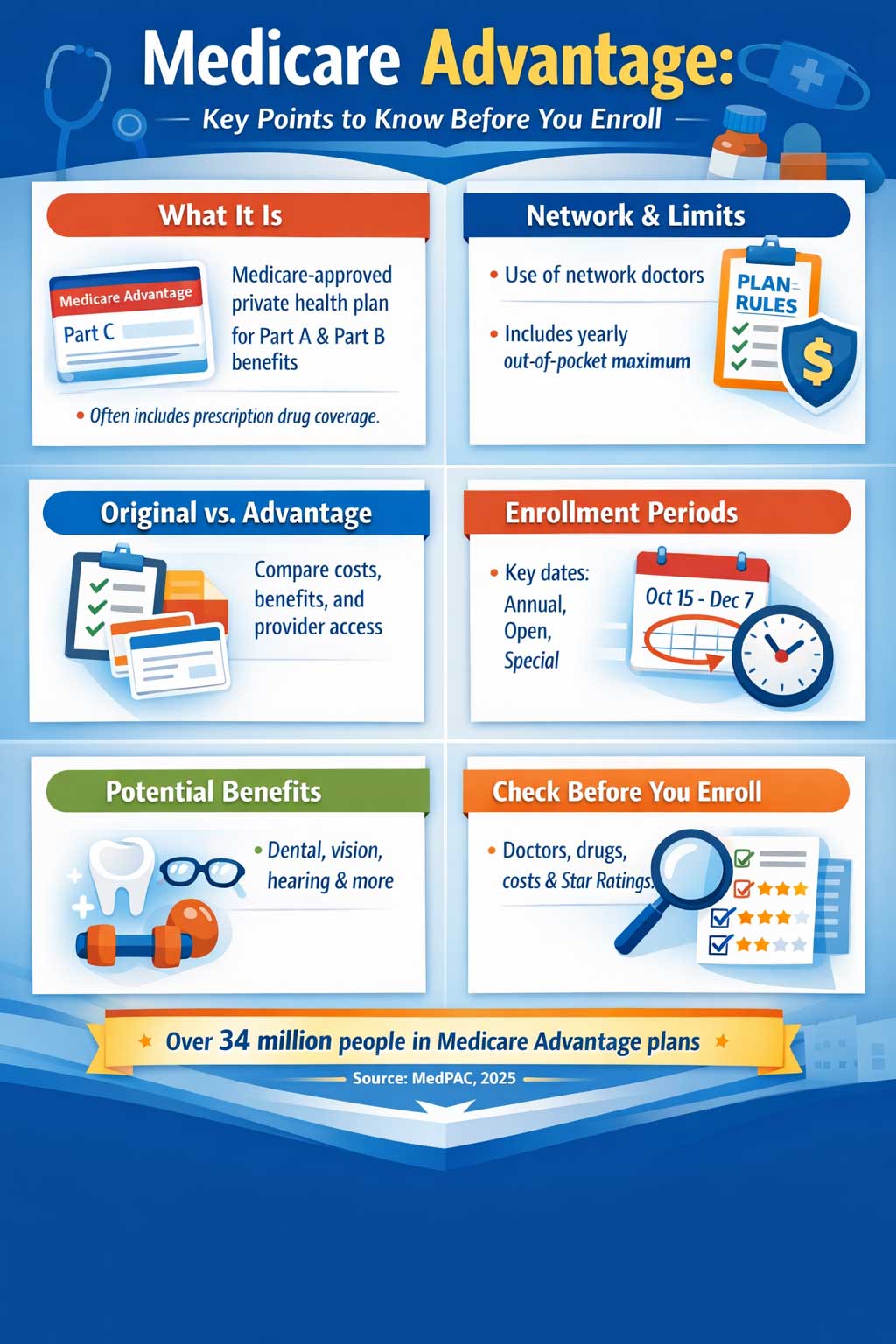
What Medicare Advantage really is
Medicare Advantage is not a separate program outside Medicare. It is one of the main ways people can receive their Medicare benefits. Instead of using Original Medicare directly for most covered services, you receive those benefits through a Medicare-approved private health plan. In exchange, the plan may package your hospital coverage, medical coverage, and often prescription coverage into one product that is easier for some beneficiaries to manage.[1][2]
That convenience comes with trade-offs. Depending on the plan, you may need to stay within a provider network, get referrals to see specialists, or obtain prior authorization for selected services, equipment, or medications. Because of those rules, the best plan is not simply the one with the lowest premium. The better choice is usually the plan that fits your doctors, your prescriptions, your expected use of care, and your tolerance for network restrictions. If you want a broader insurance foundation first, compare this with major medical health insurance.[1][2]
Original Medicare vs. Medicare Advantage
Potential advantages
- Can combine hospital, medical, and often drug coverage in one plan.[2]
- May include extra benefits that Original Medicare does not routinely provide.[2]
- Includes a yearly maximum on covered Part A and Part B out-of-pocket costs.[1][2]
- Can be practical for beneficiaries comfortable using local provider networks.
Potential drawbacks
Why the “$0 premium” pitch can be misleading
A low plan premium does not mean your healthcare will be free. Many beneficiaries still pay the monthly Medicare Part B premium, and they may also face deductibles, copays, coinsurance, pharmacy costs, and different cost-sharing rules depending on whether care is in network or out of network. When comparing plans, the smarter metric is total likely annual cost, not just the premium advertised in a mailer or TV ad.[1][2]
Who Medicare Advantage may fit best
Medicare Advantage may be a good fit for beneficiaries who like the idea of one plan handling most of their coverage, who do not mind working inside a provider network, and who value extra benefits such as routine dental, vision, hearing, or wellness-related services. It can also appeal to people who want the financial protection of a yearly maximum out-of-pocket limit for covered Part A and Part B services.[1][2]
On the other hand, people who travel often, want broader provider choice, or strongly prefer fewer plan-management rules may lean toward Original Medicare instead. The right answer depends less on ideology and more on your doctors, prescriptions, local plan offerings, and expected use of care over the next year.
Enrollment periods to know
What to compare before choosing a plan
- Check whether your primary doctor, specialists, hospitals, and preferred pharmacies are in network.[1][2]
- Look at your medications and verify the plan’s formulary, tiers, and pharmacy rules.[2]
- Review the plan’s annual maximum out-of-pocket limit, not just the monthly premium.[1][2]
- Read the evidence of coverage and note whether referrals or prior authorization could affect care you expect to use.[2]
- Compare quality through CMS Star Ratings and use Medicare’s official plan comparison tools.[4][1]
- Review the Annual Notice of Change each year if you are already enrolled, because costs and benefits may shift.[3]
Why this matters more now
Medicare Advantage is now a dominant part of the Medicare landscape. MedPAC reported that in 2025 the program included 5,492 plan options offered by 164 organizations, enrolled about 34.9 million beneficiaries, and represented about 55% of eligible Medicare beneficiaries. That scale makes careful comparison even more important, because broad growth does not mean every plan works equally well for every beneficiary.[5]
CMS also publishes Medicare Advantage Star Ratings to help beneficiaries compare plan quality. Star Ratings are not the only factor to consider, but they can help you judge plan performance alongside benefits, provider access, and expected cost-sharing.[4]
Bottom line
Medicare Advantage can be a strong option for people who want bundled coverage, extra benefits, and a built-in annual spending limit for covered Part A and Part B services. It can be less appealing for beneficiaries who want the broadest provider choice or who dislike network restrictions and plan-management rules. The best decision is usually made by comparing specific local plans carefully each year rather than assuming all Medicare Advantage plans are essentially the same.[1][2]
References
- Medicare.gov — Compare Original Medicare & Medicare Advantage ↩
- Medicare.gov — Understanding Medicare Advantage Plans ↩
- Medicare.gov — Understanding Medicare Advantage & Medicare Drug Plan Enrollment Periods ↩
- CMS — 2026 Medicare Advantage and Part D Star Ratings Fact Sheet ↩
- MedPAC — The Medicare Advantage Program: Status Report ↩
Majormedicalinsurance.com Editorial Team
This article was prepared using official Medicare, CMS, and MedPAC materials to help readers understand how Medicare Advantage works, where it may fit, and what to compare before enrolling. It is intended for educational purposes and does not replace individualized plan guidance, official plan documents, or advice from a qualified professional.
Reviewed for clarity, consumer usefulness, and alignment with current public Medicare guidance.